

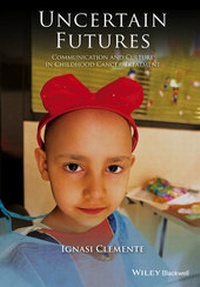
Uncertain Futures
Description

More details
Other editions
Additional editions
Person
Content
Acknowledgments xii
Preface xiv
1. Children: Contributions to Communication and Illness 1
Alternatives to Speaking 5
Disclosure as a Dynamic and Heterogeneous Process 7
Disclosure to Children with Cancer 10
Problematizing Participation 13
Uncertainty and the Practice of Optimism 21
Multiple Uncertainties 21
Hierarchically Organized Uncertainties 23
Variable Uncertainties 23
Practicing Hope and Optimism 25
Ethnography and Conversation Analysis 26
Plan of the Book 31
2. A Linguistic Anthropologist in a Pediatric Cancer Unit 33
Culture and Disclosure Practices in Catalonia 34
Fieldwork with Children 38
Contexts of Children's Questions 42
Investigating Avoidance 44
Multiple Ways of Talking about Cancer 47
3. Living and Dealing with Cancer 49
Focusing on Treatment 51
Guessing 55
Estar baixet (Having Low Blood Cell Counts) 56
Les llagues (Mouth Sores) 57
La febre (Fever and Infections) 58
Being Together 60
Acompanyar (Being at the Patient's Side) 61
Menjar (Eating) 63
Fer una visita (Visiting) 64
Talking Privately 67
Uncertainties of Treatment 71
4. Co]constructing Uncertainty 74
Questions and Answers 76
Uncertainty and the Topic of Questions 79
Contingent Answers 80
Contingent Questions 86
Uncertainty and the Action of Questions 88
Answers that Lead to Subsequent Actions 90
Avoiding Answers and Avoiding Silence 93
Stepping into the Uncertain Future One Turn at a Time 100
5. Engaging in Communication at Catalonia Hospital 102
Learning the Diagnosis 103
L'entrevista (The Treatment Interview) 109
"And When Will I Be Completely Cured?" 111
Six Communication Strategies 127
6. Patient Pressure and Medical Authority 129
Everyday Life in Treatment 130
"How Many Chemos Do I Have Left?" 133
Seeking Answers Without Challenging Medical Authority 151
7. The Limits of Optimism at the End of Treatment 153
Remission 154
Relapse 159
Negotiating Death 161
"Is the Day of the Autotransplant Going to Be Delayed?" 168
Optimistic Collusion 178
8. Conclusion 180
Appendix A: Profiles of Patients 189
Children (ages 3-6) 189
Young people (ages 11-18) 190
Appendix B: Transcription Conventions 193
References 197
Index 214
1
Children: Contributions to Communication and Illness
Key Issues
- Understanding cancer communication requires approaching it not as a reflection of what is happening, but as an active way of influencing and constituting what is happening.
- "Not telling" is different from not knowing.
- Information disclosure (or non-disclosure) is not a one-time event but a process that extends over entire cancer trajectories, and it involves highly variable and diverse communication strategies.
- A fundamental objective of communication regulation is to manage the pervasive problem of everyday uncertain news.
- Children, parents, and healthcare professionals avoid talking about the negative and uncertain aspects of cancer and its treatment, and work constantly to sustain a sense of hope and optimism.
- Children's limited participation in cancer treatment conversations illustrates their positioning in society as marginal social actors with reduced agency.
The doctor told Pedro,1 a 15-year-old boy with bone cancer in his right leg, that he had a "bump" and would need a year of treatment at Catalonia Hospital in Barcelona (Spain). As he cried, Pedro asked his doctor many questions about the negative and unknown aspects of his chemotherapy and surgery, such as "Chemotherapy makes your hair fall out, right?", "Will it (my leg) be the same way as before (the surgery)?" and "When will I be completely cured?" The doctor's answers were uncertain: she told him that his hair would fall out, but "not now"; that his leg would be "more or less the same"; and that the treatment would take a little less than a year, but she did not give him a date by which he would be cured.
After the medical team left the room, Pedro continued to cry profusely. He was furious. He yelled at his father: "All bad things always have to happen to me." His mother replied that it was not true, that all the other children in the unit were in the same situation. Pedro could not care less. Much of his anger was about having to undergo an entire year of treatment. Trying to lift Pedro's spirits, his parents began to ask him questions in order to show him that the treatment was the lesser of two evils: "What do you want: that they remove your leg? That if it is a tumor, it spreads throughout your body?"
Suddenly, Pedro asked his parents: ". because it's cancer?" His mother answered, "They've told you already. But you only have it here," pointing to her own leg. The medical team and parents never used the word "cancer." Instead, they used "lesion" or "tumor." Pedro's mother's use of the pronoun "it" and her pointing gesture also allowed her to talk about "cancer" without uttering the word. Pedro never asked his doctor if he had cancer. Indeed, I never heard Pedro use the word "cancer" again. Over the following five months of treatment, Pedro's participation in medical interactions decreased dramatically at first, and then slowly increased. In time, Pedro began to ask questions again and to take an active role in conversations about his own treatment.
Pedro is one of the 900 to 950 children and young people who are diagnosed with cancer in Spain every year (Peris-Bonet et al. 2010). With a similar incidence and 5-year survival rates as North America (Pizzo and Poplack 2011), cancer continues to be the leading cause of disease-related death among Spanish children (Peris-Bonet et al. 2010). Pediatric cancer and its treatment are traumatic events that may lead to long-term posttraumatic stress for some survivors and their mothers (Barakat et al. 2000; Zebrack et al. 2002). However, treatment improvements have drastically reduced mortality rates over the last 50 years. For instance, whereas the survival rate for acute lymphoblastic leukemia was practically 0% in the 1960s in the United States, current 5-year survival rates exceed 80% now. A majority of children with cancer survive the illness and become adults.
With limited information about his "tumor" and treatment side effects, Pedro may become one of the many childhood cancer survivors who have significant knowledge deficits about basic aspects of his diagnosis and treatment (Bashore 2004; Gianinazzi et al. 2014; Kadan-Lottick et al. 2002). As adults who will be responsible for their healthcare, cancer survivors need information about what type of cancer they had or what types of chemotherapy treatment they received in order to know their risks for late side effects and to seek and receive appropriate long-term follow-up care. Thus, meeting patients' information needs and involving them in conversation about their own treatment is essential to ensure that they can take care of themselves after cancer treatment.
Information, and more generally, compassionate and effective communication, is also essential for those children who are dying of cancer or treatment complications. Death often comes after an unpredictable succession of remissions, relapses, and painful courses of treatment. Withholding information from the dying patient may increase his or her fears (Fallowfield et al. 2002). Communication and information in uncertain times are compatible with hope and optimism. As brilliantly stated by Miles Levin, an 18-year-old young man who blogged regularly about his cancer until a few days before his death, uncertainty and hopelessness are different. As he approached death, Levin (2011: 89) noted: "We're in a period of uncertainty, which is better than being in a period of certain hopelessness."
In this book, I examine how a community formed by pediatric cancer patients, their families, and caregivers at Catalonia Hospital rely on communication to live and deal with cancer and its multiple uncertainties. By examining communication in a situated manner (i.e., grounding communication in the local circumstances in which it occurs), I illustrate this community's ways of understanding what they are saying, feeling, and doing, as well as the social organization of pediatric cancer at Catalonia Hospital.
Four claims are central to the argument that I present in this book. First, I contend that there is a diversity of pediatric cancer communicative strategies that cannot be reduced to "telling" versus "not telling." These strategies are neither cohesive nor consistent, because they change according to multiple factors, including a child's specific circumstances within his or her own cancer trajectory. Furthermore, the regulation of communication is not limited to information, but also includes the regulation of emotions, particularly negative emotions such as distress and anger.
Second, I highlight that a fundamental objective of communication regulation is to prevent the multiple, overlapping, and ever-evolving uncertainties associated with having cancer from becoming the central focus of talk and social life. Whereas bad news deliveries are limited in time and relatively rare, the regulation of uncertain news-that is, "If you have no fever maybe we'll let you go home," "We still don't have a date (for the next course of treatment)," or "It (the next course of treatment) is scheduled for when you're well")-is pervasive and constant throughout entire cancer trajectories. Furthermore, containing the uncertainties of a cancer patient's future requires a relentless institutional mandate to practice hope and optimism, to sustain the social illusion of certainty, to hide negative emotions, and to restrict talk about the future.
Third, I argue that parents and doctors do not control communication entirely, for sometimes children obtain information from parents and doctors that they-parents and doctors-have not planned to disclose. Children exert pressure with questions to negotiate how much to talk about cancer and how to talk about it. I show the tension that emerges between children's efforts to obtain information, and parents' and doctors' efforts to protect them from uncertain and bad news. Although children do not openly challenge adults' desire to protect them, they still attempt to modify-even just a little bit-the limits of their protection.
Fourth, I contend that children's ability to be informed, an integral part of their ability to participate in treatment discussions, is hampered by parents' and doctors' desire to protect them from the suffering associated with bad and uncertain news. Parents and doctors may not necessarily set out to curtail children's participation in treatment discussions, but they feel that sharing uncertain and bad news with them only creates more suffering.
In the largely under-theorized and under-examined field of pediatric cancer communication (Dixon-Woods et al. 2005: 115), this book breaks new ground in multiple ways. It is the first book to examine pediatric cancer patients in the richly textured ways of ethnography in almost 40 years, since the publication of Bluebond-Langner's (1978) pioneering ethnography with children dying of cancer. As Bluebond-Langner's book...
