

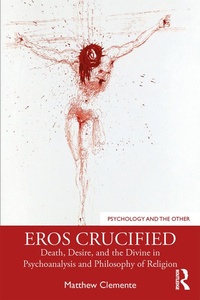
Eros Crucified
Death, Desire, and the Divine in Psychoanalysis and Philosophy of Religion
1st Edition
Published on 8. November 2019
202 pages
978-1-000-73161-3 (ISBN)
Description

Bringing contemporary philosophers, theologians, and psychoanalysts into dialogue with works of art and literature, this work provides a fresh perspective on how humans can make sense of suffering and finitude and how our existence as sexual beings shapes our relations to one another and the divine. It attempts to establish a connection between carnal, bodily love and humanity's relation to the divine.
Relying on the works of philosophers such as Manoussakis, Kearney, and Marion and psychoanalysts such as Freud and Lacan, this book provides a possible answer to these fundamental questions and fosters further dialogue between thinkers and scholars of these different fields. The author analyzes why human sexuality implies both perversion and perfection and why it brings together humanity's baseness and beatitude. Through it, the author taps once more into the dark mystery of Eros and Thanatos who, to paraphrase Dostoevsky, forever struggle with God on the battlefield of the human heart.
This book is written primarily for scholars interested in the fields of philosophical psychology, existential philosophy, and philosophy of religion
Relying on the works of philosophers such as Manoussakis, Kearney, and Marion and psychoanalysts such as Freud and Lacan, this book provides a possible answer to these fundamental questions and fosters further dialogue between thinkers and scholars of these different fields. The author analyzes why human sexuality implies both perversion and perfection and why it brings together humanity's baseness and beatitude. Through it, the author taps once more into the dark mystery of Eros and Thanatos who, to paraphrase Dostoevsky, forever struggle with God on the battlefield of the human heart.
This book is written primarily for scholars interested in the fields of philosophical psychology, existential philosophy, and philosophy of religion
Reviews / Votes
"With this provocative new book, Clemente establishes himself as a bold and original voice among the next generation of philosophers of religion. Eros Crucified is a deeply engaging work which charts new territory while showing genuine critical appreciation for the thinkers who come before. This book rewards rereading; indeed demands it."Richard Kearney, Charles Seelig Professor in Philosophy, Boston College
"It is always difficult to read a book that engages with one's work. As I read through this text, however, I realized that Clemente not only understands my thinking, he articulates it more clearly and develops it more thoroughly than I have. Equal parts critical and constructive, Eros Crucified advances the vital work being done at the intersection of philosophy, psychoanalysis, and theology. A major achievement."
John Panteleimon Manoussakis, Editor-in-Chief, The Journal for Continental Philosophy of Religion
"Eros Crucified is an exceptional book. Through original and powerful readings of Freud and Nietzsche, Clemente argues that the only Eros worth living and dying for must be grounded in self-giving rather than mastery, encompassing the 'highest and lowest' of our all-too-human experience: an Eros "crucified." Far from being a devotional consolation, Eros Crucified exposes the ambiguity of desire through a series of personal and provocative meditations.
Teresa Fenichel , College of the Holy Cross, author of Uncanny Belonging: Schelling, Freud, and the Philosophical Foundations of Psychoanalysis
More details
Series
Edition
1. Auflage
Language
English
Place of publication
London
United Kingdom
Publishing group
Taylor & Francis Ltd
Target group
Professional and scholarly
ISBN-13
978-1-000-73161-3 (9781000731613)
Copyright in bibliographic data and cover images is held by Nielsen Book Services Limited or by the publishers or by their respective licensors: all rights reserved.
Schweitzer Classification
Other editions
Additional editions
Matthew Clemente
Eros Crucified
Death, Desire, and the Divine in Psychoanalysis and Philosophy of Religion
Book
11/2019
1st Edition
Routledge
€197.20
Shipment within 15-20 days
Matthew Clemente
Eros Crucified
Death, Desire, and the Divine in Psychoanalysis and Philosophy of Religion
Book
11/2019
1st Edition
Routledge
€56.70
Shipment within 15-20 days
Person
Matthew Clemente, PhD, is a Lecturer in the Woods College of Advancing Studies at Boston College specializing in existentialism, philosophy of religion, and contemporary Continental thought. He is the associate editor of the Journal of Continental Philosophy and Religion (Brill) and the co-editor of three philosophical volumes: The Art of Anatheism (2017), misReading Nietzsche (2018), and Richard Kearney's Anatheistic Wager (2018).
Content
A brief disclaimer: Knowing that you know not, or how to read philosophy
Preface
Acknowledgements
Introduction
Part I - Creation: A Theological Aesthetic
1. Oedipus and Adam: The genesis of Eros and the infancy of man
2. Creation: Eros as word
3. Incarnation: Eros as touch, caress, kiss
4. Eschaton: Sex as contradiction
Part II - Incarnation: A Theological Dramatic
5. The hermeneutics of desire: On the Song of Songs
6. Triune Eros
7. Thanatos: Descent into the Id
8. Resurrection ex nihilo: From nothing to all things made new
Afterword - Eschaton: A Theopoetic
Conclusion - Eternal recurrence of the new: A repetition forward
Index
Preface
Acknowledgements
Introduction
Part I - Creation: A Theological Aesthetic
1. Oedipus and Adam: The genesis of Eros and the infancy of man
2. Creation: Eros as word
3. Incarnation: Eros as touch, caress, kiss
4. Eschaton: Sex as contradiction
Part II - Incarnation: A Theological Dramatic
5. The hermeneutics of desire: On the Song of Songs
6. Triune Eros
7. Thanatos: Descent into the Id
8. Resurrection ex nihilo: From nothing to all things made new
Afterword - Eschaton: A Theopoetic
Conclusion - Eternal recurrence of the new: A repetition forward
Index
