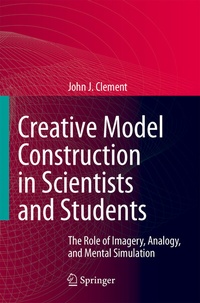
Creative Model Construction in Scientists and Students
Description

How do scientists use analogies and other processes to break away from old theories and generate new ones? This book documents such methods through the analysis of video tapes of scientifically trained experts thinking aloud while working on unfamiliar problems. Some aspects of creative scientific thinking are difficult to explain, such as the power of analogies, the use of physical intuition, and the enigmatic ability to learn from thought experiments. The book examines the hypothesis that these processes are based on imagistic mental simulation as an underlying mechanism. This allows the analysis of insight ("Aha!") episodes of creative theory formation. Advanced processes examined include specialized conserving transformations, Gedanken experiments, and adjusted levels of divergence in thinking. Student interviews are used to show that students have natural abilities for many of these basic reasoning and model construction processes and that this has important implications for expanding instructional theories of conceptual change and inquiry. "I regard this work as the most comprehensive account ever attempted to show how imagistic, analogic, and sensory-motor representations participate in creative thinking." Professor Ryan Tweney
More details
Other editions
Additional editions