

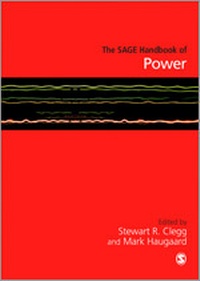
The SAGE Handbook of Power
1st Edition
Published on 27. February 2009
504 pages
978-1-4462-0671-3 (ISBN)
Description

Power is arguably one of the key concepts within the social sciences. The SAGE Handbook of Power is the first touchstone for any student or researcher wishing to initiate themselves in the state of the art.
Internationally acclaimed, Stewart R Clegg and Mark Haugaard have joined forces to select a collection of papers written by scholars with global reputations for excellence. These papers bridge different conceptual and theoretical positions and draw on many disciplines, including politics, sociology and cultural studies. The sweep and richness of the resulting handbook will help readers contextualise and grow their understanding of this dynamic and important subject area.
Internationally acclaimed, Stewart R Clegg and Mark Haugaard have joined forces to select a collection of papers written by scholars with global reputations for excellence. These papers bridge different conceptual and theoretical positions and draw on many disciplines, including politics, sociology and cultural studies. The sweep and richness of the resulting handbook will help readers contextualise and grow their understanding of this dynamic and important subject area.
Reviews / Votes
'This edited book by Stewart Clegg and Mark Haugaard, with twenty essay contributions from international scholars, is not a conventional easy reader but a handbook that offers many thought-provoking views of power...It traverses an enormous intellectual territory... and addresses many of the complex issues surrounding the visible, less visible and hidden aspects of power...The essays go way beyond superficial normative ideas of power into the strategic clarification of existing debates and new and challanging propositions surrounding power'Judy Johnston
Faculty of Business, University of Technology Sydney -- Bryan S. Turner "Remarkable for its findings and its implications, this book looks at the centrality of power (which can be characterized as 'power over', 'power to,' 'power with') to life and at how people use or surrender to power." -- L. Braude "I recommend it most strongly and think that it will be very useful indeed. A great addition to the literature." -- John Urry
All prices
More details
Edition
First Edition
Language
English
Place of publication
London
United Kingdom
Target group
Professional and scholarly
ISBN-13
978-1-4462-0671-3 (9781446206713)
Copyright in bibliographic data and cover images is held by Nielsen Book Services Limited or by the publishers or by their respective licensors: all rights reserved.
Schweitzer Classification
Other editions
Additional editions
Stewart R. Clegg | Mark Haugaard
The SAGE Handbook of Power
Book
03/2013
1st Edition
SAGE Publications Ltd
€83.50
Shipment within 15-20 days
Stewart R. Clegg | Mark Haugaard
The SAGE Handbook of Power
Book
02/2009
1st Edition
SAGE Publications Inc
€202.20
Shipment within 10-20 days
Persons
Stewart Clegg is Professor at the University of Sydney in the School of Project Management and the John Grill Institute for Project Leadership and an Emeritus Professor of the University of Technology Sydney.
Content
'Power to' versus 'Power over' in Consensual, Functionalist and Conflict Theory
PART ONE: FRAMING THE FIELD
'Power to' and 'Power over' - Gerhard Goehler
Rational-Choice Perspectives - Keith Dowding
Liberal Theories - Peter Morriss
Democratic Theories - Charles Tilly
Power and Structuration Theory - Rob Stones
Power and Discourse: Towards an Anti-Foundationalist Concept of Power - Jacob Torfing
Actor-Network Theory - Rolland Munro
Power, Efficacy and Resources: Perspectives from Anthropology - Richard Jenkins
Powerful Geographies: Spatial Shifts in the Architecture of Globalization - John Allen
PART TWO: POWER AND RELATED ANALYTIC CONCEPTS
Three Conceptions of the Relationship between Power and Liberty - Mitchell Dean
Power and Identity - Nigel Rapport
Culture and Power - Fredrik Engelstad
Hegemony and Power - Mark Haugaard
Legitimacy and Power - Raymond Daniel Gordon
Collective Violence and Power - Sinisa Malesevi?
PART THREE: POWER AND SUBSTANTIVE ISSUES
Gender and Power - Amy Allen
Managing Power in Organizations: The Hidden History of Its Constitution - Stewart Clegg
Cultures of Resistance in the Workplace - David Courpasson and Francoise Dany
Power and Exclusion - Kevin Ryan
State and Power - Robert Jessop
International Relations and Power - Phillip G Cerny
PART FOUR: CONCLUSION
Conversations in Conclusion - Stewart Clegg and Mark Haugaard
PART ONE: FRAMING THE FIELD
'Power to' and 'Power over' - Gerhard Goehler
Rational-Choice Perspectives - Keith Dowding
Liberal Theories - Peter Morriss
Democratic Theories - Charles Tilly
Power and Structuration Theory - Rob Stones
Power and Discourse: Towards an Anti-Foundationalist Concept of Power - Jacob Torfing
Actor-Network Theory - Rolland Munro
Power, Efficacy and Resources: Perspectives from Anthropology - Richard Jenkins
Powerful Geographies: Spatial Shifts in the Architecture of Globalization - John Allen
PART TWO: POWER AND RELATED ANALYTIC CONCEPTS
Three Conceptions of the Relationship between Power and Liberty - Mitchell Dean
Power and Identity - Nigel Rapport
Culture and Power - Fredrik Engelstad
Hegemony and Power - Mark Haugaard
Legitimacy and Power - Raymond Daniel Gordon
Collective Violence and Power - Sinisa Malesevi?
PART THREE: POWER AND SUBSTANTIVE ISSUES
Gender and Power - Amy Allen
Managing Power in Organizations: The Hidden History of Its Constitution - Stewart Clegg
Cultures of Resistance in the Workplace - David Courpasson and Francoise Dany
Power and Exclusion - Kevin Ryan
State and Power - Robert Jessop
International Relations and Power - Phillip G Cerny
PART FOUR: CONCLUSION
Conversations in Conclusion - Stewart Clegg and Mark Haugaard
