

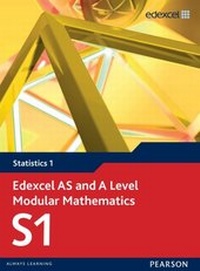
Edexcel AS and A Level Modular Mathematics Statistics 1 S1
1st Edition
Published on 30. September 2016
232 pages
978-1-292-18517-0 (ISBN)
Description

Edexcel and A Level Modular Mathematics S1 features: Student-friendly worked examples and solutions, leading up to a wealth of practice questions. Sample exam papers for thorough exam preparation. Regular review sections consolidate learning. Opportunities for stretch and challenge presented throughout the course. Escalator section to step up from GCSE. PLUS Free LiveText CD-ROM, containing Solutionbank and Exam Caf to support, motivate and inspire students to reach their potential for exam success. Solutionbank contains fully worked solutions with hints and tips for every question in the Student Books. Exam Caf includes a revision planner and checklist as well as a fully worked examination-style paper with examiner commentary.
More details
Other editions
Additional editions
Greg Attwood | Alan Clegg | Jane Dyer
Edexcel AS and A Level Modular Mathematics Statistics 1 S1
Book
08/2008
Heinemann
€20.50
Shipment within 5-8 weeks
Content
- Cover
- Contents
- About this book
- Chapter 1: Mathematical models in probability and statistics
- 1.1: What are mathematical models?
- 1.2: Designing a mathematical model
- Summary of key points
- Chapter 2: Representation and summary of data - location
- 2.1: Classification of variables
- 2.2: Classification of quantitative variables into continuous or discrete variables
- 2.3: Frequency tables and grouping data
- 2.4: Measures of location
- 2.5: Which is the correct measure of location?
- 2.6: Calculating measures of location from a frequency distribution table
- 2.7: Calculating measures of location for grouped data
- 2.8: Coding
- Summary of key points
- Chapter 3: Representation and summary of data - measures of dispersion
- 3.1: Range and quartiles
- 3.2: Percentiles
- 3.3: Standard deviation and variance for discrete data
- 3.4: Variance and standard deviation for a frequency table and grouped frequency distribution
- 3.5: Coding
- Summary of key points
- Chapter 4: Representation of data
- 4.1: Stem and leaf diagrams
- 4.2: Outliers
- 4.3: Box plots
- 4.4: Using box plots to compare sets of data
- 4.5: Representing data on a histogram
- 4.6: Skewness
- 4.7: Comparing the distributions of data sets
- Summary of key points
- Chapter 5: Probability
- 5.1: Probability vocabulary
- 5.2: Solving probability problems by drawing Venn diagrams
- 5.3: Using formulae to solve problems
- 5.4: Solving problems using conditional probability
- 5.5: Conditional probabilities on tree diagrams
- 5.6: Mutually exclusive and independent events
- 5.7: Solving probability problems
- Summary of key points
- Review Exercise 1
- Chapter 6: Correlation
- 6.1: Scatter diagrams
- 6.2: Calculating measures for the variability of bivariate data
- 6.3: Using the product moment correlation coefficient, r
- 6.4: Determining the strength of a linear relationship
- 6.5: The limits of the product moment correlation coefficient
- 6.6: Coding
- Summary of key points
- Chapter 7: Regression
- 7.1: Connecting variables
- 7.2: Independent and dependent variables
- 7.3: Minimising the sum of the squares of the residuals
- 7.4: Coding
- 7.5: The regression equation
- Summary of key points
- Chapter 8: Discrete random variables
- 8.1: Discrete random variables and random variables
- 8.2: Specifying a variable
- 8.3: Sum of probabilities
- 8.4: Finding the probability that X is less than or greater than a value, or between two values
- 8.5: The cumulative distribution function
- 8.6: The mean or expected value of a discrete random variable
- 8.7: The expected value for X2
- 8.8: The variance of a random variable
- 8.9: The expected value and variance of a function of X
- 8.10: Finding the mean and standard deviation of the original data given the mean and standard deviation of the coded data
- 8.11: A model for the probability distribution
- Summary of key points
- Chapter 9: The normal distribution
- 9.1: Use tables to find probabilities in the standard normal distribution Z
- 9.2: Use tables to find the value of z given a probability
- 9.3: Transform any normal distribution into Z and use tables
- 9.4: Use normal tables to find µ and o
- 9.5: Use the normal distribution to answer questions in context
- Summary of key points
- Review Exercise 2
- Examination style paper
- Appendix
- Answers
- Index
