

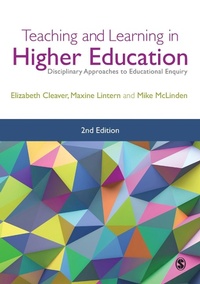
Teaching and Learning in Higher Education
Disciplinary Approaches to Educational Enquiry
2nd Edition
Published on 28. June 2018
344 pages
978-1-5264-5295-5 (ISBN)
Description

This book explores best practice approaches to undertaking enquiry into learning and teaching in higher education for staff from all academic disciplines. A general introduction to the methods most commonly used in undertaking enquiry in the field of education is complemented by chapters exploring how research methods from a range of disciplinary areas can be adapted and used for educational enquiry.
New to this second edition:
? Chapters on interdisciplinary educational enquiry in geography and using ethnographic methods for educational enquiry
? New case studies and suggested activities
? A reflective final chapter inviting readers and their institutions to develop and promote an organisational culture founded on critical enquiry
This is essential reading for anyone undertaking HE qualifications in learning and teaching (including PGCTLHE and PGCAP) and for academics wishing to apply their skills of research and enquiry to their learning and teaching practice.
New to this second edition:
? Chapters on interdisciplinary educational enquiry in geography and using ethnographic methods for educational enquiry
? New case studies and suggested activities
? A reflective final chapter inviting readers and their institutions to develop and promote an organisational culture founded on critical enquiry
This is essential reading for anyone undertaking HE qualifications in learning and teaching (including PGCTLHE and PGCAP) and for academics wishing to apply their skills of research and enquiry to their learning and teaching practice.
Reviews / Votes
'This book makes a timely contribution to debate and developing practice in critical educational inquiry, specifically in the context of research intended to enhance teaching quality, both as a laudable aim in itself and in response to external drivers such as the TEF. The central thrust of the book acknowledges the challenges for non-HE researchers coping with the 'strange land of higher education studies' and the importance of locating academic research within the discipline as a starting point. The authors make a powerful case for critical inquiry as a means of building disciplinary and cross-disciplinary communities and its potential to drive institutional culture change.' -- Fran Beaton 'The emphasis in this book on developing 'enquiring universities' is a welcome articulation of what is 'higher' about higher education. This book provides academics with a variety of tools they can use in order to conduct critical enquiries into their own academic practice.' -- Kelly Coate * University of Sussex *More details
Edition
Second Edition
Language
English
Place of publication
London
United Kingdom
Target group
College/higher education
Product notice
Reflowable
ISBN-13
978-1-5264-5295-5 (9781526452955)
Copyright in bibliographic data and cover images is held by Nielsen Book Services Limited or by the publishers or by their respective licensors: all rights reserved.
Schweitzer Classification
Other editions
Additional editions
Elizabeth Cleaver | Maxine Lintern | Mike Mclinden
Teaching and Learning in Higher Education
Disciplinary Approaches to Educational Enquiry
Book
08/2018
2nd Edition
SAGE Publications Ltd
€80.70
Shipment within 15-20 days
Elizabeth Cleaver | Maxine Lintern | Mike Mclinden
Teaching and Learning in Higher Education
Disciplinary Approaches to Educational Enquiry
Book
08/2018
2nd Edition
SAGE Publications Ltd
€168.10
Shipment within 15-20 days
Persons
Prof. Elizabeth Cleaver is Professor of Learning and Teaching at the University of the West of England, UK (UWE) where she has built and leads the University's Academic Practice Directorate: the central hub for the support, development and enhancement of academic programmes and practice. Over a career spanning 23 years she has taught, written and researched in sociology and education. Her early academic career was in the discipline of sociology where she specialised in the area of youth transitions to adulthood (early works are published in name Kenyon). It was during this period that her interest in disciplinary teaching approaches, and the importance of not just thinking and researching sociologically, but teaching sociologically, began to grow. Following a six-year spell outside the HE sector, undertaking local and government-funded policy research and evaluations at NFER, she returned to higher education in 2008. This most recent stage of Elizabeth's career has focused on providing strategic leadership for curricular and pedagogic development and change in a range of contrasting higher education institutions. Elizabeth is a Principal Fellow of the Higher Education Academy.
Prof. Maxine Lintern is Associate Dean for Research and Enterprise for the Faculty of Business, Law and Social Science at Birmingham City University, UK. Her background is in biochemistry and neurophysiology and she has always been profoundly interested in the links and interfaces between research and teaching. The research strategy she has developed for the Faculty overtly links all research activity back into the development of innovative teaching environments and the curriculum. While based in the Faculty of Health she established a successful research centre and created innovative learning experiences such as the 'Major Incident Simulation'. Prior to her roles at BCU she was Director of Learning and Teaching at the University of Birmingham where she worked closely with staff from a wide range of subject areas as they undertook formal training in teaching as part of their PGCert. The challenge of helping them to see links back to their own research environment and how that could inspire educational development is one of drivers for producing this book. Maxine is a Principal Fellow of the Higher Education Academy.
Prof. Mike McLinden is based in the School of Education at the University of Birmingham as has over 25 years' experience of curriculum design, delivery and evaluation. He has a broad interest in professional learning and pedagogy and has been involved in a range of funded pedagogical projects in partnership with colleagues in the sector. This includes Strand Lead (Part Time Learners) for HEA-funded 'Flexible Pedagogies' project. Mike's research interests include developing 'research-informed' pedagogical practice with a particular focus on the development of student-centred approaches (including problem/enquiry-based learning). With colleagues at the University, he has led a number of funded projects that link to strategic developments within the institution. Mike's disciplinary professional role is concerned with the inclusion of children and young people with special educational needs and disabilities. He is co-Director of the Visual Impairment Centre for Teaching and Research (VICTAR) in the Department of Disability Inclusion and Special Needs (DISN), Programme Director for the professional development courses in vision impairment, and is a Principal Fellow of the Higher Education Academy.
Prof. Maxine Lintern is Associate Dean for Research and Enterprise for the Faculty of Business, Law and Social Science at Birmingham City University, UK. Her background is in biochemistry and neurophysiology and she has always been profoundly interested in the links and interfaces between research and teaching. The research strategy she has developed for the Faculty overtly links all research activity back into the development of innovative teaching environments and the curriculum. While based in the Faculty of Health she established a successful research centre and created innovative learning experiences such as the 'Major Incident Simulation'. Prior to her roles at BCU she was Director of Learning and Teaching at the University of Birmingham where she worked closely with staff from a wide range of subject areas as they undertook formal training in teaching as part of their PGCert. The challenge of helping them to see links back to their own research environment and how that could inspire educational development is one of drivers for producing this book. Maxine is a Principal Fellow of the Higher Education Academy.
Prof. Mike McLinden is based in the School of Education at the University of Birmingham as has over 25 years' experience of curriculum design, delivery and evaluation. He has a broad interest in professional learning and pedagogy and has been involved in a range of funded pedagogical projects in partnership with colleagues in the sector. This includes Strand Lead (Part Time Learners) for HEA-funded 'Flexible Pedagogies' project. Mike's research interests include developing 'research-informed' pedagogical practice with a particular focus on the development of student-centred approaches (including problem/enquiry-based learning). With colleagues at the University, he has led a number of funded projects that link to strategic developments within the institution. Mike's disciplinary professional role is concerned with the inclusion of children and young people with special educational needs and disabilities. He is co-Director of the Visual Impairment Centre for Teaching and Research (VICTAR) in the Department of Disability Inclusion and Special Needs (DISN), Programme Director for the professional development courses in vision impairment, and is a Principal Fellow of the Higher Education Academy.
Content
PART ONE: UNDERSTANDING EDUCATIONAL ENQUIRY
Chapter 1: What is educational enquiry and why is it important?
Chapter 2: What do I need to know before I read educational literature?
Chapter 3: How is educational literature evidenced and reviewed?
Chapter 4: What about ethics and safety?
Chapter 5: What kind of data should I collect and use?
Chapter 6: What about dissemination?
PART TWO: ENQUIRY IN THE DISCIPLINES
Chapter 7: Enquiry into learning and teaching in the physical sciences
Chapter 8: Enquiry into learning and teaching in mathematics and engineering
Chapter 9: Enquiry into learning and teaching in the life sciences
Chapter 10: Enquiry into learning and teaching in arts and creative practice
Chapter 11: Enquiry into learning and teaching in the humanities
Chapter 12: Enquiry into learning and teaching in the health professions
Chapter 13: Enquiry into learning and teaching in the professions: the case of law
Chapter 14: Interdisciplinary enquiry into learning and teaching: lessons from geography
Chapter 15: Enquiry into learning and teaching in the social sciences: engaging with ethnographic research
Chapter 16: Developing and promoting a culture of critical enquiry within higher education
Chapter 1: What is educational enquiry and why is it important?
Chapter 2: What do I need to know before I read educational literature?
Chapter 3: How is educational literature evidenced and reviewed?
Chapter 4: What about ethics and safety?
Chapter 5: What kind of data should I collect and use?
Chapter 6: What about dissemination?
PART TWO: ENQUIRY IN THE DISCIPLINES
Chapter 7: Enquiry into learning and teaching in the physical sciences
Chapter 8: Enquiry into learning and teaching in mathematics and engineering
Chapter 9: Enquiry into learning and teaching in the life sciences
Chapter 10: Enquiry into learning and teaching in arts and creative practice
Chapter 11: Enquiry into learning and teaching in the humanities
Chapter 12: Enquiry into learning and teaching in the health professions
Chapter 13: Enquiry into learning and teaching in the professions: the case of law
Chapter 14: Interdisciplinary enquiry into learning and teaching: lessons from geography
Chapter 15: Enquiry into learning and teaching in the social sciences: engaging with ethnographic research
Chapter 16: Developing and promoting a culture of critical enquiry within higher education
