

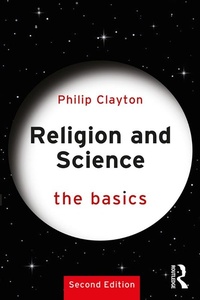
Religion and Science: The Basics
2nd Edition
Published on 20. September 2018
214 pages
978-1-351-35592-6 (ISBN)
Description

Religion and science are arguably the two most powerful social forces in the world today. But where religion and science were once held to be compatible, many people now perceive them to be in conflict. This unique book provides the best available introduction to the burning debates in this controversial field. Examining the defining questions and controversies, renowned expert Philip Clayton presents the arguments from both sides, asking readers to decide for themselves where they stand:
* science or religion, or science and religion?
* history and philosophy of science
* the role of scientific and religious ethics - modifying genes, extending life, and experimenting with human subjects
* religion and the environmental crisis
* the future of science vs. the future of religion.
Thoroughly updated throughout, this second edition explores religious traditions from around the world and provides insights from across the sciences, making this book essential reading for all those wishing to come to their own understanding of some of the most important debates of our day.
* science or religion, or science and religion?
* history and philosophy of science
* the role of scientific and religious ethics - modifying genes, extending life, and experimenting with human subjects
* religion and the environmental crisis
* the future of science vs. the future of religion.
Thoroughly updated throughout, this second edition explores religious traditions from around the world and provides insights from across the sciences, making this book essential reading for all those wishing to come to their own understanding of some of the most important debates of our day.
Reviews / Votes
'Religion and Science: The Basics is a fantastic primer that engagingly conveys clear historical, scientific, and religious-ethical approaches to key topics at the intersection of western science and religions. Clayton's approach is accessible to those who are new to the topic, and it is useful and engaging for experts and teachers. Spanning topics from physics to biology and research ethics to warfare technologies, readers will find important information and questions to consider from several world religious traditions, with an emphasis on monotheisms.'Christiana Zenner, Fordham University, USA
'This well-written introduction to the relationships between religion and science by a leading scholar of the field is an excellent choice for undergraduates. Compact yet comprehensive, and engaging with both Western and Eastern faiths, this guide ranges through a series of contemporary topics, including the interaction between religion and physics, biology, the mind sciences and medical ethics. A new chapter on historical and philosophical dimensions of science and religion relations complements an updated discussion of contemporary debates about belief and unbelief that resonate in popular culture. Deftly handling the warfare thesis and other models for the interaction of science and religion, the book also looks to the future of this interaction and offers incisive questions for classroom discussion.'
Stephen D. Snobelen, King's College, Halifax, Canada "Religion and Science: The Basics is a fantastic primer that engagingly conveys clear historical, scientific, and religious-ethical approaches to key topics at the intersection of western science and religions. Clayton's approach is accessible to those who are new to the topic, and it is useful and engaging for experts and teachers. Spanning topics from physics to biology and research ethics to warfare technologies, readers will find important information and questions to consider from several world religious traditions, with an emphasis on monotheisms."
- Christiana Zenner, Fordham University, USA
"This well-written introduction to the relationships between religion and science by a leading scholar of the field is an excellent choice for undergraduates. Compact yet comprehensive, and engaging with both western and eastern faiths, this guide ranges through a series of contemporary topics, including the interaction between religion and physics, biology, the mind sciences and medical ethics. A new chapter on historical and philosophical dimensions of science and religion relations complements an updated discussion of contemporary debates about belief and unbelief that resonate in popular culture. Deftly handling the warfare thesis and other models for the interaction of science and religion, the book also looks to the future of this interaction and offers incisive questions for classroom discussion."
- Stephen D. Snobelen, King's College, Halifax, Canada
"What could be more difficult than untangling the contemporary controversy over "science and religion"-and for a popular audience? Well, Philip Clayton seems to have achieved just that in a second-edition to Religion and Science: The Basics. [...] truly is a home-run [...] Highly recommended."
- Jamin A. Huebner, Reading Religion
More details
Series
Edition
2nd edition
Language
English
Place of publication
London
United Kingdom
Publishing group
Taylor & Francis Ltd
Target group
College/higher education
Illustrations
1 Line drawings, black and white
File size
1,13 MB
ISBN-13
978-1-351-35592-6 (9781351355926)
Copyright in bibliographic data and cover images is held by Nielsen Book Services Limited or by the publishers or by their respective licensors: all rights reserved.
Schweitzer Classification
Other editions
Additional editions
Book
09/2018
2nd Edition
Routledge
€32.30
Shipment within 10-20 days
Book
09/2018
2nd Edition
Routledge
€148.80
Shipment within 10-20 days
Person
Philip Clayton is Ingraham Professor and Director of the Center for Spirituality and Sustainability at Claremont School of Theology, and affiliated faculty at Claremont Graduate University, USA. Author or editor of several dozen books, he is widely recognized internationally as a leading figure in the field of religion and science.
Content
Preface
1. The basic question: science or religion, or science and religion?
The debate that no one can avoid
A naturalist and a theist in debate
Taking stock
2. Expanding the options
Theism and naturalism at odds
God, design, and delusion
A broader (and more interesting) exchange
Constructive skepticism: Michael Shermer
Theistic evolution: Francis Collins
Agnostic naturalism: Neil DeGrasse Tyson
New vistas
3. Science and the world's religions
Christianity
Judaism
Islam
Hinduism
Buddhism
Conclusions and further questions to explore
4. Physics
Why the religious interest in cosmology?
Fundamental physics
Fine-tuning and the multiverse
What physics does and doesn't show
5. The biological sciences
The origins of life
Evolution and creation
Are genes the fundamental units of evolution?
Are humans unique?
6. The neurosciences
Brains, minds, and consciousness
Can thoughts and intentions do anything?
Whatever happened to the soul?
Challenging the boundaries between mind and brain
Religious experience
7. Religion and science in historical and philosophical perspective
The history of religion and science
Are science and religion intrinsically at war?
The philosophy of science
Is science really objective?
Separationists and Integrationists
Change the names, solve the problem?
8. Science, technology, and ethics
Stem cell research
Modifying our genes
Ethical issues at the end of life
The rights of subjects in scientific experiments and medical care
Warfare technologies
9. The future of science and religion
Summarizing the options
Making the case for partnerships
They're your questions now...
Glossary
Index
1. The basic question: science or religion, or science and religion?
The debate that no one can avoid
A naturalist and a theist in debate
Taking stock
2. Expanding the options
Theism and naturalism at odds
God, design, and delusion
A broader (and more interesting) exchange
Constructive skepticism: Michael Shermer
Theistic evolution: Francis Collins
Agnostic naturalism: Neil DeGrasse Tyson
New vistas
3. Science and the world's religions
Christianity
Judaism
Islam
Hinduism
Buddhism
Conclusions and further questions to explore
4. Physics
Why the religious interest in cosmology?
Fundamental physics
Fine-tuning and the multiverse
What physics does and doesn't show
5. The biological sciences
The origins of life
Evolution and creation
Are genes the fundamental units of evolution?
Are humans unique?
6. The neurosciences
Brains, minds, and consciousness
Can thoughts and intentions do anything?
Whatever happened to the soul?
Challenging the boundaries between mind and brain
Religious experience
7. Religion and science in historical and philosophical perspective
The history of religion and science
Are science and religion intrinsically at war?
The philosophy of science
Is science really objective?
Separationists and Integrationists
Change the names, solve the problem?
8. Science, technology, and ethics
Stem cell research
Modifying our genes
Ethical issues at the end of life
The rights of subjects in scientific experiments and medical care
Warfare technologies
9. The future of science and religion
Summarizing the options
Making the case for partnerships
They're your questions now...
Glossary
Index
