

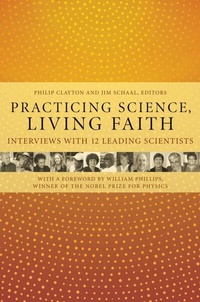
Practicing Science, Living Faith
Interviews with Twelve Leading Scientists
1st Edition
Published on 13. February 2007
272 pages
978-0-231-53422-2 (ISBN)
Description

No detailed description available for "Practicing Science, Living Faith".
More details
Other editions
Additional editions
Philip Clayton | Jim Schaal
Practicing Science, Living Faith
Interviews with Twelve Leading Scientists
Book
02/2007
Columbia University Press
€68.09
Article not available at the moment
Persons
Philip Clayton is Ingraham Professor at Claremont School of Theology and specializes in relations between science and religion. He is the author or editor of some fifteen books in the field, including God and Contemporary Science; Explanation from Physics to Theology; The Problem of God in Modern Thought; Mind and Emergence; and the Oxford Handbook of Religion and Science. From 1999 to 2003 Dr. Clayton served as principal investigator of the Science and the Spiritual Quest program at the Center for Theology and the Natural Sciences in Berkeley, California.Jim Schaal attended Deep Springs College and earned a dual baccalaureate in physics and philosophy from the University of California, Davis. From 1999 to 2003 he served as program director of the Science and the Spiritual Quest program and currently is a graduate student at the Divinity School of the University of Chicago.
Philip Clayton holds a PhD in both philosophy and religious studies from Yale University. He has taught at Haverford College, Williams College, and the California State University, and has just been named to the Ingraham Chair at the Claremont School of Theology. Clayton has been guest professor at the Divinity School, Harvard University, Humboldt Professor at the University of Munich, and Senior Fulbright Professor, also at the University of Munich. He is a past winner of the Templeton Book Prize for best monograph in the field of science and religion and a winner of the first annual Templeton Research Prize.Clayton is the author of The Problem of God in Modern Thought (Eerdmans, 2000), God and Contemporary Science (Edinburgh University Press, 1997); Explanation from Physics to Theology: An Essay in Rationality and Religion (Yale University Press, 1989; German edition, Rationalität und Religion, 1992); and Das Gottesproblem, vol. 1: Gott und Unendlichkeit in der neuzeitlichen Philosophie (Schöningh Verlag, 1996). He has edited and translated several other volumes and published some 40 articles in the philosophy of science, ethics, and the world's religious traditions. His current research interest lies in developing a theology of emergence, to be published next year as The Emergence of Spirit.Clayton is currently Principal Investigator of the "Science and the Spiritual Quest" project (SSQ) at the Center for Theology and the Natural Sciences in Berkeley, California. SSQ has brought together over 100 top scientists from around the world to explore the connections between science, ethics, religion and spirituality. The SSQ Berkeley conference in 1998 received close to 100 million media impressions and was featured on the cover of Newsweek. Other major public events (past or future) sponsored by SSQ include: Silicon Valley, Harvard University, the UNESCO World Headquarters in Paris, Granada, Bangalore, and Tokyo.
Philip Clayton holds a PhD in both philosophy and religious studies from Yale University. He has taught at Haverford College, Williams College, and the California State University, and has just been named to the Ingraham Chair at the Claremont School of Theology. Clayton has been guest professor at the Divinity School, Harvard University, Humboldt Professor at the University of Munich, and Senior Fulbright Professor, also at the University of Munich. He is a past winner of the Templeton Book Prize for best monograph in the field of science and religion and a winner of the first annual Templeton Research Prize.Clayton is the author of The Problem of God in Modern Thought (Eerdmans, 2000), God and Contemporary Science (Edinburgh University Press, 1997); Explanation from Physics to Theology: An Essay in Rationality and Religion (Yale University Press, 1989; German edition, Rationalität und Religion, 1992); and Das Gottesproblem, vol. 1: Gott und Unendlichkeit in der neuzeitlichen Philosophie (Schöningh Verlag, 1996). He has edited and translated several other volumes and published some 40 articles in the philosophy of science, ethics, and the world's religious traditions. His current research interest lies in developing a theology of emergence, to be published next year as The Emergence of Spirit.Clayton is currently Principal Investigator of the "Science and the Spiritual Quest" project (SSQ) at the Center for Theology and the Natural Sciences in Berkeley, California. SSQ has brought together over 100 top scientists from around the world to explore the connections between science, ethics, religion and spirituality. The SSQ Berkeley conference in 1998 received close to 100 million media impressions and was featured on the cover of Newsweek. Other major public events (past or future) sponsored by SSQ include: Silicon Valley, Harvard University, the UNESCO World Headquarters in Paris, Granada, Bangalore, and Tokyo.
Content
Foreword, by William D. Phillips
Preface, by W. Mark Richardson
Introduction, by Jim Schaal and Philip Clayton
1. Jane Goodall
2. Hendrik Barendregt
3. Khalil Chamcham
4. Donna Auguste
5. Ursula Goodenough
6. Thomas Odhiambo
7. Faraneh Vargha-Khadem
8. Pauline Rudd
9. Satoto
10. Paula Tallal
11. Henry Thompson
12. Robert Pollack
Conclusion, by Philip Clayton
Acknowledgments
Preface, by W. Mark Richardson
Introduction, by Jim Schaal and Philip Clayton
1. Jane Goodall
2. Hendrik Barendregt
3. Khalil Chamcham
4. Donna Auguste
5. Ursula Goodenough
6. Thomas Odhiambo
7. Faraneh Vargha-Khadem
8. Pauline Rudd
9. Satoto
10. Paula Tallal
11. Henry Thompson
12. Robert Pollack
Conclusion, by Philip Clayton
Acknowledgments
