

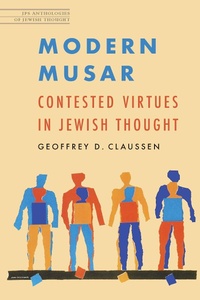
Modern Musar
Contested Virtues in Jewish Thought
Published on 1. April 2022
518 pages
978-0-8276-1888-6 (ISBN)
Description

How do modern Jews understand virtues such as courage, humility, justice, solidarity, or love? In truth: they have fiercely debated how to interpret them. This groundbreaking anthology of musar (Jewish traditions regarding virtue and character) explores the diverse ways seventy-eight modern Jewish thinkers understand ten virtues: honesty and love of truth; curiosity and inquisitiveness; humility; courage and valor; temperance and self-restraint; gratitude; forgiveness; love, kindness, and compassion; solidarity and social responsibility; and justice and righteousness. These thinkers-from the Musar movement to Hasidism to contemporary Orthodox, Reform, Conservative, Reconstructionist, Renewal, Humanist, and secular Jews-often agree on the importance of these virtues but fundamentally disagree in their conclusions. The juxtaposition of their views, complemented by Geoffrey Claussen's pointed analysis, allows us to see tensions with particular clarity-and sometimes to recognize multiple compelling ways of viewing the same virtue.
By expanding the category of musar literature to include not only classic texts and traditional works influenced by them but also the writings of diverse rabbis, scholars, and activists-men and women-who continue to shape Jewish tradition, Modern Musar challenges the fields of modern Jewish thought and ethics to rethink their boundaries-and invites us to weigh and refine our own moral ideals.
By expanding the category of musar literature to include not only classic texts and traditional works influenced by them but also the writings of diverse rabbis, scholars, and activists-men and women-who continue to shape Jewish tradition, Modern Musar challenges the fields of modern Jewish thought and ethics to rethink their boundaries-and invites us to weigh and refine our own moral ideals.
Reviews / Votes
"By expanding musar literature to include not only the texts of the Musar movement and those influenced by them but also liberal and secular Jewish thinkers, Claussen forces the fields of modern Jewish thought and ethics to rethink their boundaries."-Yonatan Y. Brafman, assistant professor of religion, Tufts University "Geoffrey Claussen's Modern Musar is a major contribution to the contemporary literature of musar. Having assembled more than a simple anthology, Claussen takes excerpts from both the traditional and the most contemporary musar authors and places them in conversation with one another, guided by his own explanations and evaluations of the material. His willingness to broaden the conversation to include those who might not consider themselves musar writers is not only refreshing but also illuminating. It suggests the breadth of ethical writing within Judaic sources and invites the growing number of folks drawn to musar to take a similarly broader view of the field."-Rabbi Ira F. Stone, Rosh Yeshiva, Center for Contemporary Mussar "A mind-expanding view of Jewish ethical character development and a pedagogic tour de force. In juxtaposing contrasting perspectives-rather than a single 'paradigmatically Jewish' view of moral virtue-on many ethical issues, Professor Claussen compels us to consider divergent views of qualities of soul. This work will become an indispensable text for students of mussar and of Jewish tradition in general."-Rabbi Amy Eilberg, author of From Enemy to Friend: Jewish Wisdom and the Pursuit of Peace and senior faculty, the Mussar Institute "How clearly and emphatically Professor Claussen proves that Jewish thinkers of varying time periods, religious orientations, and genders understand Jewish virtues differently. With the diverse (and even quite troubling) primary textual sources he provides and clarifies, readers are bound to join the discourse and define their own Jewish understandings of virtues they hold as central in their own lives."-Rabbi Vanessa Ochs, professor in the Department of Religious Studies, University of Virginia "Casting a wide net in the Jewish ethical canon and offering his invariably lucid commentary, Claussen illuminates the diversity of modern Jewish moral thought. Modern Musar will be an invaluable resource for scholars and general readers alike."-Elias Sacks, director of the Program in Jewish Studies, University of Colorado Boulder "With this deeply learned study, Geoffrey Claussen opens an inspiring vista of Jewish ethical thinking through a series of debates and a range of diverse views. His lucid explanations make this book a fabulous introduction to Jewish ethics."-Susannah Heschel, Eli M. Black Distinguished Professor of Jewish Studies, Dartmouth CollegeMore details
Series
Language
English
Place of publication
Philadelphia
United States
Target group
College/higher education
Illustrations
index
File size
4,05 MB
ISBN-13
978-0-8276-1888-6 (9780827618886)
Copyright in bibliographic data and cover images is held by Nielsen Book Services Limited or by the publishers or by their respective licensors: all rights reserved.
Schweitzer Classification
Other editions
Additional editions
Book
04/2022
Jewish Publication Society
€34.00
Shipment within 10-20 days
Persons
Geoffrey D. Claussen is an associate professor of religious studies, chair of the Department of Religious Studies, and Lori and Eric Sklut Scholar in Jewish Studies at Elon University. He is author of Sharing the Burden: Rabbi Sim?ah Zissel Ziv and the Path of Musar and is a past president of the Society of Jewish Ethics.
Content
Foreword by Louis E. Newman
Acknowledgments
Introduction
1. Honesty and Love of Truth (Yosher/Ahavat ha-Emet)
2. Curiosity and Inquisitiveness (Sakranut/?akranut)
3. Humility (Anavah)
4. Courage and Valor (Ometz Lev/Gevurah)
5. Self-Restraint and Temperance (Shelitah Atzmit/Metinut)
6. Gratitude (Hakarat ha-Tov)
7. Forgiveness (Sal?anut)
8. Love, Kindness, and Compassion (Ahavah/?esed/Ra?manut)
9. Solidarity and Social Responsibility (Arevut/A?arayut)
10. Justice and Righteousness (Tzedek)
Conclusion
List of Source Texts
Source Acknowledgments
Notes
Bibliography
Subject Index
Index of Classical Texts
Acknowledgments
Introduction
1. Honesty and Love of Truth (Yosher/Ahavat ha-Emet)
2. Curiosity and Inquisitiveness (Sakranut/?akranut)
3. Humility (Anavah)
4. Courage and Valor (Ometz Lev/Gevurah)
5. Self-Restraint and Temperance (Shelitah Atzmit/Metinut)
6. Gratitude (Hakarat ha-Tov)
7. Forgiveness (Sal?anut)
8. Love, Kindness, and Compassion (Ahavah/?esed/Ra?manut)
9. Solidarity and Social Responsibility (Arevut/A?arayut)
10. Justice and Righteousness (Tzedek)
Conclusion
List of Source Texts
Source Acknowledgments
Notes
Bibliography
Subject Index
Index of Classical Texts
