

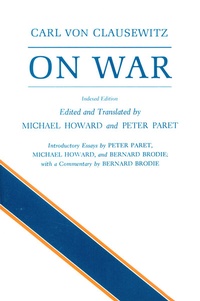
On War
1st Edition
Published on 18. November 2019
752 pages
978-1-4008-3740-3 (ISBN)
Description

The most authoritative and feature-rich edition of On War in English
Carl von Clausewitz's On War is the most significant attempt in Western history to understand war, both in its internal dynamics and as an instrument of policy. Since the work's first appearance in 1832, it has been read throughout the world, and has stimulated generations of soldiers, political leaders, and intellectuals. First published in 1976 and revised in 1984, Michael Howard and Peter Paret's Princeton edition of Clausewitz's classic work has itself achieved classic status and is widely regarded as the best translation and standard edition of On War in English. This feature-rich edition includes an essay by Paret on the genesis of Clausewitz's book, an essay by Howard on Clausewitz's influence, and an essay by Bernard Brodie on the continuing relevance of On War. In addition, Brodie provides a lengthy and detailed commentary on and guide to reading On War, and the edition also includes a comprehensive index.
Carl von Clausewitz's On War is the most significant attempt in Western history to understand war, both in its internal dynamics and as an instrument of policy. Since the work's first appearance in 1832, it has been read throughout the world, and has stimulated generations of soldiers, political leaders, and intellectuals. First published in 1976 and revised in 1984, Michael Howard and Peter Paret's Princeton edition of Clausewitz's classic work has itself achieved classic status and is widely regarded as the best translation and standard edition of On War in English. This feature-rich edition includes an essay by Paret on the genesis of Clausewitz's book, an essay by Howard on Clausewitz's influence, and an essay by Bernard Brodie on the continuing relevance of On War. In addition, Brodie provides a lengthy and detailed commentary on and guide to reading On War, and the edition also includes a comprehensive index.
All prices
More details
Other editions
Persons
Michael Howard (1922-2019) was a leading British military historian who held professorships at the University of Oxford and Yale University. His many books included The Franco-Prussian War and War in European History. Peter Paret (1924-2020) was professor emeritus at the Institute for Advanced Study in Princeton. His many books include Clausewitz in His Time, The Cognitive Challenge of War (Princeton), and Clausewitz and the State (Princeton). He received the Pritzker Literary Award for lifetime achievement in military writing. Bernard Brodie (1910-1978), who wrote widely on military and nuclear strategy, was professor of political science at the University of California, Los Angeles.
Content
- Cover
- Title Page
- Copyright Page
- Table of Contents
- Editors' Note
- Note for the 1984 Edition
- Introductory Essays
- The Genesis of On War
- The Influence of Clausewitz
- The Continuing Relevance of On War
- On War
- Author's Preface
- Author's Comment
- Preface
- Two Notes by the Author On War
- BOOK ONE: On the Nature of War
- 1 What is War?
- 2 Purpose and Means in War
- 3 On Military Genius
- 4 On Danger in War
- 5 On Physical Effort in War
- 6 Intelligence in War
- 7 Friction in War
- 8 Concluding Observations on Book One
- BOOK TWO: On the Theory of War
- 1 Classifications of the Art of War
- 2 On the Theory of War
- 3 Art of War or Science of War
- 4 Method and Routine
- 5 Critical Analysis
- 6 On Historical Examples
- BOOK THREE: On Strategy in General
- 1 Strategy
- 2 Elements of Strategy
- 3 Moral Factors
- 4 The Principal Moral Elements
- 5 Military Virtues of the Army
- 6 Boldness
- 7 Perseverance
- 8 Superiority of Numbers
- 9 Surprise
- 10 Cunning
- 11 Concentration of Forces in Space
- 12 Unification of Forces in,Time
- 13 The Strategic Reserve
- 14 Economy of Force
- 15 The Geometrical Factor
- 16 The Suspension of Action in War
- 17 The Character of Contemporary Warfare
- 18 Tension and Rest
- BOOK FOUR: The Engagement
- 1 Introduction
- 2 The Nature of Battle Today
- 3 The Engagement in General
- 4 The Engagement in General-Continued
- 5 The Significance of the Engagement
- 6 Duration of the Engagement
- 7 Decision of the Engagement
- 8 Mutual Agreement to Fight
- 9 The Battle: Its Decision
- 10 The Battle-Continued: The Effects of Victory
- 11 The Battle-Continued: The Use of Battle
- 12 Strategic Means of Exploiting Victory
- 13 Retreat after a Lost Battle
- 14 Night Operation
- BOOK FIVE: Military Forces
- 1 General Survey
- 2 The Army, the Theater of Operations, the Campaign
- 3 Relative Strength
- 4 Relationship between the Branches of the Service
- 5 The Army's Order of Battle
- 6 General Disposition of the Army
- 7 Advance Guard and Outposts
- 8 Operational Use of Advanced Corps
- 9 Camps
- 10 Marches
- 11 Marches-Continued
- 12 Marches-Concluded
- 13 Billets
- 14 Maintenance and Supply
- 15 Base of Operations
- 16 Lines of Communication
- 17 Terrain
- 18 The Command of Heights
- BOOK SIX: Defense
- 1 Attack and Defense
- 2 The Relationship between Attack and Defense in Tactics
- 3 The Relationship between Attack and Defense in Strategy
- 4 Convergence of Attack and Divergence of Defense
- 5 The Character of Strategic Defense
- 6 Scope of the Means of Defense
- 7 Interaction between Attack and Defense
- 8 Types of Resistance
- 9 The Defensive Battle
- 10 Fortresses
- 11 Fortresses-Continued
- 12 Defensive Positions
- 13 Fortified Positions and Entrenched Camps
- 14 Flank Positions
- 15 Defensive Mountain Warfare
- 16 Defensive Mountain Warfare-Continued
- 17 Defensive Mountain Warfare-Concluded
- 18 Defense of Rivers and Streams
- 19 Defense of Rivers and Streams-Continued
- 20 A. Defense of Swamps
- B. Inundations
- 21 Defense of Forests
- 22 The Cordon
- 23 The Key to the Country
- 24 Operations on a Flank
- 25 Retreat to the Interior of the Country
- 26 The People in Arms
- 27 Defense of a Theater of Operations
- 28 Defense of a Theater of Operations-Continued
- 29 Defense of a Theater of Operations-Continued: Phased Resistance
- 30 Defense of a Theater of Operations-Concluded: Where a Decision Is Not the Objective
- BOOK SEVEN: The Attack
- 1 Attack in Relation to Defense
- 2 The Nature of Strategic Attack
- 3 The Object of the Strategic Attack
- 4 The Diminishing Force of the Attack
- 5 The Culminating Point of the Attack
- 6 Destruction of the Enemy's Forces
- 7 The Offensive Battle
- 8 River Crossings
- 9 Attack on Defensive Positions
- 10 Attack on Entrenched Camps
- 11 Attack on a Mountainous Area
- 12 Attack on Cordons
- 13 Maneuver
- 14 Attacks on Swamps, Flooded Areas, and Forests
- 15 Attack on a Theater of War: Seeking a Decision
- 16 Attack on a Theater of War: Not Seeking a Decision
- 17 Attack on Fortresses
- 18 Attack on Convoys
- 19 Attack on an Enemy Army in Billets
- 20 Diversions
- 21 Invasion
- 22 The Culminating Point of Victory
- BOOK EIGHT: War Plans
- 1 Introduction
- 2 Absolute War and Real War
- 3 A. Interdependence of the Elements of War
- B. Scale of the Military Objective and of the Effort To Be Made
- 4 Closer Definition of the Military Objective: The Defeat of the Enemy
- 5 Closer Definition of the Military Objective-Continued: Limited Aims
- 6 A. The Effect of the Political Aim on the Military Objective
- B. War Is an Instrument of Policy
- 7 The Limited Aim: Offensive War
- 8 The Limited Aim: Defensive War
- 9 The Plan of a War designed to Lead to the Total Defeat of the Enemy
- A Commentary
- A Guide to the Reading of On War
- Index

