

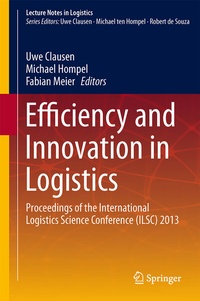
Efficiency and Innovation in Logistics
Proceedings of the International Logistics Science Conference (ILSC) 2013
1st Edition
Published on 16. August 2013
XII, 178 pages
978-3-319-01378-7 (ISBN)
Description

The importance of logistics in all its variations is still increasing. New technologies emerge, new planning methods and algorithms are developed, only to face a market with a growing complexity and the need of weighting monetary costs against ecological impact. Mastering these challenges requires a scientific viewpoint on logistics, but always with applications in mind.
This volume presents up-to-date logistics research in all its diversity and interconnectedness. It grew out of the "International Logistics Science Conference" (ILSC) held in Dortmund in September 2013, bringing together leading scientists and young academics from nine different countries. The conference was jointly organized by the "Efficiency Cluster Logistics" and the "Fraunhofer Institute for Material Flow and Logistics".
The Program Committee used a double blind review process to choose the 12 strongest contributions, which were then grouped in four areas:
- Sustainability logistics , including electric mobility, smart information, communication technologies and corporate social responsibility management
- Intralogistics , including the detection of autonomous vehicles, 3D computer vision and sensor functions for forklift trucks
- Transport logistics , including distribution centre organization, delivery performance in railway systems and logistics reference modelling
- Logistics facilities , including environmental impact of container ports, parcel sorting systems and model based systems engineering.
This volume presents up-to-date logistics research in all its diversity and interconnectedness. It grew out of the "International Logistics Science Conference" (ILSC) held in Dortmund in September 2013, bringing together leading scientists and young academics from nine different countries. The conference was jointly organized by the "Efficiency Cluster Logistics" and the "Fraunhofer Institute for Material Flow and Logistics".
The Program Committee used a double blind review process to choose the 12 strongest contributions, which were then grouped in four areas:
- Sustainability logistics , including electric mobility, smart information, communication technologies and corporate social responsibility management
- Intralogistics , including the detection of autonomous vehicles, 3D computer vision and sensor functions for forklift trucks
- Transport logistics , including distribution centre organization, delivery performance in railway systems and logistics reference modelling
- Logistics facilities , including environmental impact of container ports, parcel sorting systems and model based systems engineering.
More details
Series
Language
English
Place of publication
Cham
Switzerland
Publishing group
Springer International Publishing
Target group
Professional and scholarly
Product notice
Reflowable
Illustrations
XII, 178 p.
File size
5,61 MB
ISBN-13
978-3-319-01378-7 (9783319013787)
DOI
10.1007/978-3-319-01378-7
Schweitzer Classification
Other editions
Additional editions
Uwe Clausen | Michael ten Hompel | J. Fabian Meier
Efficiency and Innovation in Logistics
Proceedings of the International Logistics Science Conference (ILSC) 2013
Book
08/2015
Springer
€160.49
Shipment within 10-15 days
Uwe Clausen | Michael ten Hompel | J. Fabian Meier
Efficiency and Innovation in Logistics
Proceedings of the International Logistics Science Conference (ILSC) 2013
Book
08/2013
Springer
€160.49
Shipment within 10-15 days
Content
- Intro
- Preface
- Program Committee
- Organizing Committee
- Contents
- 317265_1_En_1_PartFrontmatter_OnlinePDF
- Part ISustainability Logistics
- 1 Electric Mobility in Last Mile Distribution
- Abstract
- 1.Introduction
- 2.Logistics Process Changes
- 3.Cost Implications
- 4.Sustainability Implications
- 5.Comprehensive Evaluation
- 6.Conclusions
- Acknowledgments
- References
- 2 Green Technologies and Smart ICT for Sustainable Freight Transport
- Abstract
- 1.Introduction
- 2.The SuperGreen Project
- 2.1 EU Corridor Baseline
- 2.2 Benchmark Objective
- 3.Benchmarking of Green Corridors with Green Technologies
- 3.1 Green Technology Survey and Qualitative Assessment
- 3.2 Benchmark Scenarios
- 3.3 Implementation of Exhaust Gas Abatement Systems in the Mare Nostrum Corridor
- 3.3.1 Green Technology Description
- 3.3.2 Benchmarking of Scrubbers on the Mare Nostrum Corridor
- 4.Benchmarking of Green Corridors with Smart ICT
- 4.1 Qualitative Assessment
- 4.2 Benchmark Scenarios
- 4.3 Implementation of Expert Charging ICT in the Brenner Corridor
- 4.3.1 General Description of Expert Charging ICT
- 4.3.2 Expert Charging ICT Status on Corridor
- 4.3.3 Benchmarking of Expert Charging ICT
- 5.Conclusions
- 5.1 Green Technologies and Corridors
- 5.2 Smart ICTs and Corridors
- Acknowledgments
- References
- 3 Corporate Social Responsibility Management of Small and Medium Sized Logistics Service Providers
- Abstract
- 1.Introduction
- 2.Summary of the Literature
- 3.Methodology
- 4.Main Findings
- 5.Discussion of Findings
- 6.Conclusion
- References
- Part IIIntralogistics
- 4 Collaborative Detection of Autonomous Transport Vehicles
- Abstract
- 1.Introduction and Motivation
- 2.Key Technologies
- 2.1 Wireless Sensor Network Synchronization
- 2.1.1 Precision Time Protocol Synchronization
- 2.1.2 Network Time Protocol Synchronization
- 2.1.3 Benchmark
- 2.2 Sensor Models
- 3.Computer Vision
- 3.1 Segmentation and Line Extraction
- 3.2 Object Extraction
- 3.3 Classification
- 3.4 Vehicle Detection
- 4.Evaluation
- 5.Discussion and Outlook
- References
- 5 3D-Computer Vision for Automation of Logistic Processes
- Abstract
- 1.Introduction
- 2.3D-Computer Vision
- 3.Object Recognition System
- 3.1 Offline Training Process
- 3.2 Online Recognition Process
- 4.Evaluation
- 4.1 Simulated Sensor Data
- 4.2 Real Sensor Data
- 5.Conclusion
- Acknowledgments
- References
- 6 ''Staplerauge'': A Framework for Camera-Based Sensor Functions on Forklift Trucks
- Abstract
- 1.Introduction
- 2.Software Framework
- 2.1 Architecture
- 2.1.1 Sensorfunction
- 2.1.2 Design Pattern for Image Processing
- 2.1.3 Image Acquisition: Sharing an Image Source
- 2.1.4 Integration of Cameras
- 2.1.5 Image Processing Methods
- 2.1.6 Concept of Use
- 2.1.7 Example
- 2.2 Development Environment
- 3.Demonstrators
- 3.1 Fork Height
- 3.2 Marker-Based Localization
- 4.Outlook
- Acknowledgments
- References
- Part IIITransport Logistics
- 7 Integrated System for Combining Decisional Problems in a Distribution Centre
- Abstract
- 1.Introduction
- 2.Problem Statement
- 3.Literature Review
- 3.1 Storage Location Assignment Problem
- 3.2 Order Picking
- 3.3 Truck--Dock Assignment
- 3.4 Workforce Assignment
- 3.5 Simulation
- 4.Methodology
- 4.1 Decision Problems
- 4.2 Priority Management
- 4.3 Simulation Model
- 5.Case Studies
- 5.1 Case I: Home Appliance Distribution Centre
- 5.2 Case II: Industrial Manufacturer
- 6.Results
- 6.1 Results for Case I
- 6.2 Results Case II
- 7.Conclusions
- Acknowledgments
- References
- 8 Measurement and Optimization of Delivery Performance in Industrial Railway Systems
- Abstract
- 1.Introduction
- 1.1 Literature Review
- 1.2 Methodology
- 2.Performance Measurement System
- 2.1 Process Analysis of Industrial Railway Systems
- 2.2 Performance Categories and Goals
- 2.2.1 Effectiveness
- 2.2.2 Efficiency
- 2.3 Railway-Specific Influences
- 3.Conclusions
- References
- 9 Development of a Logistics Reference Model for Subsurface Construction
- Abstract
- 1.Introduction
- 2.Reference Modeling
- 2.1 Systemization and Classification of Process Reference Models
- 3.Assessment of Logistics Reference Models
- 4.Logistics Reference Models and Their Application in Construction
- 4.1 Construction of Reference Model for Subsurface Construction
- 5.Conclusion and Outlook
- References
- Part IVLogistics Facilities
- 10 A Life-Cycle Approach to Characterizing Environmental Impact of Logistics Equipment in Container Ports: An Example of Yard Trucks
- Abstract
- 1.Introduction
- 2.Strategies to Mitigate Environmental Impacts of Yard Trucks
- 3.Life-Cycle Approach to Characterizing Environmental Impacts
- 4.Comparative LCA of Yard Trucks
- 4.1 Assumptions
- 4.2 LCA of Yard Trucks
- 5.Results
- 6.Conclusions
- Acknowledgments
- References
- 11 Throughput Maximization of Parcel Sorter Systems by Scheduling Inbound Containers
- Abstract
- 1.Introduction
- 2.Literature Review
- 3.Scheduling Inbound Containers
- 3.1 The Dynamic Load Balancing Algorithm
- 3.2 The Adapted-DLBA
- 4.Computational Studies
- 4.1 Experimental Setup
- 4.2 Results and Discussion
- 5.Conclusion
- References
- 12 Model Based Systems Engineering and Warehouse Design
- Abstract
- 1.Introduction
- 2.Warehouse Design Technology
- 3.MBSE and Warehouse Design
- 3.1 SysML and Domain Semantics
- 3.2 SysML, MBSE and Design Workflow
- 3.3 SysML and Design Semantics
- 4.Warehouse Design Decision Support
- 5.Integrating Design and Decision Support
- 6.Broader Impacts
- Acknowledgments
