

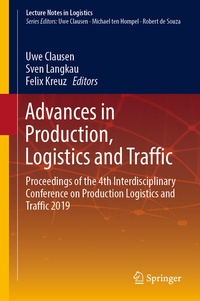
Advances in Production, Logistics and Traffic
Description

The series of Interdisciplinary Conferences on Production, Logistics and Traffic (ICPLT) address the research community as well as practitioners in these fields with special attention to links and interfaces between the three disciplines. The fourth ICPLT in particular deals with technology from intralogistics to automated trucking driving as well as the societal aspects of commercial transport.
To contribute to a high-level and beneficial exchange between authorities in politics and municipalities with researchers and practitioners in production and logistics management the ICPLT has asked for contributions from the three disciplines to better understand innovative technologies, best practises and latest results. These contributions have been evaluated and selected based on a double-blind review process to become part of this book. It comprises 21 contributions examining trends and challenges for commercial transport as the essential link for production, logistics and society. Therefore, innovative technologies and strategies are presented and discussed to better understand the interdependencies, conflicts of interest and to develop feasible solutions.
Topics
· Simulation & Optimization in Production and Logistics
· Freight Transport Demand Modelling
· Intralogistics & Logistics Facilities· Policy & Human Factors
· Production & Maintenance
· Supply Chain Management
· Sustainable Logistics & Energy
Target Groups
· Representatives of public authorities, municipalities & politics· Actors of sectoral, transport & spatial planning
· Actors of production & logistics
· Researchers in the disciplines production, logistics, transport & spatial planning
More details
Other editions
Additional editions
Persons
Content
- Intro
- Foreword
- Acknowledgements
- Scientific Committee of 4th ICPLT 2019
- Organization Committee of 4th ICPLT 2019
- Chair of 4th ICPLT 2019
- Contents
- Simulation of an Optimized Last-Mile Parcel Delivery Network Involving Delivery Robots
- 1 Introduction
- 2 Literature Review
- 2.1 Simulation of Urban Delivery
- 2.2 Optimization
- 3 Problem Description
- 4 Optimization
- 4.1 Truck Delivery Tour
- 4.2 Robot Parcel Tour
- 5 Simulation Model
- 5.1 Functional Requirements
- 5.2 Implementation
- 6 Experimentation and Results
- 7 Conclusion and Outlook
- References
- Stack Shuffling Optimization of Steel Bars by Using Genetic Algorithms
- Abstract
- 1 Introduction
- 2 Method for Reducing the Number of Necessary Reshuffles Using Genetic Algorithm
- 2.1 Heuristics for Selection of Reachable SSBs and Suitable Empty Slots
- 2.1.1 Heuristics for SSB Selection
- 2.1.2 Selection of an Empty Slot Heuristics
- 2.2 The Genetic Algorithm
- 3 Results
- 4 Conclusions
- References
- Decoupling the Modeling of Actions in Logistics Networks from the Underlying Simulation Data Model
- Abstract
- 1 Introduction
- 2 Related Work
- 2.1 Logistics Networks
- 2.2 Data in Logistics Networks
- 2.3 Database Systems
- 2.4 Logistics Assistance Systems
- 2.5 Logistics Assistance System for Wholesale Logistics Networks
- 3 Decoupling Actions from the Underlying Data Model
- 4 Implementation and Results
- 4.1 Nomenclature and Structure of the Enterprise-Specific Data Model
- 4.2 Extensibility and Interchangeability of the Underlying Simulation Data Model
- 5 Conclusion and Outlook
- References
- Agent-Based Simulation in Logistics and Supply Chain Research: Literature Review and Analysis
- Abstract
- 1 Introduction
- 2 Agent-Based Simulation
- 3 Methodology
- 3.1 Classification Framework
- 3.1.1 Problem Description
- 3.1.2 Modeling Approach
- 3.1.3 Maturity
- 4 Results
- 4.1 Distribution Among the Categories
- 5 Conclusion
- Acknowledgments
- References
- Acceptance of Technology Implementation in Industrial Intralogistics
- 1 Introduction
- 2 Acceptance
- 2.1 On the Concept of Acceptance
- 2.2 Core Elements of Acceptance
- 2.3 Dimensions of Acceptance
- 2.4 Models and Systematics for Acceptance
- 2.5 Factors Influencing the Formation of (in-)Acceptance
- 3 Concept and Method of the Research
- 4 Empirical Findings
- 4.1 Inform
- 4.2 Include
- 4.3 Intermingle
- 5 Outlook
- References
- Premises for Truck Sharing in General Cargo Cooperatives - An Exploratory Case Study Research
- Abstract
- 1 Motivation
- 1.1 Road Freight Transportation - An Industry Under Pressure
- 1.2 Road Freight Transportation - An Industry that Could Benefit of Sharing Economy Showcases
- 1.3 Truck Sharing - Providing the Industry a Versatile Range of Advantages
- 2 A Short Review of Relevant Literature Leading to the Research Gap
- 3 Methodology
- 4 Analysis
- 4.1 Mindset of Sharing Resources
- 4.2 Data Security
- 4.3 Legal Liability
- 4.4 Financial Contribution System
- 4.5 Reputation of the Sharing Platform
- 4.6 Trust in the Transaction Partner
- 4.7 Incentive Program
- 5 Results
- 5.1 Property-Requirements
- 5.2 Market-Requirements
- 5.3 Architecture-Requirements
- 6 Conclusion, Limitations and Outlook
- References
- Influence of a Reasonable Allocation of Pallets in the Pallet Exchange System
- Abstract
- 1 Introduction
- 2 State of Research
- 3 Modelling and Development of the Simulation Model
- 4 Results of the Simulation Study
- 5 Conclusion
- References
- Automated Trucks in Road Freight Logistics: The User Perspective
- Abstract
- 1 Introduction
- 2 Methodology of Interviews
- 3 The Results of the Interviews
- 3.1 The Need for Automation Technology
- 3.2 Potential Obstacles for Technology Adoption
- 3.3 Use Cases of Automated Vehicles
- 3.4 Conditions of the Technology Adoption in Logistic and Transport Services
- 4 Implications for Technology Manufacturers and Transport Policy
- Acknowledgement
- Appendix
- References
- The Impact of Driverless Vehicles on Transportation Costs in Road Haulage: A System Dynamical Approach
- Abstract
- 1 Introduction
- 2 System and Subject of the Study
- 3 The Theoretical Approach
- 4 The Simulation Model
- 5 Assumptions for the Simulation Model
- 6 Results of the Simulation
- 7 Conclusion
- References
- Standard Designs for Multifunctional Small and Medium-Sized Transhipment Sites
- Abstract
- 1 Introduction
- 2 Definitions
- 3 Literature Review
- 4 Structure and Methodology
- 5 Current Situation of Rail Freight in Switzerland
- 6 Market Requirements
- 6.1 Best Practices
- 6.2 Aggregated Demand Structures
- 6.3 Expert Interviews with Shippers
- 7 Requirements for Multifunctional Transhipment Sites
- 7.1 Transhipment and Storage Area
- 7.2 Infrastructures for Rail and Road Vehicles
- 7.3 Additional Logistics Services and Operational Equipment
- 7.4 Equipment for Measuring, Weighing and Safety
- 8 Example Module
- 8.1 Definition of the Modules
- 8.2 Example Design
- 9 Results and Conclusion
- References
- A Survey on the Potentials of Indoor Localization Systems in Production
- Abstract
- 1 Introduction
- 2 Fundamentals
- 2.1 Real-Time Indoor Localization System
- 2.2 Classification in the Value Creation Levels of the Internet of Things
- 3 Related Work
- 4 Exploration and Design
- 5 Evaluation: Potential Analysis and Genesis
- 5.1 Review Workshop
- 5.2 Five-Level-Model
- 6 Conclusion
- References
- Realization of ETA Predictions for Intermodal Logistics Networks Using Artificial Intelligence
- 1 Introduction
- 2 Market and Literature Review
- 3 Methodology
- 4 Results
- 4.1 Processes Analysis
- 4.2 Data Analysis
- 4.3 Disruption Analysis
- 4.4 Potential Analysis
- 4.5 Analysis of Application Cases
- 4.6 Requirement Analysis
- 4.7 Model Development
- 5 Conclusion
- Acknowledgments
- Appendix
- References
- Assessment of the Topology and Efficiency of a Railway Network: The Case of Deutsche Bahn
- Abstract
- 1 Introduction and Motivation
- 1.1 Transport and Logistics Networks as Small-World and Scale-Free Networks
- 1.2 The Case of Deutsche Bahn (DB)
- 2 The Analyses
- 2.1 Data Acquisition
- 2.2 Abstraction of the Networks
- 2.3 Indicators for Analysing the Networks
- 2.3.1 Average Shortest Path Length (L)
- 2.3.2 Clustering Coefficients (C) Here Transitivity
- 2.3.3 Network Density (d)
- 2.3.4 Power Law Coefficient (?)
- 2.3.5 The Efficiency of a Network
- 3 The Experiments and Their Results
- 3.1 Assessment of the Topology and Structure of the Networks
- 3.1.1 Average Shortest Path Length (L)
- 3.1.2 Clustering Coefficient (C) Here Transitivity
- 3.1.3 Network Density (D) and the Power-Law Coefficient (?)
- 3.2 A Brief Discussion
- 3.3 Assessment Based on Efficiency
- 3.3.1 Global Efficiency (EGlob) and Local Efficiency (ELoc)
- 3.3.2 A Brief Discussion
- 4 An Algorithm to Optimise a Network by Its Efficiencies
- 4.1 Results from the Algorithm
- 4.2 A Brief Discussion
- 5 Conclusions and Outlook
- References
- Forecast of Transport Demand Effects of Longer Trucks in Germany
- Abstract
- 1 Overview
- 2 Methods
- 2.1 Study Design
- 2.2 Model Approach
- 3 Modelling Results
- 4 Conclusion
- Acknowledgements
- References
- Delivery and Shipping Behaviour of Commercial Clients of the CEP Service Providers
- 1 Motivation
- 2 Research Objectives
- 3 State of the Art
- 4 Research Design of the Empirical Study
- 5 Descriptive Analysis of the Empirical Study
- 6 Conclusions and Outlook
- Acknowledgement
- Appendix
- References
- Urban Factories - Identification of Measures for Resource-Efficient Integration of Production Systems in Cities
- Abstract
- 1 Introduction
- 2 Methodology
- 2.1 Introduction of the "Resources of the Urban Factory"
- 2.2 Introduction of a Three-Level Model
- 2.3 Introduction of the "Factory-City-System"
- 3 Implementation
- 4 Summary and Outlook
- Acknowledgement
- References
- Implementation of Public Supply Chain Management: A Case Study of the Nelson Mandela Bay Municipality in South Africa
- Abstract
- 1 Introduction
- 2 Literature Review on Public Supply Chain Management in South Africa
- 3 Conceptual Model and Research Propositions
- 4 Methodology
- 5 Results of the Study
- 5.1 Biographic Information
- 5.2 Perceptions of Respondents Regarding the Implementation of Public Supply Chain Management in the Municipality
- 5.3 Correlation Analysis
- 5.4 Regression Analysis
- 5.4.1 The Relationship Between Public Supply Chain Management and Supply Chain Performance
- 5.4.2 The Relationship Between Public Supply Chain Management and Service Delivery
- 5.5 The Relationship Between Supply Chain Performance and Service Delivery
- 6 Conclusions and Managerial Implications
- 7 Limitations and Suggestions for Further Research
- References
- Complexity-Oriented Evaluation of Production Systems for Online-Switching of Autonomous Control Methods
- Abstract
- 1 Introduction
- 2 Complexity and Dynamics in Production and Logistics
- 3 Methods for Complexity-Oriented Evaluation of Production and Logistic Systems
- 4 Evaluation of Complexity Drivers in the Field of Autonomous Control
- 5 Conclusion and Outlook
- Acknowledgment
- References
- Using the Digital Shadow for a Prescriptive Optimization of Maintenance and Operation
- Abstract
- 1 Introduction
- 2 Motivation
- 2.1 Prognostics and Health Management
- 2.2 Forms of Data Analysis
- 2.3 Prescriptive Maintenance
- 3 State of Scientific Research
- 3.1 CPS and CPPS
- 3.2 Digital Twin and Digital Shadow
- 4 Conception of a Digital Twin of a Locomotive
- 4.1 Data Acquisition and Operation Adjustment
- 4.2 Digital Shadow
- 4.3 Digital Twin
- 5 Conclusion and Outlook
- References
- Reliable Power Supply for Smart Telematics in Freight Vehicles
- Abstract
- 1 Introduction
- 2 Requirements for Power Supply
- 3 Sensors
- 4 Wireless Communication Networks
- 5 Sources of Energy
- 6 Circuit Layout
- 7 Axle Generator Design
- 8 Battery Backup
- 9 Reliability Analysis
- 10 Conclusion
- Acknowledgments
- References
- Liquid Petroleum Gas Supply Chain Challenges in Rural Medical Facilities in Zimbabwe
- Abstract
- 1 Introduction and Background of the Study
- 2 Literature Review
- 2.1 The Extent of Liquid Petroleum Gas Use in Rural Medical Facilities
- 2.2 Strategies to Enhance the Effectiveness of Using Liquid Petroleum Gas in Vaccine Programs in Rural Medical Facilities
- 3 Research Methodology
- 3.1 Assumptions
- 3.2 Design and Sample
- 3.3 Procedures for Data Collection
- 4 Research Results
- 4.1 Demographic Profile of Respondents
- 4.2 Scale Reliability and Validity
- 4.3 Level of Adoption of Liquid Petroleum Gas
- 4.4 The Extent to Which the Procurement of Liquid Petroleum Gas Leads to the Achievement of Strategic Objectives
- 4.5 Major Supply Chain Challenges in the Liquid Petroleum Gas Industry in Zimbabwe
- 4.6 Significance of the Knowledge of Liquid Petroleum Gas Supply Chain Challenges
- 4.7 The Significance of Current Risks to Medical Facilities' Supply Chain
- 4.8 The Extent to Which Medical Facilities Are Affected by Supply Chain Problems
- 4.9 Effects of Liquid Petroleum Gas Supply Chain Disruptions
- 5 Conclusions and Managerial Implications
- References
- Author Index
