

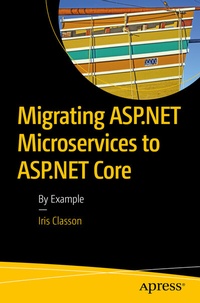
Migrating ASP.NET Microservices to ASP.NET Core
Description

Migrate your existing microservice cluster from ASP .NET to ASP .NET Core. While improved performance and cross-platform support are evident, this book helps you cut through the noise to determine how, when, and to what extent a migration is needed.
Microsoft's introduction of .NET Core has created a lot of excitement, but also a lot of confusion for developers accustomed to ASP applications and services. This book gives you specific steps to embark on a partial or full SaaS microservices system migration, factoring in limited resources, time, and finances. In addition to practical advice and real-world examples, many mishaps will be shared, providing you with a complete 360-degree view of a migration.
As a developer intimately familiar with the migration process, author Iris Classon shares prescriptive guidance on every part of the system-from code, dependencies, editors, integration, and the deployment pipeline to a distribution model. You will come away with all the information you need to plan and prepare your migration to ASP.NET Core.
What You'll Learn
-
Conduct an in-depth, pre-migration analysis of your system
-
Know the differences between ASP .NET and ASP .NET Core
-
Plan for and execute a full or partial migration to ASP .NET Core
-
Understand the continuous integration and deployment process
-
Gain insight on tools and templates that will accelerate and facilitate the migration process
-
Leverage a real-world migration example, complete with genuine challenges
- Migrate specific components such as logging, authentication, data access, and more
Who This Book Is For
Developers who are considering or are tasked with migrating an existing microservice cluster from ASP.NET to ASP.NET Core. Experience with C#, Web API, ASP.NET, Visual Studio, and PowerShell is helpful.More details
Other editions
Additional editions
Person
Iris Classon is a force of nature. Her unique and engaging methods of teaching complex topics have garnered her considerable respect from the developer community and a great deal of media attention-Channel 9, Hanselminutes, Computer Sweden, and Developer Magazine-just to name a few. She is a Microsoft MVP and holds multiple certifications. Currently a freelance developer with her company, In Love With Code LTD, Iris can be found consulting for large enterprises and working on back-end systems and operations for startups. She often speaks at conferences such as TechDays and NDC, and at user groups. Her passion for teaching code extends to her tweets @IrisClasson, her popular blog StackOverflow, MSDN, and a myriad of other social media sites.
Content
Chapter 1: The SaaS System in Question.- Chapter 2: Should We Migrate?.- Chapter 3: Phase 1: Analysis.- Chapter 4: Phase 2: Planning the Architecture.- Chapter 5: Phase 3: Migration.- Chapter 6: Phase 4: Upgrading the Deployment Pipeline.- Chapter 7: Maintenance and Resources.-
