

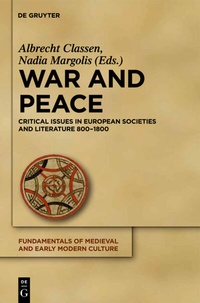
War and Peace
Description

The contributors to the present volume examine, from a wide variety of perspectives, the issues of war and peace in the Middle Ages and early modern time, probing the direction of the relevant discourse regarding the legitimacy and justification of military operations. Because man is a deeply aggressive and greedy creature, wars have been waged throughout times. Nevertheless, we can identify many voices in medieval literature, theology, philosophy, and in chronicle literature that questioned the validity and effectiveness of war, while many others argued for the traditional knightly ideals or called for crusades against the infidels. Those heroes who defend a people against an evil threat enjoyed profound respect, but there were also those figures calling for peace and the end of all fighting. As this volume demonstrates, war and peace have fundamentally determined medieval and early modern culture.
More details
Other editions
Additional editions
Persons
Content
2 - Introduction [Seite 10]
2.1 - A. Theoretical and Historical Reflections [Seite 10]
2.2 - B. Literary Case Studies [Seite 20]
2.3 - C. Criticism of War in Medieval Literature [Seite 24]
2.4 - D. Historical Voices Against War and Pragmatic Aspects of War [Seite 26]
2.5 - E. Attempts to Establish Peace and To Reach out for Toleration or Tolerance (?) [Seite 29]
2.6 - F. Severe Criticism of War [Seite 34]
2.7 - G. Philosophical Reflections Upon War [Seite 42]
2.8 - H. Research on War and Peace in the Middle Ages and the Early Modern Period [Seite 44]
2.9 - I. Intellectuals' Protest of and Analysis of War [Seite 46]
2.10 - J. Critical Summaries of the Contributions [Seite 55]
2.11 - K. Conclusion [Seite 84]
3 - Chapter 1. The Conquest of Sodom: Symbiosis of Calumny and Canon in the Jus Belli from Ireland to the Indies [Seite 90]
4 - Chapter 2. Just War in Anglo-Saxon England: Transmission and Reception [Seite 108]
5 - Chapter 3. Histories of Violence: The Origins of War in Beowulf [Seite 130]
6 - Chapter 4. Warlords and Diplomats in the Four Branches of the Mabinogi [Seite 164]
7 - Chapter 5. Origins of Medieval Public Opinion in the Peace of God Movement [Seite 180]
8 - Chapter 6. "A Compulsory and Burdensome Imposition": Billeting Troops in Medieval and Early Modern Ireland [Seite 202]
9 - Chapter 7. From Holy War to Patient Endurance: Henry IV, Matilda of Tuscany, and the Evolution of Bonizo of Sutri's Response to Heretical Princes [Seite 226]
10 - Chapter 8. Cligés Un-cut: Some Notes on the Battlefields in Chretien de Troyes Cligés [Seite 262]
11 - Chapter 9. Peace and Love: Communities and Couples in Old French Romance Plots [Seite 286]
12 - Chapter 10. Kiss and Make Up? Ritual Peacemaking in Frankish Morea and Its Narrative Reflections [Seite 302]
13 - Chapter 11. The Power of Sermons in War and Peace: The Example of Berthold of Regensburg [Seite 322]
14 - Chapter 12. Promoting Peace in Medieval Siena: Peacemaking Legislation and Its Effects [Seite 342]
15 - Chapter 13. A "Just War"? A Further Reassessment of the Alliterative Morte Arthure [Seite 358]
16 - Chapter 14. Waging Spiritual War: Philippe de Mézières, The Order of the Passion and the Power of Performance [Seite 386]
17 - Chapter 15. Christine de Pizan's Epistre a la reine: A Woman's Perspective on War and Peace? [Seite 404]
18 - Chapter 16. Armed Conflict as a Deadly Sin: Michel Beheim's Verses on Wrath (1454-ca.1470) [Seite 434]
19 - Chapter 17. Love and War in the Fifteenth-Century Burgundian Prose Cligés: The Duke of Saxony's Passion for Fenice [Seite 452]
20 - Chapter 18. Sailing Away from Byzantium: Renaissance Crusade Literature and the Peace Plans [Seite 472]
21 - Chapter 19 .The Art of Defying the Enemy: Albrecht Dürer s Concept of the Ars fortificatoria [Seite 500]
22 - Chapter 20. Sixteenth-Century Protests Against War and Its Tragic Consequences: The Testimony of Hans Sachs and His Contemporaries [Seite 526]
23 - Chapter 21. Racine's Holy Wars [Seite 550]
24 - Chapter 22. Out of the Kitchen and into the Fire: The Dutch Heroine Tradition [Seite 566]
25 - Chapter 23. The Animal Actor and the Spectacle of Warfare: Lewis's Timour the Tartar at Covent Garden [Seite 608]
26 - List of Illustrations [Seite 628]
27 - Contributors [Seite 632]
28 - Index [Seite 640]
