

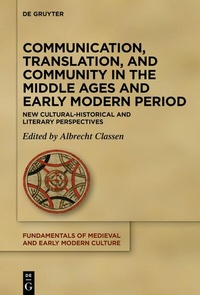
Communication, Translation, and Community in the Middle Ages and Early Modern Period
Description

Literature serves many purposes, and one of them certainly proves to be to convey messages, wisdom, and instruction, and this across languages, religions, and cultures. Beyond that, as the contributors to this volume underscore, people have always endeavored to reach out to their community members, that is, to build community, to learn from each other, and to teach. Hence, this volume explores the meaning of communication, translation, and community building based on the medium of language. While all these aspects have already been discussed in many different venues, the contributors endeavor to explore a host of heretofore less considered historical, religious, literary, political, and linguistic sources. While the dominant focus tends to rest on conflicts, hostility, and animosity in the pre-modern age, here the emphasis rests on communication with its myriad of challenges and potentials for establishing a community.
As the various studies illustrate, a close reading of communicative issues opens profound perspectives regarding human relationships and hence the social context. This understanding invites intensive collaboration between medical historians, literary scholars, translation experts, and specialists on religious conflicts and discourses. We also learn how much language carries tremendous cultural and social meaning and determines in a most sensitive manner the interactions among people in a communicative and community-based fashion.
More details
Other editions
Additional editions
Person
Albrecht Classen , University of Arizona, USA.
Content
- Intro
- Table of Contents
- List of Illustrations
- Introduction: An Essay on Language, Culture, and Identity: Medieval and Early Modern Perspectives on and Approaches to Communication, Translation, and Community
- Ways of Communication and Mis/communication in Abu Tammam's "Ode on the Conquest of Amorium" (838 C.E.)
- Proscribed Communication: The Obscene Language of the Troubadour William IX, Duke of Aquitaine and VII Count of Poitiers
- (Non)-Imaginary Ideal Communities in the Pre-Modern World: A Reading in the Utopian Works of al-Farabi', Ibn Khaldun, Christine de Pizan, and Thomas More
- A Jewish Moneylender, Miscommunication, and a Lie: Gonzalo de Berceo's Milagro no. 23
- Words, Signs, Meanings: William Langland's Piers Plowman as a Window on Linguistic Chaos
- The Chaucerian Translator
- Entertainment, Laughter, and Reflections as a Training Ground for Communication in Public and Private: The Case of Heinrich Kaufringer, ca. 1400
- .written in my own Jewish hand
- Demonic Operators: Forbidden Relations in Medieval Communication
- Paroemiac Expressions: A Touch of Color in the Ambassadors' Diplomatic Correspondence in the Fifteenth Century
- Communication and Translation in Early Modern Basque Society. The Role Played by the Public Notaries
- Preventing Miscommunication: Early Modern German Surgeons as Specialized Translators
- Reputation and Authority in the Physicians' Communication with Patients as Reflected in the Czech-Language Sources of the Early Modern Period
- The Physicians' Community in Pre-Thirty Years' War Bohemia
- A Bond of True Love: Performing Courtship and Betrothal in Gower's Cinkante balades and Spenser's Amoretti, in Light of Christine de Pizan's Cent balades
- Noble Friendship in Relation to the Community: Hamlet and The Merchant of Venice
- Deconstructing the (Mis)Interpretation of Paratextual Elements in Ross's English Translation of the Qur'an, The Alcoran of Mahomet (1649)
- Community and the Others: Unveiling Boundaries in Shakespeare's The Merchant of Venice
- Biographies of the Contributors
- Index
