

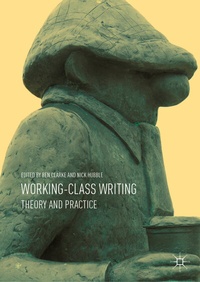
Working-Class Writing
Description

This book updates our understanding of working-class fiction by focusing on its continued relevance to the social and intellectual contexts of the age of Trump and Brexit. The volume draws together new and established scholars in the field, whose intersectional analyses use postcolonial and feminist ideas, amongst others, to explore key theoretical approaches to working-class writing and discuss works by a range of authors, including Ethel Carnie Holdsworth, Jack Hilton, Mulk Raj Anand, Simon Blumenfeld, Pat Barker, Gordon Burn, and Zadie Smith. A key informing argument is not only that working-class writing shows 'working class' to be a diverse and dynamic rather than monolithic category, but also that a greater critical attention to class, and the working class in particular, extends both the methods and objects of literary studies. This collection will appeal to students, scholars and academics interested in working-class writing and the need to diversify the curriculum.
More details
Other editions
Additional editions
Persons
Ben Clarke is Associate Professor of Post-1900 British Literature at the University of North Carolina, Greensboro, USA. He is author of Orwell in Context (2007) and co-author of Understanding Richard Hoggart (2011). He has published on subjects including public house and mining communities, and authors including Jack Hilton, H. G. Wells, Edward Upward, and Virginia Woolf.
Nick Hubble is Reader in English at Brunel University London, UK and the author of Mass Observation and Everyday Life (2006) and The Proletarian Answer to the Modernist Question (2017).
