

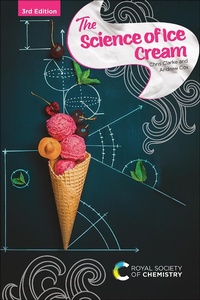
Science of Ice Cream
3rd Edition
Published on 24. July 2024
270 pages
978-1-83916-616-7 (ISBN)
Description

Ice cream as we recognize it today has been in existence for at least 300 years, though its origins probably go much further back in time. Before the development of refrigeration, ice cream was a luxury reserved for special occasions but its advance to commercial manufacture was helped by the first ice cream making machine patented by Nancy Johnson in Philadelphia in the 1840s.
The third edition of The Science of Ice Cream has been fully revised and updated with new material. The book still begins with the history of ice cream, subsequent chapters looking at the link between the microscopic and macroscopic properties and how these relate to the ultimate texture of the product you eat. A new chapter on non-dairy ice cream has been added and the book is completed with some suggestions for experiments relating to ice cream and how to make it at home or in a school laboratory.
The book has authenticity and immediacy, with a new co-author who is an active industrial practitioner, and is ideal for undergraduate food science students as well as those working in the food industry. It is also accessible to the general reader with a basic knowledge of science and provides teachers with ideas for using ice cream to illustrate scientific principles.
The third edition of The Science of Ice Cream has been fully revised and updated with new material. The book still begins with the history of ice cream, subsequent chapters looking at the link between the microscopic and macroscopic properties and how these relate to the ultimate texture of the product you eat. A new chapter on non-dairy ice cream has been added and the book is completed with some suggestions for experiments relating to ice cream and how to make it at home or in a school laboratory.
The book has authenticity and immediacy, with a new co-author who is an active industrial practitioner, and is ideal for undergraduate food science students as well as those working in the food industry. It is also accessible to the general reader with a basic knowledge of science and provides teachers with ideas for using ice cream to illustrate scientific principles.
More details
Edition
3rd edition
Language
English
Place of publication
Cambridge
United Kingdom
Product notice
Reflowable
ISBN-13
978-1-83916-616-7 (9781839166167)
DOI
10.1039/9781837673032
Copyright in bibliographic data and cover images is held by Nielsen Book Services Limited or by the publishers or by their respective licensors: all rights reserved.
Schweitzer Classification
Other editions
Additional editions
Chris Clarke | Andrew Cox
Science of Ice Cream
Book
07/2024
3rd Edition
Royal Society of Chemistry
€41.00
Shipment within 3-4 weeks
Previous edition
Chris Clarke | Andrew Cox
Science of Ice Cream
Book
07/2024
3rd Edition
Royal Society of Chemistry
€41.00
Shipment within 3-4 weeks
Persons
Chris Clarke has a degree and PhD in physics from Cambridge University. After post-doctoral work on the properties of polymers and colloids at surfaces and interfaces in Cambridge and at McGill University, Montreal, Chris joined Unilever first as a research scientist in the Ice Cream group, and then as a patent attorney responsible for Unilever's ice cream patents. He has given talks on ice cream science at various schools and universities, as well as at the Royal Institution, the Science Museum and the Cambridge Science Festival. Chris left Unilever in 2013, and currently works on formulations and devices for inhaled medicines, but retains an interest in ice cream.
Content
The Story of Ice Cream;Colloidal Dispersions, Freezing and Rheology;Ice Cream Ingredients;Making Ice Cream in the Factory;Product Assembly;Measuring Ice Cream;Ice Cream: A Complex Composite Material;Nutritional Aspects of Ice Cream Formulations;Experiments with Ice Cream and Ice Cream Products
