

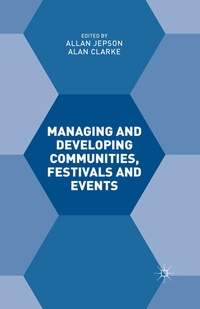
Managing and Developing Communities, Festivals and Events
1st Edition
Published on 29. April 2016
XIX, 241 pages
978-1-137-50855-3 (ISBN)
Description

The different stages of a festival's evolution provide a plethora of opportunities for us to better understand our culture, the relationships we build, what we value in our culture and our communities, and how we socialize and interact with one another. Managing and Developing Community Festivals and Events brings together community festival and event research from nine different countries. It critically explores how festivals and their communities develop and impact upon one another. The chapters focus on a wide range of festivals such as food and culinary festivals, art events, religious pilgrimage and feast festivals, as well as a variety of diverse themes such as joy, civil unrest, preservation of cultures and authenticity.
Reviews / Votes
"This book gathers a great number of research articles by a large number of scholars to give the reader a wide range of information. The book is easy to read because each chapter stands by itself. Together, though, they provide a wide-ranging look at diverse aspects of festivals and events. Many useful data can be found here, and further research can be made from case studies presented in book." (Dajana Lulic, Annals of Tourism Research, Issue 61, 2016)More details
Other editions
Additional editions
Allan Jepson | Alan Clarke
Managing and Developing Communities, Festivals and Events
Book
04/2016
Palgrave Macmillan
€90.94
The article will not be published
Alan Clarke | Allan Jepson
Managing and Developing Communities, Festivals and Events
Book
12/2015
Palgrave Macmillan
€160.49
Shipment within 10-20 days
Persons
Allan Jepson is a senior academic in Event Management & Tourism, and researcher within the Marketing Insight research Group (MIRU) at the University of Hertfordshire in the UK. Allan currently serves as a reviewer for the International Journal of Culture, Tourism & Hospitality Research, Marketing Intelligence and Planning and the Journal of Policy Research in Tourism, Leisure and Events. His research with Alan Clarke explores power, hegemony and decision making processes that produce community cultural events, community engagement within the planning process, and the impact that festivals and events have upon overall quality of life. Allan is also Vice-Chair for the Association of Events Management Education (AEME).
Alan Clarke is a Docens in the Faculty of Business and Economics at University of Pannonia, Hungary. He has been part of the research team undertaking a yearlong review and evaluation of the festivals and events in Veszprém for the Tourism Destination Management Organisation and is currently working on new offers, such as the Auer Festival. Previously he was the Assistant Dean in the Business School, and in the School of Tourism and Hospitality at the University of Derby, UK. He chaired the Derby Tourism Challenge Team, was Vice-Chair of the Derbyshire Tourism Partnership and was the founding chair of the Derbyshire and Peak District Sustainable Partnership.
Alan Clarke is a Docens in the Faculty of Business and Economics at University of Pannonia, Hungary. He has been part of the research team undertaking a yearlong review and evaluation of the festivals and events in Veszprém for the Tourism Destination Management Organisation and is currently working on new offers, such as the Auer Festival. Previously he was the Assistant Dean in the Business School, and in the School of Tourism and Hospitality at the University of Derby, UK. He chaired the Derby Tourism Challenge Team, was Vice-Chair of the Derbyshire Tourism Partnership and was the founding chair of the Derbyshire and Peak District Sustainable Partnership.
Content
PART I: INVESTIGATING MANAGEMENT PHILOSOPHIES, IDEAS, AND PRINCIPLES IN THE CONTEXT OF FESTIVALS, EVENTS, AND COMMUNITIES
1. An Introduction to Planning, design, and management of community festivals and events; Allan Jepson & Alan Clarke
2. Rising to the Challenge of Sustainable Community Events by the Community, For the Community; James Bostock, Richard Cooper & Gareth Roberts
3. Co-creating Places through Events. The Case of a Tourism Community Event in Finnish Lapland; Minni Haanpää, José-Carlos García-Rosell, & Seija Tuulentie
4. The motivations of event volunteers at local events; David Lamb & Alfred Ogle
5. Museum events as a tool for community and organisational development; Valery Gordin & Mariya Dedova
6. The 'Performance of an Easter festival on an island community: Bringing communities together or entertaining tourists?; Nigel Morpeth
7. Community Development through Public Art Event in Ratchaburi, Thailand; Sompong Amnuay-ngerntra
8. Understanding Stakeholder Status and Legitimate Power Exertion within Community Sport Events: A Case Study of the Christchurch (New Zealand) City to Surf; Rachel J. Batty
9. Events: cause or consequence of community involvement; Egbert van der Zee & Pepijn Olders
PART II: PLANNING AND MANAGING THE IMPACTS OF FESTIVALS, EVENTS, AND COMMUNITIES
10. The rediscovery of an ancient community event in a language minority village: the case of Bova (Italy); Sonia Ferrari & Pasquale Faenza
11. Indulgence feasts: manifestation of religious and communal identity; Darius Liutikas
12. Developing a Community Festival Amidst Civil Unrest; Adrian Devine, Frances Devine, & Clare Carruthers
13. Community Food Festivals and Events In The South West Of England, UK; Paul Cleave
14. Creating Joy Association: A Social Imperative; Neil Cameron & Steve Brown
15. Girona and its culinary events; Silvia Aulet and Joaquim Majó
16. Conclusions and future research agenda's in managing and developing communities, festivals, and events; Allan Jepson & Alan Clarke
1. An Introduction to Planning, design, and management of community festivals and events; Allan Jepson & Alan Clarke
2. Rising to the Challenge of Sustainable Community Events by the Community, For the Community; James Bostock, Richard Cooper & Gareth Roberts
3. Co-creating Places through Events. The Case of a Tourism Community Event in Finnish Lapland; Minni Haanpää, José-Carlos García-Rosell, & Seija Tuulentie
4. The motivations of event volunteers at local events; David Lamb & Alfred Ogle
5. Museum events as a tool for community and organisational development; Valery Gordin & Mariya Dedova
6. The 'Performance of an Easter festival on an island community: Bringing communities together or entertaining tourists?; Nigel Morpeth
7. Community Development through Public Art Event in Ratchaburi, Thailand; Sompong Amnuay-ngerntra
8. Understanding Stakeholder Status and Legitimate Power Exertion within Community Sport Events: A Case Study of the Christchurch (New Zealand) City to Surf; Rachel J. Batty
9. Events: cause or consequence of community involvement; Egbert van der Zee & Pepijn Olders
PART II: PLANNING AND MANAGING THE IMPACTS OF FESTIVALS, EVENTS, AND COMMUNITIES
10. The rediscovery of an ancient community event in a language minority village: the case of Bova (Italy); Sonia Ferrari & Pasquale Faenza
11. Indulgence feasts: manifestation of religious and communal identity; Darius Liutikas
12. Developing a Community Festival Amidst Civil Unrest; Adrian Devine, Frances Devine, & Clare Carruthers
13. Community Food Festivals and Events In The South West Of England, UK; Paul Cleave
14. Creating Joy Association: A Social Imperative; Neil Cameron & Steve Brown
15. Girona and its culinary events; Silvia Aulet and Joaquim Majó
16. Conclusions and future research agenda's in managing and developing communities, festivals, and events; Allan Jepson & Alan Clarke
