

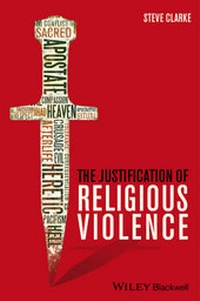
The Justification of Religious Violence
Justification of Religious Violence
Published on 6. March 2014
272 pages
978-1-118-52965-2 (ISBN)
Description

How are justifications for religious violence developed and dothey differ from secular justifications for violence? Can liberalsocieties tolerate potentially violent religious groups? Can thosewho accept religious justifications for violence be dissuaded fromacting violently? Including six in-depth contemporary case studies,The Justification of Religious Violence is the first book toexamine the logical structure of justifications of religiousviolence.
* The first book specifically devoted to examining the logicalstructure of justifications of religious violence
* Seeks to understand how justifications for religious violenceare developed and how or if they differ from ordinary secularjustifications of violence
* Examines 3 widely employed premises used in religiousjustifications of violence - 'cosmic war', theimportance of the afterlife, and 'sacred values'
* Considers to what extent liberal democratic societies shouldtolerate who hold that their religion justifies violent acts
* Reflects on the possibility of effective policy measures topersuade those who believe that violent action is justified byreligion, to refrain from acting violently
* Informed by recent work in psychology, cognitive science,neuroscience and evolutionary biology
* Part of the Blackwell Public Philosophy Series
Reviews / Votes
"How could anyone believe that they are justified inblowing up school busses or the World Trade Center? What role doesreligion play in their thinking? Steve Clarke illuminates thesecomplex and controversial issues with clarity and balance. Thisimportant book is highly recommended for all of us who wonder aboutthe relations between religion and violence." --Walter Sinnott-Armstrong, Duke University "Avoiding big claims about religion causing violence,Steve Clarke argues that many religiously-based justifications forviolence, far from being wildly irrational, are formally similar tothose commonly offered as secular justifications. Clear, veryreadable, and thoroughly researched, the book makes a valuablecontribution to one strand in the current debate about religion andviolence." --C.A.J. Coady, University of Melbourne "The heated debates over the relation between religion andviolence that burst onto the world's political andintellectual scene after 9/11 have spewed much foam and fury, butlittle fact or reason. Now, Stephen Clarke offers a sober yethumanistic analysis of how people justify violent acts in the nameof religion, showing how historically and cross-culturallypervasive these justifications are. Mostly, secular and religiousargument in support of violence proceeds much the same. Thedifference arises from three classes of premises that stem fromreligious metaphysics, and that transcend - and so resistcontradiction by - empirical evidence and reason: appeal tocosmic war, the afterlife, sacred values, or some combination ofthese three. Religion thus outperforms the secular in armingviolence, with conceptual resources both wider in scope and moreresistant to challenge. Fortunately, Clarke also shows us how thesesame religious assets can be used to lessen violence and resolveeven the most intractable conflicts: for example, throughunderstanding and leveraging knowledge of sacred values, andlearning how to reframe them, rather than by futilely trying to getopposing sides to ignore, abandon or compromise them." --Scott Atran, Directeur de Recherche, Anthropologie, CNRS/ Ecole Normale Supérieure, ParisMore details
Other editions
Additional editions
Steve Clarke
The Justification of Religious Violence
Book
04/2014
Wiley
€58.50
Shipment within 15-20 days
Steve Clarke
The Justification of Religious Violence
Book
04/2014
Wiley
€25.00
Shipment within 15-20 days
Person
Steve Clarke is a Senior Research Fellow in the Centre for Applied Philosophy and Public Ethics at Charles Sturt University in Australia, and a Senior Research Associate of the Uehiro Centre for Practical Ethics at the University of Oxford. He has published over sixty academic papers and is the author of Metaphysics and the Disunity of Scientific Knowledge (1998), and co-editor of three books including Religion, Intolerance and Conflict: a Scientific and Conceptual Investigation (with Russell Powell and Julian Savulescu, 2013).
Content
Preface
1 Justification, Religion, and Violence
2 Religion
3 Morality
4 Justifying Violence,War, and CosmicWar
5 The Afterlife
6 The Sacred
7 Recent Justifications of Religious Violence
8 Tolerance
9 Reducing Religious Violence
References
Index
