

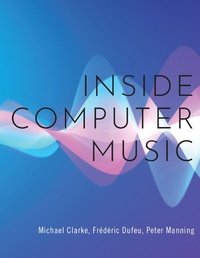
Inside Computer Music
1st Edition
Published on 15. September 2020
304 pages
978-0-19-065967-7 (ISBN)
Description

Inside Computer Music is an investigation of how new technological developments have influenced the creative possibilities of composers of computer music in the last 50 years. This book combines detailed research into the development of computer music techniques with nine case studies that analyze key works in the musical and technical development of computer music. The book's companion website offers demonstration videos of the techniques used and downloadable software. There, readers can view interviews and test emulations of the software used by the composers for themselves. The software also presents musical analyses of each of the nine case studies to enable readers to engage with the musical structure aurally and interactively.
More details
Other editions
Additional editions
Michael Clarke | Frederic Dufeu | Peter Manning
Inside Computer Music
Book
11/2020
Oxford University Press Inc
€50.70
Shipment within 15-20 days
Michael Clarke | Frederic Dufeu | Peter Manning
Inside Computer Music
Book
11/2020
Oxford University Press Inc
€144.80
Shipment within 15-20 days
Persons
Michael Clarke is Professor of Music at the University of Huddersfield, UK where he is currently Director of the IRiMaS project (Interactive Research in Music as Sound), funded by a European Research Council (ERC) Advanced Grant.
Frédéric Dufeu is Senior Research Fellow in Music and Music Technology at the University of Huddersfield and currently working on the IRiMaS project .
Peter Manning is Emeritus Professor of Music at Durham University.
Content
- Cover
- Inside Computer Music
- Contents
- Acknowledgments
- About the companion website
- Technology and Creativity in Computer Music
- Combining text and software to explore computer music from the inside
- The pursuit of new perspectives in the analysis of electronic and computer music
- Nine case studies from the history of computer music
- 1 John Chowning: Stria
- Contexts for Stria
- Max Mathews and the beginnings of software for computer music
- Jean-?Claude Risset and timbral synthesis
- John Chowning and the evolution of FM synthesis
- Inside Stria
- The golden ratio
- Timbre and FM synthesis in Stria
- The golden ratio in the context of FM synthesis
- Stria's synthesis algorithm
- The shape of Stria
- Conclusions
- 2 Barry Truax: Riverrun
- Contexts for Riverrun
- The birth and early development of granular synthesis
- Inside Riverrun
- Riverrun: Technique, form, and structure
- Granular synthesis in Riverrun and the GSX system
- Tape techniques
- Spatialization in Riverrun
- Sections and streams
- Conclusions
- 3 Philippe Manoury: Pluton
- Contexts for Pluton
- First steps in the development of technologies for live computer music
- The pioneering contributions of IRCAM
- The development of the IRCAM 4X synthesizer
- Philippe Manoury: The background to the composition of Pluton
- Inside Pluton
- The global form and materials of Pluton
- Constitution of the digital environment for the performance of Pluton
- Mapping the piano performance to the real-?time environment
- The interactions between the piano and the computer through the musical work
- Conclusions
- 4 Hildegard Westerkamp: Beneath the Forest Floor
- Contexts for Beneath the Forest Floor
- The World Soundscape Project and the evolution of soundscape composition
- New directions in the development of the World Soundscape Project
- Hildegard Westerkamp and her influences on soundscape composition
- Inside Beneath the Forest Floor
- Recording as part of the creative process
- Field recording locations in British Columbia
- The raw materials of Beneath the Forest Floor
- Digitally processing the environmental sources
- Assembling the processed sound files into premixes
- The environmental materials through the structure of Beneath the Forest Floor
- Conclusions
- 5 Francis Dhomont: Phonurgie
- Contexts for Phonurgie
- Background and early career
- Musique concrète and the birth of Groupe de Recherches Musicales (GRM)
- New directions for GRM: From analog to digital
- The birth of SYTER
- Dhomont, Quebec, and GRM
- A final homage to musique concrète within Dhomont's Cycle du son
- Inside Phonurgie
- The materials of Phonurgie
- The sound sources
- Processing the sound sources
- The structure of Phonurgie
- Conclusions
- 6 Trevor Wishart: Imago
- Contexts for Imago
- The Composers Desktop Project
- The development of Sound Loom as a composing resource
- Inside Imago
- From a single source to a variety of processed sound files
- Successive Sound Loom processes
- Assembling the work
- The Opening of Imago
- The Gamelan section
- The large-?scale structure of Imago
- Conclusions
- 7 Jonathan Harvey: Fourth String Quartet
- Contexts for the Fourth String Quartet
- First steps exploring the possibilities of electronic and computer music
- The IRCAM dimension
- Inside the Fourth String Quartet
- Inspiration and structure
- Acoustic compositional techniques
- Electroacoustic techniques
- Performing the electroacoustic part of the Fourth String Quartet
- Summary of the integration of acoustic writing and electronics
- Conclusions
- 8 Cort Lippe: Music for Tuba and Computer
- Inside Music for Tuba and Computer
- General form and materials
- The digital environment for the performance of Music for Tuba and Computer
- Global control of the digital environment
- Instrumental and electronic interactions through Music for Tuba and Computer
- Conclusions
- 9 Natasha Barrett: Hidden Values-?The Lock
- Contexts for Hidden Values-?The Lock
- The early evolution of spatial technologies
- The development of sound diffusion systems for performance
- John Chowning
- Surround sound techniques
- Ambisonics
- The IRCAM Spatializer (Spat)
- Vector base amplitude panning (VBAP)
- Natasha Barrett and spatial projection
- Inside Hidden Values-?The Lock
- The musical materials of The Lock
- Barrett's software environment for the playback and spatialization of materials
- Three-?dimensional positioning and movements operated by IRCAM's Spatialisateur
- Spatialization and dramatization in the structure of The Lock
- Conclusions
- Conclusion
- Notes
- Bibliography
- Index
