

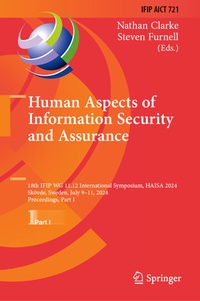
Human Aspects of Information Security and Assurance
Description

The two-volume set IFIP AICT 721 + 722 constitutes the proceedings of the 18th IFIP WG 11.12 International Symposium on Human Aspects of Information Security and Assurance, HAISA 2024, held in Skövde, Sweden, in July 9-11, 2024.
The 39 full papers presented were carefully reviewed and selected from 55 submissions. The papers are organized in the following topical sections:
Part I - Management and Risk; Social Engineering; Technical Attacks and Defenses; Usable Security.
Part II - Awareness and Education; Privacy.
More details
Other editions
Additional editions
Content
.- Management & Risk.
.- Employee Motivation in Organizational Cybersecurity: Matching Theory and Reality.
.- Information security behavioural threshold analysis: An application in the South African retail sector.
.- Scoping Review: The Landscape of Digital Risks and Cybersecurity Solutions for Journalists.
.- A Diary Study to Understand Young Saudi Adult Users' Experiences of Online Security Threats.
.- Investigating the Factors Influencing Individuals' Self-Sovereign Identity Adoption Intentions.
.- "There is a Damn Hello on the Social Media!" Insights into Public Risk Communication in the Digital Age.
.- A Profile-Based Cyber Security Readiness Assessment Framework at Country Level.
.- To risk analyse, or not to risk analyse: That's the question.
.- Information Security and Privacy Challenges Related to Personal eHealth Services - A Literature Review.
.- Information Security Management in Digitized Identity Systems The Case of the Ghanaian National Identification Authority (NIA).
.- Assessing Cyber Security Support for Small and Medium-Sized Enterprises.
.- Social Engineering.
.- A Systematic Task and Knowledge-Based Process to Tune Cybersecurity Training to User Learning Groups: Application to Email Phishing Attacks.
.- Defining Measures of Effect for Disinformation Attacks.
.- Phish and Tips:Phishing Awareness and Education for Older Adults.
.- Literature Review: Misconceptions about Phishing.
.- Technical Attacks & Defenses.
.- Linux Kernel Keyloggers and Information Security.
.- The Perceived Barriers to the Adoption of Blockchain in Addressing Cybersecurity Concerns in the Financial Services Industry.
.- An Interdisciplinary Thematic Analysis of the US National Guard Bureau Response to the SolarWinds Attack.
.- Research Agenda for Speaker Authentication.
.- Usable Security.
.- A Unified Privacy and Permission Management Framework.
.- Understanding users' mental models of Federated Identity Management (FIM): use of a new tangible elicitation method.
.- Multi-factor authentication adoption: A comparison between digital natives and digital immigrants in Sweden.
.- Discerning Challenges of Security Information and Event Management (SIEM) Systems in Large Organizations.
.- Assessing the Cybersecurity Needs and Experiences of Disabled Users.
