

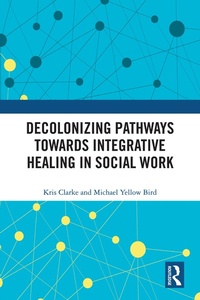
Decolonizing Pathways towards Integrative Healing in Social Work
1st Edition
Published on 1. October 2020
208 pages
978-1-351-84627-1 (ISBN)
Description

Taking a new and innovative angle on social work, this book seeks to remedy the lack of holistic perspectives currently used in Western social work practice by exploring Indigenous and other culturally diverse understandings and experiences of healing.
This book examines six core areas of healing through a holistic lens that is grounded in a decolonizing perspective. Situating integrative healing within social work education and theory, the book takes an interdisciplinary approach, drawing from social memory and historical trauma, contemplative traditions, storytelling, healing literatures, integrative health, and the traditional environmental knowledge of Indigenous Peoples.
In exploring issues of water, creative expression, movement, contemplation, animals, and the natural world in relation to social work practice, the book will appeal to all scholars, practitioners, and community members interested in decolonization and Indigenous studies.
This book examines six core areas of healing through a holistic lens that is grounded in a decolonizing perspective. Situating integrative healing within social work education and theory, the book takes an interdisciplinary approach, drawing from social memory and historical trauma, contemplative traditions, storytelling, healing literatures, integrative health, and the traditional environmental knowledge of Indigenous Peoples.
In exploring issues of water, creative expression, movement, contemplation, animals, and the natural world in relation to social work practice, the book will appeal to all scholars, practitioners, and community members interested in decolonization and Indigenous studies.
More details
Edition
1. Auflage
Language
English
Place of publication
London
United Kingdom
Publishing group
Taylor & Francis Ltd
Target group
College/higher education
Product notice
Reflowable
File size
2,06 MB
ISBN-13
978-1-351-84627-1 (9781351846271)
Copyright in bibliographic data and cover images is held by Nielsen Book Services Limited or by the publishers or by their respective licensors: all rights reserved.
Schweitzer Classification
Other editions
Additional editions
Kris Clarke | Michael Yellow Bird
Decolonizing Pathways towards Integrative Healing in Social Work
Book
04/2022
1st Edition
Routledge
€65.10
Shipment within 15-20 days
Kris Clarke | Michael Yellow Bird
Decolonizing Pathways towards Integrative Healing in Social Work
Book
10/2020
1st Edition
Routledge
€216.30
Shipment within 15-20 days
Book
10/2020
Taylor & Francis
Unfortunately, price unknown
Available (delivery time upon request)
Persons
Kris Clarke is Associate Professor at the University of Helsinki, Faculty of Social Sciences. She is a queer Irish American who has held faculty appointments at the University of Tampere, Finland, and California State University, Fresno. She has worked in the field of advocacy with migrants living with HIV in the European Union. She has also organized several social memory projects to develop dialogues between community members and students. Her research focuses on structural social work, social memory, LGBTQ+ issues in social work, and harm reduction. A portfolio of her work can be seen at www.krisclarke.net.
Michael Yellow Bird is Dean and Professor of the Faculty of Social Work at the University of Manitoba. He is a member of the MHA (Mandan, Hidatsa, and Arikara) Nation in North Dakota, USA. He has held faculty appointments at the University of British Columbia, University of Kansas, Arizona State University, Humboldt State University, and North Dakota State University. His research focuses on the effects of colonization and methods of decolonization, ancestral health, Indigenous mindfulness and contemplative practices, and the cultural significance of rez dogs. He is the author of numerous scholarly articles, book chapters, research reports, and co-editor of four books, including Indigenous Social Work around the World: Towards Culturally Relevant Education and Practice (Routledge, 2010).
Michael Yellow Bird is Dean and Professor of the Faculty of Social Work at the University of Manitoba. He is a member of the MHA (Mandan, Hidatsa, and Arikara) Nation in North Dakota, USA. He has held faculty appointments at the University of British Columbia, University of Kansas, Arizona State University, Humboldt State University, and North Dakota State University. His research focuses on the effects of colonization and methods of decolonization, ancestral health, Indigenous mindfulness and contemplative practices, and the cultural significance of rez dogs. He is the author of numerous scholarly articles, book chapters, research reports, and co-editor of four books, including Indigenous Social Work around the World: Towards Culturally Relevant Education and Practice (Routledge, 2010).
Content
Introduction. 1. Grounding Modern Social Work. 2. Postcolonial Trauma and Memory Work. 3. Confronting Professional Imperialism and Moving Towards Integrative Healing. 4. Water. 5. Creative Expression. 6. Movement. 7. Quiet and Contemplation. 8. Fellow Creatures. 9. Mother Earth. Epilogue: Dreaming a Decolonized Futurity. Discussion Guide.
