

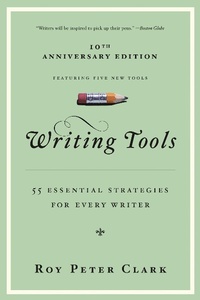
Writing Tools
55 Essential Strategies for Every Writer
Published on 10. January 2008
272 pages
978-0-316-02840-0 (ISBN)
Description

A special 10th anniversary edition of Roy Peter Clark's bestselling guide to writing, featuring five bonus tools.
Ten years ago, Roy Peter Clark, America's most influential writing teacher, whittled down almost thirty years of experience in journalism, writing, and teaching into a series of fifty short essays on different aspects of writing. In the past decade, Writing Tools has become a classic guidebook for novices and experts alike and remains one of the best loved books on writing available.
Organized into four sections, "Nuts and Bolts," "Special Effects," "Blueprints for Stories," and "Useful Habits," Writing Tools is infused with more than 200 examples from journalism and literature. This new edition includes five brand new, never-before-shared tools.
Accessible, entertaining, inspiring, and above all, useful for every type of writer, from high school student to novelist, Writing Tools is essential reading.
Ten years ago, Roy Peter Clark, America's most influential writing teacher, whittled down almost thirty years of experience in journalism, writing, and teaching into a series of fifty short essays on different aspects of writing. In the past decade, Writing Tools has become a classic guidebook for novices and experts alike and remains one of the best loved books on writing available.
Organized into four sections, "Nuts and Bolts," "Special Effects," "Blueprints for Stories," and "Useful Habits," Writing Tools is infused with more than 200 examples from journalism and literature. This new edition includes five brand new, never-before-shared tools.
Accessible, entertaining, inspiring, and above all, useful for every type of writer, from high school student to novelist, Writing Tools is essential reading.
More details
Other editions
Additional editions
Book
09/2006
Little, Brown & Company
€41.03
Article exhausted; check for reprint
Person
Roy Peter Clark is senior scholar at the Poynter Institute, one of the most prestigious schools for journalists in the world. He has taught writing at every level -- from schoolchildren to Pulitzer Prize-winning authors -- for more than forty years.
A writer who teaches and a teacher who writes, he has authored or edited nineteen books on writing and journalism, including The Art of X-Ray Reading, How to Write Short, Writing Tools, The Glamour of Grammar, and Help! for Writers. He lives in St. Petersburg, Florida, where he is considered a garage-band legend.
A writer who teaches and a teacher who writes, he has authored or edited nineteen books on writing and journalism, including The Art of X-Ray Reading, How to Write Short, Writing Tools, The Glamour of Grammar, and Help! for Writers. He lives in St. Petersburg, Florida, where he is considered a garage-band legend.
Content
- Intro
- Title Page
- Copyright
- Welcome
- Table of Contents
- Dedication
- Preface to the Tenth Anniversary Edition
- Introduction: A Nation of Writers
- Part One. NUTS AND BOLTS
- 1. Begin sentences with subjects and verbs.
- 2. Order words for emphasis.
- 3. Activate your verbs.
- 4. Be passive-aggressive.
- 5. Watch those adverbs.
- 6. Take it easy on the -ings.
- 7. Fear not the long sentence.
- 8. Establish a pattern, then give it a twist.
- 9. Let punctuation control pace and space.
- 10. Cut big, then small.
- Part Two. SPECIAL EFFECTS
- 11. Prefer the simple over the technical.
- 12. Give key words their space.
- 13. Play with words, even in serious stories.
- 14. Get the name of the dog.
- 15. Pay attention to names.
- 16. Seek original images.
- 17. Riff on the creative language of others.
- 18. Set the pace with sentence length.
- 19. Vary the lengths of paragraphs.
- 20. Choose the number of elements with a purpose in mind.
- 21. Know when to back off and when to show off.
- 22. Climb up and down the ladder of abstraction.
- 23. Tune your voice.
- Part Three. BLUEPRINTS
- 24. Work from a plan.
- 25. Learn the difference between reports and stories.
- 26. Use dialogue as a form of action.
- 27. Reveal traits of character.
- 28. Put odd and interesting things next to each other.
- 29. Foreshadow dramatic events and powerful conclusions.
- 30. To generate suspense, use internal cliffhangers.
- 31. Build your work around a key question.
- 32. Place gold coins along the path.
- 33. Repeat, repeat, and repeat.
- 34. Write from different cinematic angles.
- 35. Report and write for scenes.
- 36. Mix narrative modes.
- 37. In short works, don't waste a syllable.
- 38. Prefer archetypes to stereotypes.
- 39. Write toward an ending.
- Part Four. USEFUL HABITS
- 40. Draft a mission statement for your work.
- 41. Turn procrastination into rehearsal.
- 42. Do your homework well in advance.
- 43. Read for both form and content.
- 44. Save string.
- 45. Break long projects into parts.
- 46. Take an interest in all crafts that support your work.
- 47. Recruit your own support group.
- 48. Limit self-criticism in early drafts.
- 49. Learn from your critics.
- 50. Own the tools of your craft.
- Part Five. BONUS TOOLS
- 51. Take advantage of narrative numbers.
- 52. Express your best thought in the shortest sentence.
- 53. Match your diction to your writing purpose.
- 54. Create a mosaic of detail to reveal character.
- 55. Look for the "inciting incident" to kick-start your story.
- Afterword
- Acknowledgments
- Discover More
- Writing Tools Quick List
- About the Author
- Also by Roy Peter Clark
- In Praise of Roy Peter Clark's "Writing Tools
- A Preview of "The Art of X-Ray Reading
