

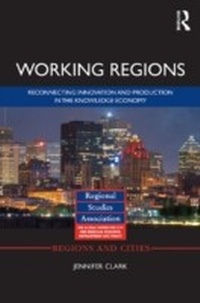
Working Regions
Reconnecting Innovation and Production in the Knowledge Economy
1st Edition
Published on 29. May 2013
216 pages
978-1-135-92384-6 (ISBN)
Description

Working Regions focuses on policy aimed at building sustainable and resilient regional economies in the wake of the global recession. Using examples of four 'working regions' - regions where research and design functions and manufacturing still coexist in the same cities - the book argues for a new approach to regional economic development. It does this by highlighting policies that foster innovation and manufacturing in small firms, focus research centers on pushing innovation down the supply chain, and support dynamic, design-driven firm networks.
This book traces several key themes underlying the core proposition that for a region to work, it has to link research and manufacturing activities - namely, innovation and production - in the same place. Among the topics discussed in this volume are the issues of how the location of research and development infrastructure produces a clear role of the state in innovation and production systems, and how policy emphasis on pre-production processes in the 1990s has obscured the financialization of intellectual property. Throughout the book, the author draws on examples from diverse industries, including the medical devices industry and the US photonics industry, in order to illustrate the different themes of working regions and the various institutional models operating in various countries and regions.
This book traces several key themes underlying the core proposition that for a region to work, it has to link research and manufacturing activities - namely, innovation and production - in the same place. Among the topics discussed in this volume are the issues of how the location of research and development infrastructure produces a clear role of the state in innovation and production systems, and how policy emphasis on pre-production processes in the 1990s has obscured the financialization of intellectual property. Throughout the book, the author draws on examples from diverse industries, including the medical devices industry and the US photonics industry, in order to illustrate the different themes of working regions and the various institutional models operating in various countries and regions.
Reviews / Votes
Jennifer Clark's Working Regions is a timely and welcome addition to the growing literature discussing the new developments required in regional economic policies in order to construct resilient working regions capable of responding to exogenous shocks. The book addresses some of the key themes current in economic geography, including the links between proximity and innovation, and highlights some of the rethinking of regional development policy options that has been taking place recently, and particularly in the light of experiences in the aftermath 2008 global financial crisis. For the broader scope of issues, this is a book that can easily be of interest to economists, geographers, policy scientists and other social scientists. It illustrates each of the issues raised on the basis of real case studies and specific examples. There is a wealth of information and evidence provided spanning issues of technology and institutions, as well as detailed insights into the workings of particular sectors including photonics and apparel, all of which is brought together to underpin the book's main contentions.Raquel Ortega-Argiles
University of Groningen, Groningen, the Netherlands
This review appeared in the journal Regional Studies.
More details
Series
Language
English
Place of publication
London
United Kingdom
Publishing group
Taylor & Francis Ltd
Target group
College/higher education
Product notice
Reflowable
Illustrations
4 s/w Abbildungen, 8 s/w Tabellen, 4 s/w Zeichnungen
8 Tables, black and white; 4 Line drawings, black and white; 4 Illustrations, black and white
File size
1,59 MB
ISBN-13
978-1-135-92384-6 (9781135923846)
Copyright in bibliographic data and cover images is held by Nielsen Book Services Limited or by the publishers or by their respective licensors: all rights reserved.
Schweitzer Classification
Other editions
Additional editions
Book
05/2014
1st Edition
Routledge
€75.50
Shipment within 10-20 days
Book
05/2013
1st Edition
Routledge
€222.84
Shipment within 15-20 days
Person
Jennifer Clark is Associate Professor at Georgia Institute of Technology, USA. She writes, consults, and speaks on the subject of national and regional development policies related to innovation and manufacturing, and the effect of those policies on cities and their economic competitiveness. Her book Remaking Regional Economies: Power, Labor, and Firm Strategies in the Knowledge Economy, a collaboration with Susan Christopherson, won the Best Book Award from the Regional Studies Association in 2009 and is also published by Routledge.
Content
1. Working Regions: Regeneration by design 2. The Spatial Distribution of Advanced Manufacturing 3. The Rise of the Research Center: The nexus between national innovation policies and regional development 4. The Trade in Innovation: The evolution of intellectual property markets 5. Hidden in Plain Sight: The North American optics and photonics industry 6. Working Regions in Practice: Apparel and outdoor equipment and medical devices industries 7. Flexible Specialization 2.0: The design + build approach to working regions
