

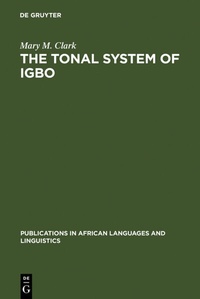
The Tonal System of Igbo
Tonal System of Igbo
1st Edition
Published on 20. September 2011
XI, 323 pages
978-3-11-086909-5 (ISBN)
Description

No detailed description available for "The Tonal System of Igbo".
More details
Series
Edition
Reprint 2011
Language
English
Place of publication
Berlin/Boston
Germany
Publishing group
de Gruyter Mouton
Target group
Professional and scholarly
US School Grade: College Graduate Student
Illustrations
Num. figs.
Num. figs.
File size
7,28 MB
ISBN-13
978-3-11-086909-5 (9783110869095)
Schweitzer Classification
Other editions
Additional editions
Mary M. Clark
The Tonal System of Igbo
Book
01/1990
1st Edition
De Gruyter Mouton
€169.95
Article exhausted; check different version
Mary M. Clark
The Tonal System of Igbo
Book
01/1990
1st Edition
De Gruyter Mouton
€119.95
Shipment within 7-9 days
Content
- Intro
- ACKNOWLEDGMENTS
- Chapter 1: INTRODUCTION
- 1. Overview
- 2. An Introduction to Igbo
- 2.1. Syntax
- 2.2. Morphology
- 2.3. Phonology
- Notes to Chapter 1
- Chapter 2: THE NATURE OF THE TONAL REPRESENTATION
- 1. The Separation of the Tonal and non-Tonal Features
- 2. Underspecification in Underlying Representation
- 2.1. The Underlying Representation
- 2.2. Default Tone Assignment
- 2.3. Assignment of Tone by Tonal Affixes
- 2.4. A Comparison with Previous Analyses
- 2.5. Potential Problems
- 3. The Phonological Representation of Downstep
- 3.1. The Distribution of Downstep
- 3.2. The Rule of H Deletion
- 3.3. Downstep and Downdrift
- 3.4. A Comparison with Other analyses
- 4. Conclusion
- 5. Rule Summary
- Notes to Chapter 2
- Chapter 3: THE ORGANIZATION OF THE LEXICAL PHONOLOGY
- 1. Introduction
- 2. Cyclicity
- 3. The Word Level
- 4. The Root and Stem Levels
- 4.1. The Argument from Morphological Ordering
- 4.2. The Argument from ATR Harmony
- 4.3. Palatalization
- 5. The Organization of the Lexical Phonology
- 6. Strict Cyclicity
- 6.1. Introduction
- 6.2. Strict Cyclicity in Reduplicated Nouns
- 7. Rule Ordering
- 7.1. Ordering Relationships That Follow from the Level Ordering
- 7.2. Ordering Relationships That Follow from the Cyclical Application of Rules
- 7.3. Ordering That Follows from a "Feeding" Relationship Between Rules
- 7.4. Ordering by the Elsewhere Condition
- 7.5. Positive Advantages of Free Ordering Within the Level
- 8. Conclusion
- 9. Rule Summary
- Notes to Chapter 3
- Chapter 4: THE PHRASAL PHONOLOGY
- 1. Introduction
- 2. Two Phrasal Levels
- 2.1. H Deletion
- 2.2. Vowel Assimilation
- 2.3. Phrase Level I and Phrase Level II
- 2.4. Falling Contour Simplification
- 2.5. Middle H Deletion
- 3. he Role of Syntactic Structure in the Postlexical Phonology
- 3.1. Syntactic Structure in Phonological Rules
- 3.2. The Branching Condition
- 4. The Role of Prosodic Structure in the Phrasal Phonology
- 4.1. Intonational Phrasing
- 4.2. The Lack of Evidence for Other Levels of Prosodic Structure
- 5. Coalescence and Syllable Shortening
- 5.1. Coalescence
- 5.2. Feature Sharing and Long Syllable Shortening
- 6. On Conditions of the Form "X is Unspecified for [F]"
- 7. Conclusion
- 8. Rule Summary
- Notes to Chapter 4
- Chapter 5: VERBS AND VERBAL CONSTRUCTIONS
- 1. Introduction
- 2. The Inflectional Morphology of the Verb
- 2.1. The Inflectional Affixes
- 2.2. The Assignment of Inflectional Features
- 3. The Tonal Melody of the Verb
- 4. The [+ASSERTIVE] INFL Particle
- 5. The Tonal Alternation in the NP That Follows the Verb
- 6. The Subject Prefixes
- 7. The Relative Clause Forms
- 8. The "Question" Forms
- 9. The Sequential Forms
- 10. Auxiliary Verbs
- 11. The Structure of INFL
- 12. Conclusion
- Notes to Chapter 5
- Chapter 6: THE LEXICAL PHONOLOGY OF NOUNS
- 1. Morphology
- 2. The Tonology of Nouns with Monosyllabic Roots
- 3. Polysyllabic Nouns
- 3.1. Nouns Formed by the Lexicalization of Phrases
- 3.2. Nouns Formed from Compound Verb Stems
- 3.3. Nouns Formed by Reduplication
- 3.4. Nouns Formed with the Nominalizing Suffix -lV or -rV
- 3.5. Nouns Formed by Compounding
- 4. Conclusion
- Notes to Chapter 6
- Chapter 7: THE ASSOCIATIVE CONSTRUCTION
- 1. Introduction
- 2. The Syntactic Status of the Associative Particle
- 3. The Phonological Effects of the Associative Particle
- 3.1. The Associative Forms of Nouns with Monosyllabic Stems
- 3.2. Associative Marking in Polysyllabic Nouns
- 3.3. Associative Marking in Nouns that Begin with Geminate Nasals
- 3.4. Agentives and Personal Name Possessives
- 3.5. Cardinal Numerals
- 3.6. Monosyllabic Possessive Pronouns
- 4. Conclusion
- Notes to Chapter 7
- Chapter 8: CONCLUSION
- Notes to Chapter 8
- Appendix I: Maps
- Appendix II: Summary of Principles
- Appendix III: Summary of Rules
- REFERENCES
