

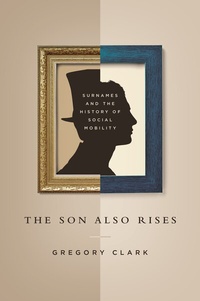
The Son Also Rises
Surnames and the History of Social Mobility
1st Edition
Published on 28. July 2015
384 pages
978-1-4008-5109-6 (ISBN)
Description

A surprising look at how ancestry still determines social outcomes
How much of our fate is tied to the status of our parents and grandparents? How much does it influence our children? More than we wish to believe. While it has been argued that rigid class structures have eroded in favor of greater social equality, The Son Also Rises proves that movement on the social ladder has changed little over eight centuries. Using a novel technique-tracking family names over generations to measure social mobility across countries and periods-renowned economic historian Gregory Clark reveals that mobility rates are lower than conventionally estimated, do not vary across societies, and are resistant to social policies.
Clark examines and compares surnames in such diverse cases as modern Sweden and Qing Dynasty China. He demonstrates how fate is determined by ancestry and that almost all societies have similarly low social mobility rates. Challenging popular assumptions about mobility and revealing the deeply entrenched force of inherited advantage, The Son Also Rises is sure to prompt intense debate for years to come.
How much of our fate is tied to the status of our parents and grandparents? How much does it influence our children? More than we wish to believe. While it has been argued that rigid class structures have eroded in favor of greater social equality, The Son Also Rises proves that movement on the social ladder has changed little over eight centuries. Using a novel technique-tracking family names over generations to measure social mobility across countries and periods-renowned economic historian Gregory Clark reveals that mobility rates are lower than conventionally estimated, do not vary across societies, and are resistant to social policies.
Clark examines and compares surnames in such diverse cases as modern Sweden and Qing Dynasty China. He demonstrates how fate is determined by ancestry and that almost all societies have similarly low social mobility rates. Challenging popular assumptions about mobility and revealing the deeply entrenched force of inherited advantage, The Son Also Rises is sure to prompt intense debate for years to come.
All prices
More details
Edition
Pilot project. eBook available to selected US libraries only
Language
English
Place of publication
Princeton, NJ
United States
Publishing group
De Gruyter
Target group
Professional and scholarly
Edition type
Digital original
Product notice
Reflowable
Illustrations
7 b/w ill., 15 halftones. 111 line illus. 50 tables. 7 maps.
File size
7,19 MB
ISBN-13
978-1-4008-5109-6 (9781400851096)
Schweitzer Classification
Other editions
Additional editions

Book
08/2015
Princeton University Press
€22.00
Shipment within 10-20 days

Book
02/2014
Princeton University Press
€30.95
Shipment within 10-20 days
Persons
Gregory Clark is professor of economics at the University of California, Davis.
Content
Preface ix
1 Introduction: Of Ruling Classes and Underclasses: The Laws of Social Mobility 1
PART I Social Mobility by Time and Place
2 Sweden: Mobility Achieved? 19
3 The United States: Land of Opportunity 45
4 Medieval England: Mobility in the Feudal Age 70
5 Modern England: The Deep Roots of the Present 88
6 A Law of Social Mobility 107
7 Nature versus Nurture 126
PART II Testing the Laws of Mobility
8 India: Caste, Endogamy, and Mobility 143
9 China and Taiwan: Mobility after Mao 167
10 Japan and Korea: Social Homogeneity and Mobility 182
11 Chile: Mobility among the Oligarchs 199
12 The Law of Social Mobility and Family Dynamics 212
13 Protestants, Jews, Gypsies, Muslims, and Copts: Exceptions to the Law of Mobility? 228
14 Mobility Anomalies 253
PART III The Good Society
15 Is Mobility Too Low? Mobility versus Inequality 261
16 Escaping Downward Social Mobility 279
Appendix 1: Measuring Social Mobility 287
Appendix 2: Deriving Mobility Rates from Surname Frequencies 296
Appendix 3: Discovering the Status of Your Surname Lineage 301
Data Sources for Figures and Tables 319
References 333
Index 349
1 Introduction: Of Ruling Classes and Underclasses: The Laws of Social Mobility 1
PART I Social Mobility by Time and Place
2 Sweden: Mobility Achieved? 19
3 The United States: Land of Opportunity 45
4 Medieval England: Mobility in the Feudal Age 70
5 Modern England: The Deep Roots of the Present 88
6 A Law of Social Mobility 107
7 Nature versus Nurture 126
PART II Testing the Laws of Mobility
8 India: Caste, Endogamy, and Mobility 143
9 China and Taiwan: Mobility after Mao 167
10 Japan and Korea: Social Homogeneity and Mobility 182
11 Chile: Mobility among the Oligarchs 199
12 The Law of Social Mobility and Family Dynamics 212
13 Protestants, Jews, Gypsies, Muslims, and Copts: Exceptions to the Law of Mobility? 228
14 Mobility Anomalies 253
PART III The Good Society
15 Is Mobility Too Low? Mobility versus Inequality 261
16 Escaping Downward Social Mobility 279
Appendix 1: Measuring Social Mobility 287
Appendix 2: Deriving Mobility Rates from Surname Frequencies 296
Appendix 3: Discovering the Status of Your Surname Lineage 301
Data Sources for Figures and Tables 319
References 333
Index 349

