

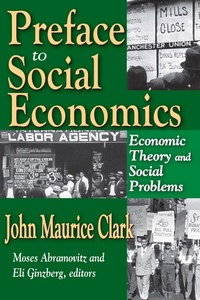
Preface to Social Economics
Economic Theory and Social Problems
Published on 12. July 2017
456 pages
978-1-351-49705-3 (ISBN)
Description

Economics both describes the way economic forces work and studies the effi ciency, or ineffi ciency, that results. These two aspects of economics have probably never been wholly separated, and it is debatable how far it is possible or desirable to separate them. The question will ultimately be answered by evaluating these different theoretical methods in terms of the results they deliver.
The theory of economic effi ciency uniquely incorporates problem of ideals of good conduct and welfare; in short, of morals and ethics. Preface to Social Economics presents thumbnail sketches describing the growth of our awareness of social problems over the past century. Beginning in the nineteenth century, the sciences, both natural and social, made us aware of many factors governing our behavior. With the discovery of controllable external social causes, the responsibility for problems (and change) shifted from the individual to the group.
Studies of industrial accidents are an example. When it was learned that the number of injuries per hour increases with the length of the working day and with the absence of mechanical safeguards, it led to a demand for shorter hours, safety laws, and compulsory accident insurance. Similarly, as we begin to understand the connection between the rate of interest with booms in building, unemployment ceases to be a matter of individual responsibility and becomes a problem for business and society. This classic book, initially published in 1936, illumines a growing knowledge of controllable causes of social evils.
John Maurice Clark was a long-time professor of economics at Columbia University. The editors of this volume Moses Abramovitz and Eli Ginzberg were both students of Clark, and prepared this volume under his direct supervision.
The theory of economic effi ciency uniquely incorporates problem of ideals of good conduct and welfare; in short, of morals and ethics. Preface to Social Economics presents thumbnail sketches describing the growth of our awareness of social problems over the past century. Beginning in the nineteenth century, the sciences, both natural and social, made us aware of many factors governing our behavior. With the discovery of controllable external social causes, the responsibility for problems (and change) shifted from the individual to the group.
Studies of industrial accidents are an example. When it was learned that the number of injuries per hour increases with the length of the working day and with the absence of mechanical safeguards, it led to a demand for shorter hours, safety laws, and compulsory accident insurance. Similarly, as we begin to understand the connection between the rate of interest with booms in building, unemployment ceases to be a matter of individual responsibility and becomes a problem for business and society. This classic book, initially published in 1936, illumines a growing knowledge of controllable causes of social evils.
John Maurice Clark was a long-time professor of economics at Columbia University. The editors of this volume Moses Abramovitz and Eli Ginzberg were both students of Clark, and prepared this volume under his direct supervision.
More details
Language
English
Place of publication
London
United Kingdom
Publishing group
Taylor & Francis Ltd
Target group
College/higher education
File size
23,03 MB
ISBN-13
978-1-351-49705-3 (9781351497053)
Copyright in bibliographic data and cover images is held by Nielsen Book Services Limited or by the publishers or by their respective licensors: all rights reserved.
Schweitzer Classification
Other editions
Additional editions
Book
09/2017
1st Edition
Routledge
€209.20
Shipment within 10-20 days
Book
03/2009
1st Edition
Routledge
€78.00
Shipment within 10-15 days
Content
I: Economic Theory and Social Problems; I: The Socializing of the Oretical EConomics; II: To Ward a Concept of Social Value; III: The Changing Basis of Economic Responsibility; IV: Economics and Modern Psychology; V: Adam Smith and the Currents of History; VI: The Relation Between Statics and Dynamics; VII: Long-Range Planning for the Regularization of Industry; II: Dynamics of the Economic Mechanism; VIII: A Contribution to the Theory of Competitive Price; IX: Inductive Evidence on Marginal Productivity; X: Business Acceleration and the Law of Demand: A Technical Factor in Economic Cycles; XI: Productive Capacity and Effective Demand; XII: Aggregate Spending by Public Works; XIII: Wesley C. Mitchell's Contri-Bution to the Theory of Business Cycles; XIV: Past Accomplishments and Present Prospects of American Economics
