

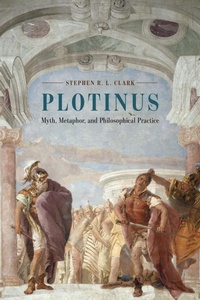
Plotinus
Myth, Metaphor, and Philosophical Practice
Published on 22. December 2022
368 pages
978-0-226-33970-2 (ISBN)
Description

"A bold work that applies a new approach to the interpretation of the thought of the founder of Neoplatonism... beautifully written." -
Notre Dame Philosophical Reviews
Plotinus, the Roman philosopher (c. 204-270 CE) who is widely regarded as the founder of Neoplatonism, was also the creator of numerous myths, images, and metaphors. They have influenced both secular philosophers and Christian and Muslim theologians, but have frequently been dismissed by modern scholars as merely ornamental. In this book, distinguished philosopher Stephen R. L. Clark shows that they form a vital set of spiritual exercises by which individuals can achieve one of Plotinus's most important goals: self-transformation through contemplation.
Clark examines a variety of Plotinus's myths and metaphors within the cultural and philosophical context of his time, asking probing questions about their contemplative effects. What is it, for example, to "think away the spatiality" of material things? What state of mind is Plotinus recommending when he speaks of love, or drunkenness, or nakedness? What star-like consciousness is intended when he declares that we were once stars or are stars eternally? What does it mean to say that the soul goes around God? And how are we supposed to "bring the god in us back to the god in all?" Through these rich images and structures, Clark casts Plotinus as a philosopher deeply concerned with philosophy as a way of life.
"Highly enjoyable... His book is the tool by which we learn to read Plotinus in a dynamic way that transforms our very selves." - Classical World
Plotinus, the Roman philosopher (c. 204-270 CE) who is widely regarded as the founder of Neoplatonism, was also the creator of numerous myths, images, and metaphors. They have influenced both secular philosophers and Christian and Muslim theologians, but have frequently been dismissed by modern scholars as merely ornamental. In this book, distinguished philosopher Stephen R. L. Clark shows that they form a vital set of spiritual exercises by which individuals can achieve one of Plotinus's most important goals: self-transformation through contemplation.
Clark examines a variety of Plotinus's myths and metaphors within the cultural and philosophical context of his time, asking probing questions about their contemplative effects. What is it, for example, to "think away the spatiality" of material things? What state of mind is Plotinus recommending when he speaks of love, or drunkenness, or nakedness? What star-like consciousness is intended when he declares that we were once stars or are stars eternally? What does it mean to say that the soul goes around God? And how are we supposed to "bring the god in us back to the god in all?" Through these rich images and structures, Clark casts Plotinus as a philosopher deeply concerned with philosophy as a way of life.
"Highly enjoyable... His book is the tool by which we learn to read Plotinus in a dynamic way that transforms our very selves." - Classical World
More details
Other editions
Additional editions
Book
05/2016
University of Chicago Press
€51.38
Article exhausted; check different version
Person
Stephen R. L. Clark is professor emeritus at the University of Liverpool and has also taught at the University of Oxford and the University of Glasgow. He is the author of many books, most recently
Understanding Faith,
Philosophical Futures, and
Ancient Mediterranean Philosophy.
Content
- Intro
- Contents
- Preface
- Acknowledgments
- Part I: Prolegomena
- 1. Why Read Plotinus?
- 2. How to Read Plotinus
- 3. Theories about Metaphor
- 4. Dialectic
- Part II: Metaphorically Speaking
- 5. Naked and Alone
- 6. On Becoming Love
- 7. Shadow Plays and Mirrors
- 8. Reason Drunk and Sober
- 9. Dancing
- 10. Remembering and Forgetting
- 11. Standing Up to the Blows of Fortune
- Part III: The Plotinian Imaginary
- 12. Platonic and Classical Myths
- 13. Spheres and Circles
- 14. Charms and Countercharms
- 15. Invoking Demons
- 16. Images Within and Without
- 17. Fixed Stars and Planets
- 18. Waking Up
- Part IV: Understanding the Hypostases
- 19. Matter
- 20. Nature
- 21. Soul
- 22. Nous
- 23. The One
- Part V: The Plotinian Way
- Bibliography
- Index of Passages from the Enneads
- Index of Names and Subjects
