

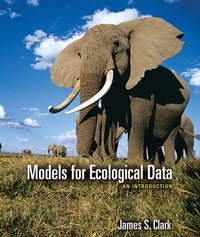
Models for Ecological Data
An Introduction
1st Edition
Published on 26. October 2020
632 pages
978-0-691-22012-3 (ISBN)
Description

The environmental sciences are undergoing a revolution in the use of models and data. Facing ecological data sets of unprecedented size and complexity, environmental scientists are struggling to understand and exploit powerful new statistical tools for making sense of ecological processes.
In Models for Ecological Data, James Clark introduces ecologists to these modern methods in modeling and computation. Assuming only basic courses in calculus and statistics, the text introduces readers to basic maximum likelihood and then works up to more advanced topics in Bayesian modeling and computation. Clark covers both classical statistical approaches and powerful new computational tools and describes how complexity can motivate a shift from classical to Bayesian methods. Through an available lab manual, the book introduces readers to the practical work of data modeling and computation in the language R. Based on a successful course at Duke University and National Science Foundation-funded institutes on hierarchical modeling, Models for Ecological Data will enable ecologists and other environmental scientists to develop useful models that make sense of ecological data.
- Consistent treatment from classical to modern Bayes
- Underlying distribution theory to algorithm development
- Many examples and applications
- Does not assume statistical background
- Extensive supporting appendixes
- Lab manual in R is available separately
In Models for Ecological Data, James Clark introduces ecologists to these modern methods in modeling and computation. Assuming only basic courses in calculus and statistics, the text introduces readers to basic maximum likelihood and then works up to more advanced topics in Bayesian modeling and computation. Clark covers both classical statistical approaches and powerful new computational tools and describes how complexity can motivate a shift from classical to Bayesian methods. Through an available lab manual, the book introduces readers to the practical work of data modeling and computation in the language R. Based on a successful course at Duke University and National Science Foundation-funded institutes on hierarchical modeling, Models for Ecological Data will enable ecologists and other environmental scientists to develop useful models that make sense of ecological data.
- Consistent treatment from classical to modern Bayes
- Underlying distribution theory to algorithm development
- Many examples and applications
- Does not assume statistical background
- Extensive supporting appendixes
- Lab manual in R is available separately
More details
Other editions
Additional editions
Book
04/2007
Princeton University Press
€104.60
Article not available at the moment
Person
James S. Clark is H. L. Blomquist Professor in the Nicholas School for the Environment, Professor of Statistics and Decisions Sciences, and Professor of Biology at Duke University. An award-winning researcher on the ecological impact of climate change, he is the author of more than one hundred papers for leading journals, including Science, Nature, and Ecology. In 2005, he was elected to the American Academy of Arts and Sciences.
Content
- Cover Page
- Title page
- Half-title page
- Copyright page
- Contents
- Preface
- Part I: Introduction
- 1. Models in Context
- 1.1 Complexity and Obscurity in Nature and in Models
- 1.2 Making the Connections: Data, Inference, and Decision
- 1.3 Two Elements of Models: Known and Unknown
- 1.4 Learning with Models: Hypotheses and Quantification
- 1.5 Estimation versus Forward Simulation
- 1.6 Statistical Pragmatism
- 2. Model Elements: Application to Population Growth
- 2.1 A Model and Data Example
- 2.2 Model State and Time
- 2.3 Stochasticity for the Unknown
- 2.4 Additional Background on Process Models
- Part II: Elements of Inference
- 3. Point Estimation: Maximum Likelihood and the Method of Moments
- 3.1 Introduction
- 3.2 Likelihood
- 3.3 A Binomial Model
- 3.4 Combining the Binomial and Exponential
- 3.5 Maximum Likelihood Estimates for the Normal Distribution
- 3.6 Population Growth
- 3.7 Application: Fecundity
- 3.8 Survival Analysis Using Maximum Likelihood
- 3.9 Design Matrixes
- 3.10 Numerical Methods for MLE
- 3.11 Moment Matching
- 3.12 Common Sampling Distributions and Dispersion
- 3.13 Assumptions and Next Steps
- 4. Elements of the Bayesian Approach
- 4.1 The Bayesian Approach
- 4.2 The Normal Distribution
- 4.3 Subjective Probability and the Role of the Prior
- 5. Confidence Envelopes and Prediction Intervals
- 5.1 Classical Interval Estimation
- 5.2 Bayesian Credible Intervals
- 5.3 Likelihood Profile for Multiple Parameters
- 5.4 Confidence Intervals for Several Parameters: Linear Regression
- 5.5 Which Confidence Envelope to Use
- 5.6 Predictive Intervals
- 5.7 Uncertainty and Variability
- 5.8 When Is It Bayesian?
- 6. Model Assessment and Selection
- 6.1 Using Statistics to Evaluate Models
- 6.2 The Role of Hypothesis Tests
- 6.3 Nested Models
- 6.4 Additional Considerations for Classical Model Selection
- 6.5 Bayesian Model Assessment
- 6.6 Additional Thoughts on Bayesian Model Assessment
- Part III: Larger Models
- 7. Computational Bayes: Introduction to Tools Simulation
- 7.1 Simulation to Obtain the Posterior
- 7.2 Some Basic Simulation Techniques
- 7.3 Markov Chain Monte Carlo Simulation
- 7.4 Application: Bayesian Analysis for Regression
- 7.5 Using MCMC
- 7.6 Computation for Bayesian Model Selection
- 7.7 Priors on the Response
- 7.8 The Basics Are Now Behind Us
- 8. A Closer Look at Hierarchical Structures
- 8.1 Hierarchical Models for Context
- 8.2 Mixed and Generalized Linear Models
- 8.3 Application: Growth Responses to CO2
- 8.4 Thinking Conditionally
- 8.5 Two Applications to Trees
- 8.6 Noninformative Priors in Hierarchical Settings
- 8.7 From Simple Models to Graphs
- Part IV: More Advance Methods
- 9. Time
- 9.1 Why Is Time Important?
- 9.2 Time Series Terminology
- 9.3 Descriptive Elements of Time Series Models
- 9.4 The Frequency Domain
- 9.5 Application: Detecting Density Dependence in Population Time Series
- 9.6 Bayesian State Space Models
- 9.7 Application: Black Noddy on Heron Island
- 9.8 Nonlinear State Space Models
- 9.9 Lags
- 9.10 Regime Change
- 9.11 Constraints on Time Series Data
- 9.12 Additional Sources of Variablity
- 9.13 Alternatives to the Gibbs Sampler
- 9.14 More on Longitudinal Data Structures
- 9.15 Intervention and Treatment Effects
- 9.16 Capture-Recapture Studies
- 9.17 Structured Models as Matrixes
- 9.18 Structure as Systems of Difference Equations
- 9.19 Time Series, Population Regulation, and Stochasticity
- 10. Space-Time
- 10.1 A Deterministic Model for a Stochastic Spatial Process
- 10.2 Classical Inference on Population Movement
- 10.3 Island Biogeography and Metapopulations
- 10.4 Estimation of Passive Dispersal
- 10.5 A Bayesian Framework
- 10.6 Models for Explicit Space
- 10.7 Point-Referenced Data
- 10.8 Block-Referenced Data and Misalignment
- 10.9 Hierarchical Treatment of Space
- 10.10 Application: A Spatio-Temporal Model of Population Spread
- 10.11 How to Handle Space
- 11. Some Concluding Perspectives
- 11.1 Models, Data, and Decision
- 11.2 The Promise of Graphical Models, Improved Algorithms, and Faster Computers
- 11.3 Predictions and What to Do with Them
- 11.4 Some Remarks on Software
- Appendix A. Taylor Series
- Appendix B. Some Notes on Differential and Difference Equations
- Appendix C. Basic Matrix Algebra
- Appendix D. Probability Models
- Appendix E. Basic Life History Calculations
- Appendix F. Common Distributions
- Appendix G. Common Conjugate Likelihood-Prior Pairs
- References
- Index
