

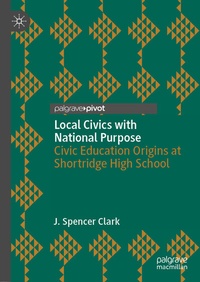
Local Civics with National Purpose
Description

This book examines the development of civic education in the United States through the lives of two teachers at Shortridge High School (SHS) in Indianapolis around 1900. After situating civic education at the turn-of-the-century, the book describes the career of Laura Donnan-her influences, teaching, extracurriculars, and civic life-through the lens of her unique epistemology, shaped by negotiating the gendered ideologies of her era. Then, the book re-examines Arthur W. Dunn's career, focusing on his ten years at SHS, and the influence of Donnan on his popular community civics curriculum and subsequently the 1916 report "The Social Studies in Secondary Education." Previous scholars have overlooked Dunn's time at SHS, viewing it simply as a stepping stone for the progressive educator's career. This book argues that Dunn's time at SHS was pivotal to his career due to influential colleagues, primarily Donnan. To conclude, Clark discusses the implications of Donnan's epistemology in shaping civic education in the United States.
Reviews / Votes
"Filling a major gap in the history of social studies by looking at the local-level, Clark's book examines turn of the twentieth-century civic education in Indianapolis, Indiana. It focuses on the efforts and accomplishments of Laura Donnan, a Shortridge High School teacher who promoted innovative pedagogies and extracurricular activities. By focusing his analysis on a woman teacher, Clark's carefully researched study reveals how Donnan shaped the national discourse on civic education."- Christine Woyshner , Professor of Education, Temple University, USA
More details
Other editions
Additional editions
Person
J. Spencer Clark is Associate Professor of Curriculum Studies at Kansas State University, USA. He teaches courses on curriculum theory, history of education, research methodology, and social studies curriculum. His research examines the concept of agency in teacher education, history of education, civic and social studies education, and rural education.
