

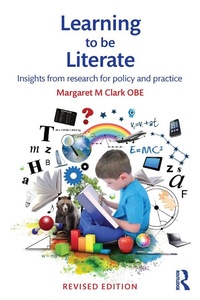
Learning to be Literate
Insights from research for policy and practice
Published on 10. March 2016
210 pages
978-1-317-28621-9 (ISBN)
Description

Winner of the prestigious UK Literacy Association Academic Book Award for 2015 in its original edition, this fully revised edition of Learning to be Literate uniquely analyses research into literacy from the 1960s through to 2015 with some surprising conclusions.
Margaret Clark explores the argument that young children growing up in a literate environment are forming hypotheses about the print around them, including environmental print, television, computer games and mobile phones. In a class where no child can yet read there is a wide range of understanding with regards to concepts of print and the critical features of written language. While to any literate adult, the relationship between spoken and written language may be obvious, young children have to be helped to discover it.
This persuasive argument demonstrates the value of research in order to make informed policy decisions about children's literacy development. Accessible and succinct, Professor Clark's writing brings into sharp focus the processes involved in becoming literate. The effect on practice of many recent government policies she claims run counter to these insights. The key five thematic sections are backed up with case studies throughout and include:
Insights from Literacy Research: 1960s to 1980s
Young Literacy Learners: how we can help them
Curriculum Developments and Literacy Policies, 1988 to 1997: a comparison between England and Scotland
Synthetic Phonics and Literacy Learning: government policy in England 2006 to 2015
Interpretations of Literacy in the Twenty-first Century
Margaret Clark explores the argument that young children growing up in a literate environment are forming hypotheses about the print around them, including environmental print, television, computer games and mobile phones. In a class where no child can yet read there is a wide range of understanding with regards to concepts of print and the critical features of written language. While to any literate adult, the relationship between spoken and written language may be obvious, young children have to be helped to discover it.
This persuasive argument demonstrates the value of research in order to make informed policy decisions about children's literacy development. Accessible and succinct, Professor Clark's writing brings into sharp focus the processes involved in becoming literate. The effect on practice of many recent government policies she claims run counter to these insights. The key five thematic sections are backed up with case studies throughout and include:
Insights from Literacy Research: 1960s to 1980s
Young Literacy Learners: how we can help them
Curriculum Developments and Literacy Policies, 1988 to 1997: a comparison between England and Scotland
Synthetic Phonics and Literacy Learning: government policy in England 2006 to 2015
Interpretations of Literacy in the Twenty-first Century
Reviews / Votes
This exceptional book documents and critically analyses literacy education over a period of fifty years. Margaret Clark continues in her relentless quest to raise awareness of the changing nature and quality of literacy research evidence, theory and practice. Her goal has ever been to ensure that the best evidence underpins literacy education policy. She [is] among the most influential figures in literacy research of her generation.Carol Aubrey, Professor Emeritus, Warwick University.
Provides vital illumination for classroom teachers and those who steer the processes of education. Henrietta Dombey, Professor Emeritus, University of Brighton, Past Chair of NATE and a Past President of UKLA.
Professor Clark's latest book takes a cool, primary trained, look at the insights gained from over fifty years of research into children learning the skill of reading. The result is a book which summarizes the evidence upon which our teaching should be based. This book supports our professionalism and it merits a place in the libraries of all schools and universities, particularly those engaged in initial training. John Coe, NAPE Primary First.
More details
Language
English
Place of publication
London
United Kingdom
Publishing group
Taylor & Francis Ltd
Target group
College/higher education
Professional and scholarly
Illustrations
18 s/w Photographien bzw. Rasterbilder
18 Halftones, black and white
File size
4,52 MB
ISBN-13
978-1-317-28621-9 (9781317286219)
Copyright in bibliographic data and cover images is held by Nielsen Book Services Limited or by the publishers or by their respective licensors: all rights reserved.
Schweitzer Classification
Other editions
Additional editions
Book
03/2016
1st Edition
Routledge
€46.50
Shipment within 10-20 days
Book
03/2016
1st Edition
Routledge
€193.13
Shipment within 10-20 days
Person
Margaret M Clark OBE is Emeritus Professor of Education at the University of Birmingham, and Visiting Professor at Newman University, Birmingham, UK.
Content
Introduction PART I Insights from literacy research: 1960s to 1980s 2. Reading and related skills: lessons from the early 1970s 3. Language and reading: insights from early research 4. Strengths and weaknesses of children with reading difficulties and young fluent readers 5. Insights from young fluent readers PART II Young literacy learners: how we can help them 6. Literacy learning in creative contexts 7. Sensitive observation and the development of literacy: a tribute to Marie Clay 8. Meeting individual needs in learning to read 9. High frequency words: a neglected resource in learning to read 10. Reading and writing: a reciprocal relationship PART III Curriculum developments and literacy policies, 1988 to 1997: a comparison between England, Wales and Scotland 11. The first National Curriculum in England and Wales: lessons for the future 12. Government policy on literacy in Scotland from the 1980s to the 1990s PART IV Synthetic phonics and literacy learning: government policy in England, 2006 to 2015 13. The Rose Report and the teaching of reading: a critique 14. One best method of teaching reading: what is the research evidence? 15. The phonics check: its background, initial results and possible effects 16. Research evidence on the phonics check for all Year 1 children in England 17. Unresolved issues on the value and validity of the phonics check: four years on 18. Whose knowledge counts in government literacy policies: at what cost? PART V Interpretations of literacies in the twenty-first century 19. International studies of reading, such as PIRLS: a cautionary tale 20. Literacies in and for a changing world: what is the evidence? 21. Insights on literacy from research
