

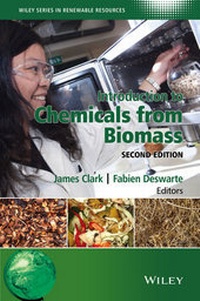
Introduction to Chemicals from Biomass
Description

More details
Other editions
Additional editions
Persons
Content
List of Contributors xi
Series Preface xiii
Preface xv
1 The Biorefinery Concept: An Integrated Approach 1
James Clark and Fabien Deswarte
1.1 Sustainability for the Twenty-First Century 1
1.2 Renewable Resources: Nature and Availability 2
1.3 The Challenge of Waste 4
1.3.1 Waste Policy and Waste Valorisation 6
1.3.2 The Food Supply Chain Waste Opportunity 7
1.3.3 Case Study: Citrus Waste 8
1.4 Green Chemistry 9
1.5 The Biorefinery Concept 11
1.5.1 Definition 11
1.5.2 Different Types of Biorefinery 12
1.5.3 Challenges and Opportunities 20
1.5.4 Biorefinery Size 24
1.6 Conclusions 24
1.7 Acknowledgement 25
References 25
2 Biomass as a Feedstock 31
Thomas M. Attard, Andrew J. Hunt, Avtar S. Matharu, Joseph A. Houghton and Igor Polikarpov
2.1 Introduction 31
2.2 Lignocellulosic Biomass 32
2.3 Food Supply Chain Waste 40
2.4 Mango Waste: A Case Study 44
2.5 Concluding Remarks 46
References 47
3 Pretreatment and Thermochemical and Biological Processing of Biomass 53
Wan Chi Lam, Tsz Him Kwan, Vitaliy L. Budarin, Egid B. Mubofu, Jiajun Fan and Carol Sze Ki Lin
3.1 Introduction 53
3.2 Biomass Pretreatments 54
3.2.1 Mechanical Pretreatment of Biomass 54
3.2.2 Physical Pretreatment of Biomass 57
3.2.3 Chemical Pretreatment of Biomass 60
3.2.4 Microwave-Assisted Hydrothermal Biomass Treatment 63
3.2.5 Biological Pretreatment 65
3.2.6 Summary 66
3.3 Thermochemical Processing of Biomass 66
3.3.1 Direct Liquefaction 66
3.3.2 Direct Combustion 70
3.3.3 Gasification 72
3.3.4 Pyrolysis 73
3.3.5 Torrefaction 74
3.4 Biological Processing 78
3.4.1 Fermentation 78
3.4.2 Anaerobic Digestion 79
3.5 Summary 83
References 83
4 Platform Molecules 89
Thomas J. Farmer and Mark Mascal
4.1 Introduction 89
4.2 Fossil-Derived Base Chemicals 91
4.3 Definition of a Platform Molecule 93
4.4 Where Platform Molecules Come From 96
4.4.1 Saccharides 97
4.4.2 Lignin 103
4.4.3 Protein 105
4.4.4 Extracts 109
4.5 Process Technologies: Biomass to Platform Molecules 114
4.6 Bio-Derived v. Fossil-Derived: Changing Downstream Chemistry 117
4.7 List of Platform Molecules 119
4.8 Example Platform Molecules 130
4.8.1 Synthesis Gas Platform: Thermal Treatment 130
4.8.2 5-(Chloromethyl)furfural: Chemical-Catalytic Treatment 133
4.8.3 n-Butanol (Biobutanol): Biological Treatment 135
4.8.4 Triglyceride Platform: Extraction 137
4.9 Conclusion 142
References 143
5 Monomers and Resulting Polymers from Biomass 157
James A. Bergman and Michael R. Kessler
5.1 Introduction 157
5.2 Polymers from Vegetable Oils 159
5.2.1 Isolation of Vegetable Oil 163
5.2.2 Thermosets of Vegetable Oils and Comonomers 163
5.2.3 Epoxidized and Acrylated Epoxidized Vegetable Oil 164
5.2.4 Polyurethanes from Vegetable Oil 165
5.2.5 Polyesters 167
5.2.6 Polyamides 168
5.2.7 Vegetable Oil Conclusion 168
5.3 Furan Chemistry 169
5.3.1 Production of Furfural and HMF 169
5.3.2 Second-Generation Derivatives 171
5.3.3 Addition Polymerizations 171
5.3.4 Furfuryl Alcohol 172
5.3.5 Polyesters 172
5.3.6 Polyamides 173
5.3.7 Other Polymers 175
5.3.8 Furan Conclusion 176
5.4 Terpenes 176
5.4.1 Production of Turpentine 177
5.4.2 Cationic Polymerization of Pinenes 178
5.4.3 Copolymerization of Pinenes 178
5.4.4 Polymerization of Non-Pinene Terpenes 179
5.4.5 Terpenoids 180
5.4.6 Terpene Conclusion 181
5.5 Rosin 181
5.5.1 Production and Chemistry of Rosin 181
5.5.2 Epoxy Resins from Rosin 183
5.5.3 Polyesters and Polyurethanes from Rosin 184
5.5.4 Thermoplastic Polymers from Rosin: Controlled Radical Techniques 184
5.5.5 Rosin Conclusion 185
5.6 The Potential of Tannins 186
5.6.1 Recent Work with Tannin Polycondensation 187
5.6.2 Tannins Conclusion 189
5.7 Alpha-Hydroxy Acids 189
5.7.1 Production of PLA 190
5.7.2 Properties of PLA 192
5.7.3 Applications of PLA 193
5.8 Conclusion 193
References 193
6 Bio-based Materials 205
Antoine Rouilly and Carlos Vaca-Garcia
6.1 Introduction 205
6.2 Wood and Natural Fibres 206
6.2.1 Molecular Constitution 206
6.2.2 Hierarchical Structure of Wood and Timber 208
6.2.3 Plant Fibres 214
6.3 Isolated and Modified Biopolymers as Biomaterials 219
6.3.1 Cellulose 220
6.3.2 Cellulose Derivatives 224
6.3.3 Starch 228
6.3.4 Starch Derivatives 230
6.3.5 Chitin and Chitosan 230
6.3.6 Proteins 231
6.4 Agromaterials, Blends and Composites 236
6.4.1 Agromaterials 236
6.4.2 Blends of Synthetic Polymers and Starch 239
6.4.3 Composites with Natural Fibres 240
6.4.4 Wood-Based Boards 243
6.4.5 Materials for Construction 244
6.5 Conclusion 245
References 245
7 Biomass-Based Energy Production 249
Mehrdad Arshadi and Anita Sellstedt
7.1 Introduction 249
7.2 Physical Upgrading Processes 250
7.2.1 Refinement of Biomass into Solid Fuels 250
7.2.2 Wood Powder 250
7.2.3 Briquette Production 251
7.2.4 Pellet Production 252
7.2.5 Storage of Solid Biomass 255
7.2.6 Torrefaction Technology 256
7.3 Microbiological Processes 257
7.3.1 Organisms and Processes 257
7.3.2 Hydrogen Production 257
7.3.3 Classification of Hydrogen-Forming Processes 258
7.3.4 Butanol Production Using Bacteria as Biocatalysts 259
7.3.5 Microbiological Ethanol Production 260
7.3.6 Production of Biodiesel from Plants and Algae 262
7.3.7 Biogas Production 263
7.4 Thermochemical Processes 265
7.4.1 Thermal Processing Equipment 266
7.4.2 Gasification 269
7.4.3 Pyrolysis 271
7.4.4 Liquefaction 272
7.4.5 Combustion 273
7.5 Chemical Processes 274
7.5.1 Dimethyl Ether (DME) 274
7.5.2 Biodiesel 274
7.6 Primary Alcohols 276
7.6.1 Methanol 276
7.6.2 Ethanol 277
7.6.3 Butanol 280
7.7 Conclusions 280
References 281
8 Policies and Strategies for Delivering a Sustainable Bioeconomy: A European Perspective 285
David Turley
8.1 Introduction 285
8.2 Drivers for Change 287
8.3 The Starting Point: Strategies for Change 288
8.4 Direct Measures 289
8.4.1 Integrated Development 290
8.4.2 Policy Mechanisms 291
8.4.3 Preferential Purchasing Policies 293
8.5 Supporting Measures 294
8.5.1 Supply-Side Drivers 294
8.5.2 Demand-Side Drivers 297
8.6 Bioeconomy Definitions 298
8.6.1 Biobased Content 298
8.6.2 Biodegradability 301
8.6.3 Composting Standards 302
8.6.4 Material Recycling 303
8.7 Life-Cycle Analysis 303
8.8 Ecolabels 304
8.9 Concluding Remarks 307
References 308
Index 311
1
The Biorefinery Concept: An Integrated Approach
James Clark1 and Fabien Deswarte2
1 Department of Chemistry, Green Chemistry Centre of Excellence, University of York, UK
2 The Biorenewables Development Centre, The Biocentre, York Science Park, UK
1.1 Sustainability for the Twenty-First Century
The greatest challenge we face in the twenty-first century is to reconcile our desires as a society to live lives based on consumption of a wider range of articles both essential (e.g. food) and luxury (e.g. mobile phones) with the fact that we live on a single planet with limited resources (to make the articles) and limited capacity to absorb our wastes (spent articles). While some will argue that we should not be limited by our own planet and instead seek to exploit extra-terrestrial resources (e.g. mining the asteroids), most of us believe it makes more sense to match our lifestyles with the planet we live on.
We can express this in the form of an equation whereby the Earth's capacity (EC) is defined as the product of world population P, the economic activity of an individual C and a conversion factor between activity and environmental burden B:
EC = P × C × B.
Since we live in a time of growing P and C (through the rapid economic development of the mega-states of the East in particular), and if we assume that all the indicators of environmental stress (including climate change, full landfill sites, pollution and global warming) are at least partly correct, then to be sustainable we must reduce B. There are two ways to do this:
- dematerialisation: use less resources per person and hence produce less waste; and
- transmaterialisation: use different materials and have a different attitude to 'waste'.
While many argue for dematerialisation, this is a dangerous route to go down as it typically requires that the developing nations listen to the developed nations and 'learn from their mistakes'. While many of our manufacturing processes in regions such as Europe and North America are becoming increasingly more efficient, we continue to treat most of our waste with contempt, focusing on disposal and an 'out of sight, out of mind' attitude. We also have to face the unavoidable truth that people in developing countries want to enjoy the same standard of living we have benefited from in the developed world; pontificating academics and politicians in the West talking about the need to reduce consumption will have little impact on the habits of the rest of the world!
Transmaterialisation, as it would apply to a sustainable society based on consumer goods, is more fundamental. It makes no assumption about limits of consumption other than the need to fit in with natural cycles such as using biomass at no more than the rate nature can produce it. Transmaterialisation also avoids clearly environmentally incompatible practices (such as using short-lifetime articles that linger unproductively in the environment for long periods of time, e.g. non-biodegradable polyolefin plastic bags) and bases our consumption pattern on the circular economy model, with spent articles becoming a resource for other manufacturing [1]. This model is essentially the same as the green chemistry concept, at least in terms of the chemical processes and products that dominate consumer goods, described in more detail in Section 1.4.
1.2 Renewable Resources: Nature and Availability
We need to find new ways of generating the chemicals, energy and materials as well as food that a growing world population (increasing P) and growing individual expectations (increasing C) needs, while limiting environmental damage. At the beginning of transmaterialisation is the feedstock or primary resource and this needs to be made renewable (see Figure 1.1). An ideal renewable resource is one that can be replenished over a relatively short timescale or is essentially limitless in supply. Resources such as coal, natural gas and crude oil come from carbon dioxide, 'fixed' by nature through photosynthesis many millions of years ago. They are of limited supply, cannot be replaced and are therefore non-renewable. In contrast, resources such as solar radiation, wind, tides and biomass can be considered as renewable resources, which are (if appropriately managed) in no danger of being over-exploited. However, it is important to note that while the first three resources can be used as a renewable source of energy, biomass can be used to produce not only energy but also chemicals and materials, the focus of this book.
Figure 1.1 Different types of renewable and non-renewable resources.
By definition, biomass corresponds to any organic matter available on a recurring basis (see Figure 1.2). The two most obvious types of biomass are wood and crops (e.g. wheat, maize and rice). Another very important type of biomass we tend to forget about is waste (e.g. food waste, manure, etc.), which is the focus of Section 1.3. These resources are generally considered to be renewable as they can be continually re-grown/regenerated. They take up carbon dioxide from the air while they are growing (through photosynthesis) and then return it to the air at the end of life, thereby creating a closed loop [2].
Figure 1.2 Different types of biomass.
Food crops can indeed be used to produce energy (e.g. biodiesel from vegetable oil), materials (e.g. polylactic acid from corn) and chemicals (e.g. polyols from wheat). However, it is becoming widely recognised by governments and scientists that waste and lignocellulosic materials (e.g. wood, straw and energy crops) provide a much better energy production opportunity than food crops since they avoid competition with the food sector and often do not require as much land and fertilisers to grow. In fact, only 3% of the 170 million tonnes of biomass produced yearly by photosynthesis is currently being cultivated, harvested and used (food and non-food applications) [3]. Indeed, according to a report published by the USDOE and the USDA [4], the US alone could sustainably supply more than one billion dry tons of biomass annually by 2030. As seen in Table 1.1, the biomass potential in Europe is also enormous.
Table 1.1 Biomass potential in the EU [5].
Biomass potential (MTonnes oil equivalent) 2010 2020 2030 Organic wastes 100 100 102 Energy crops 43-46 76-94 102-142 Forest products 43 39-45 39-72 Total 186 215-239 243-3161.3 The Challenge of Waste
Waste is a major global issue and is becoming more important in developing countries, as well as in the West. According to the World Bank, world cities generate about 1.3 billion tonnes (Gt) of solid waste per year, and this is expected to increase to 2.2 Gt by 2025 [6]. Globally, solid waste management costs will increase from today's $200 billion per year to about $375 billion per year in 2025. Cost increases will be most severe in low-income countries (more than five-fold increases) and lower-middle income countries (more than four-fold increases). Global governments need to put in place programmes to reduce, reuse, recycle or valorise as much waste as possible before burning it (and recovering the energy) or otherwise disposing of it.
Few countries have a constructive waste management policy whereby a significant proportion of the waste is used in some way (see Figure 1.3); reliable data are however not easily available from developing countries, other than anecdotal evidence such as from India where many people apparently make a living from waste [7]. The increasing costs of traditional fossil reserves, along with concerns over security of supply and the identification of critical raw mineral materials by the European Union (EU) is beginning to make people realise that the traditional linear economy model of extract-process-consume-dispose is unsustainable [8]. Rather, we must move towards a circular economy whereby we continue to make use of the resources in articles when they are no longer required in their current form. This is waste valorisation.
Figure 1.3 The fate of waste in different countries.
Waste produced in the food supply chain is a good example of a pre-consumer type of waste generated on a large scale all over the world. Sixty percent of this is organic matter, which can represent up to 50% of all the waste produced in a country. Food waste is ranked third of 15 identified resource productivity opportunities in the McKinsey report 'Resource Revolution: Meeting the World's Energy, Material, Food and Water Needs' [9]. But there are few examples that take us away from the totally wasteful and polluting landfilling or first-generation and limited-value recycling practices such as composting and animal feed production. We...
