

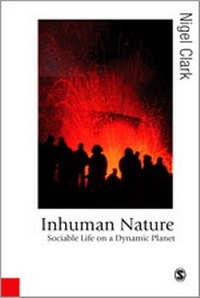
Inhuman Nature
Sociable Life on a Dynamic Planet
1st Edition
Published on 10. December 2010
272 pages
978-1-4462-0934-9 (ISBN)
Description

The relationship between social thought and earth processes is an oddly neglected part of the social sciences.
This exciting book offers to make good the deficit by exploring how human activity and planetary processes impact upon each other. The book:
* Provides a much needed in-depth inquiry into the volatile relationship between human life and the physical earth
* Considers the social and political implications of consistently thinking of the earth as a dynamic planet
* Asks what we can learn from natural catastrophes and from those who have lived through them
* Offers an inter-disciplinary perspective bringing together insights from sociology, geography, philosophy and earth / life sciences.
The result is a landmark work that will be of interest to readers across the social sciences and humanities as well as environmental studies and disaster studies.
This exciting book offers to make good the deficit by exploring how human activity and planetary processes impact upon each other. The book:
* Provides a much needed in-depth inquiry into the volatile relationship between human life and the physical earth
* Considers the social and political implications of consistently thinking of the earth as a dynamic planet
* Asks what we can learn from natural catastrophes and from those who have lived through them
* Offers an inter-disciplinary perspective bringing together insights from sociology, geography, philosophy and earth / life sciences.
The result is a landmark work that will be of interest to readers across the social sciences and humanities as well as environmental studies and disaster studies.
Reviews / Votes
Drawing on an impressive array of philosophical, social, and natural science sources Nigel Clark's magnificent Inhuman Nature provides a compelling account of the respects in which modern ways of living are perpetually exposed to unpredictable natural processes and transformations and the manner in which communities have responded with care and hospitality to the desperate plight of othersBarry Smart
Professor of Sociology, Portmouth University
Inhuman Nature: Sociable Life on a Dynamic Planet is a watershed for social theory. Nigel Clark's engaging book brings together earth systems science, philosophy, and history to challenge the longstanding impasse created through the philosophical separation of humans from the world. This book does not simply 'take nature into account': fires, floods, volcanoes, climate change, and hurricanes take centre-stage in this thorough re-writing of the organic and inorganic. Inhuman Nature asks the most important questions of our time, and is a must-read for anyone who takes nature and our future on this planet seriously
Myra Hird
Professor of Sociology, Queen's University Canada
This is possibly one of the most important books you are ever likely to read, particularly if you have been duped into thinking 'nature' and 'planet earth' are merely benevolent forces at the mercy of an insane, disordered humanity. According to Clark this just-so story illustrates our twin bad habits of focussing almost exclusively on human powers (exaggerating them wildly) and developing a blindness to the agency and powers of non-humans. This book reveals what the world is like when we come to our senses, literally. You wont look back (the view is better)
Adrian Franklin
Professor of Sociology, University of Tasmania Nigel Clark offers in this book a unique position, and radical, on the links between human and non-human to question the contemporary "environmental crisis". The ambitious question the author asks is: How to live with others and things in this context of profound insecurity? ...Above all, this book is incredibly stimulating. -- Severine Durand, Universite de Grenoble- UMR Pacte
All prices
More details
Series
Language
English
Place of publication
London
United Kingdom
Target group
Professional and scholarly
Readers across the social sciences and humanities, as well as in geography and environmental studies
ISBN-13
978-1-4462-0934-9 (9781446209349)
Copyright in bibliographic data and cover images is held by Nielsen Book Services Limited or by the publishers or by their respective licensors: all rights reserved.
Schweitzer Classification
Other editions
Additional editions
Book
12/2010
1st Edition
SAGE Publications Inc
€170.80
Shipment within 15-20 days
Person
Content
Introduction
The Earth in Physical and Social Thought
Ways to Make a World: From Relational Materiality to Radical Asymmetry
After the Tsunami: Vulnerability on a Volatile Planet
Quaking: The 1755 Lisbon Disaster and the Modern Subject
Justice and Abrupt Climate Change
Hurricane Katrina and the Origins of Community
'Burning for the Other': Colonial Encounters on a Planet of Fire
Extending Hospitality: Global Mobility and Journeys in Deep Time
The Earth in Physical and Social Thought
Ways to Make a World: From Relational Materiality to Radical Asymmetry
After the Tsunami: Vulnerability on a Volatile Planet
Quaking: The 1755 Lisbon Disaster and the Modern Subject
Justice and Abrupt Climate Change
Hurricane Katrina and the Origins of Community
'Burning for the Other': Colonial Encounters on a Planet of Fire
Extending Hospitality: Global Mobility and Journeys in Deep Time
