

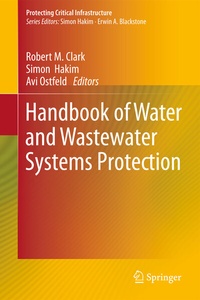
Handbook of Water and Wastewater Systems Protection
Description

Following the events of 9/11, the Administrator of the US Environmental Protection Agency created the Water Protection Task Force (WPTF), which identified water and wastewater systems as a major area of vulnerability to deliberate attack. The WPTF suggested that there are steps that can be taken to reduce these vulnerabilities and to make it as difficult as possible for potential saboteurs to succeed. The WPTF recommended that be scrutinized with renewed vigor to secure water and wastewater systems against these possible threats. It also recommended that water and wastewater systems have a response plan in place in the event an act of terrorism occurs. The WPTF identified water distribution networks as an area of special vulnerability and highlighted the need for rapid on-line detection methods that are accurate and have a wide detection range. As a result of these recommendations novel technologies from various fields of science and engineering are now addressing water security issues and water and wastewater utilities are looking for innovative solutions. Once such technologies are available, there will be a rapid implementation process that will present many business opportunities for the private sector. However, in addition to terrorist threats water and wastewater systems are inherently vulnerable to natural disasters such as earthquakes and floods. This volume will address the problems associated with both intended terrorist attacks and natural disasters affecting water or wastewater systems. The book is divided into parts based on the kinds of threats facing water and wastewater systems: (1) a direct attack on water and wastewater infrastructure storage reservoirs, and distribution and collection networks; (2) a cyber attack disabling the functionality of the water and wastewater systems or taking over control of key components which might result in system failures; and (3) a deliberate chemical or biological contaminant injection at one of the waterdistribution system's nodes. It will examine unique plans, technological and managerial innovations for protecting such systems, and includes descriptions of projects that were implemented to respond to natural disasters. Case studies are presented that discuss existing projects and evaluate their performance, with an emphasis on providing guidelines and techniques that can be implemented by water and wastewater planners and managers to deal with natural and manmade disasters should they occur.
More details
Other editions
Additional editions
Persons
Content
- Intro
- Acknowledgement
- Contents
- Contributors
- 1 Securing Water and Wastewater Systems: An Overview
- 1.1 Introduction
- 1.2 History of Water Supply Vulnerability
- 1.3 Threats from Earthquakes
- 1.3.1 The Loma Prieta Earthquake
- 1.3.2 The Northridge Earthquake
- 1.3.3 Kobe City Earthquake
- 1.3.4 Technological and Institutional Adaptation
- 1.3.4.1 Technological Adaptations
- 1.3.4.2 Institutional Adaptations
- 1.4 Vulnerable Characteristics of US Water Supply Systems
- 1.5 The Threat of Terrorism to Urban Water Systems
- 1.5.1 Bioterrorism and Chemical Contamination
- 1.6 Countermeasures Against Terrorism
- 1.6.1 Physical Countermeasures
- 1.6.2 Sensor Networks
- 1.7 Cyber Security
- 1.7.1 Laws and Regulations Governing the Internet
- 1.7.2 Internet Recovery
- 1.7.3 Examples of Internet Interruption
- 1.7.3.1 Case Study -- The Slammer Worm
- 1.7.3.2 Case Study -- A Root Server Attack
- 1.7.3.3 Case Study -- The Baltimore Train Tunnel Fire
- 1.7.3.4 Case Study -- The September 11, 2001, Terrorist Attack on the World Trade Center
- 1.7.3.5 Case Study -- Hurricane Katrina
- 1.7.4 Cyber Attacks in the Public Sector
- 1.7.4.1 The ''Stuxnet'' Virus
- 1.8 Material to Be Included in This Book
- 1.8.1 Current State of Water Supply and Wastewater Systems Security: An Overview
- 1.8.2 Characteristics of Water and Wastewater Systems in the United States
- 1.8.3 Chemical and Microbiological Threats for Water System Contamination
- 1.8.4 Monitoring for Natural and Manmade Threats in Water and Wastewater Systems
- 1.8.5 Modeling Contaminant Propagation and Contaminant Threats
- 1.8.6 Case Study Applications
- 1.8.7 Distribution System Modeling, SCADA Systems, Security and Surveillance Systems
- 1.8.8 Institutional and Management Issues in Responding to Natural and Manmade Threats
- 1.8.9 Developing Techniques and Approaches for Natural and Manmade Threat Response
- 1.9 Summary and Conclusions
- References
- 2 Water/Wastewater Infrastructure Security: Threats and Vulnerabilities
- 2.1 Introduction
- 2.2 Why Secure Water Infrastructure?
- 2.3 Threats to Water Systems
- 2.3.1 Evolving Threat Environment
- 2.3.1.1 September 11 Terrorist Attacks
- 2.3.1.2 Hurricane Katrina
- 2.3.2 Threat Assessments
- 2.3.3 Natural Disasters
- 2.3.3.1 Human-Caused Incidents
- 2.3.3.2 External Threats
- 2.3.3.3 Internal Threats
- 2.3.3.4 Cyber Threats
- 2.3.4 Design Basis Threat
- 2.3.5 Continuity Threats to Workforce and Infrastructure
- 2.3.5.1 The Dual Threat: Aging Infrastructure and Aging Workforce
- 2.3.5.2 Aging Infrastructure
- 2.3.5.3 Interdependent Infrastructure Failures
- 2.3.5.4 Workforce Illness
- 2.4 Water System Vulnerabilities
- 2.4.1 Above-Ground Structures
- 2.4.2 Below-Ground Structures
- 2.4.3 SCADA and Cyber Systems
- 2.4.4 Vulnerability Assessments
- References
- 3 EPA Drinking Water Security Research Program
- 3.1 Background
- 3.2 Research Drivers
- 3.3 Objectives and Desired Outcomes
- 3.4 Water Security Research
- 3.4.1 Protection and Prevention
- 3.4.1.1 Blast Vulnerability Assessment Tool
- 3.4.1.2 Design and Renovation of Drinking Water Systems
- 3.4.1.3 Contingency Planning Following Disasters and Disruption of Service
- 3.4.2 Detection
- 3.4.2.1 Commercially Available Sensors/Detectors
- 3.4.2.2 Development of New Detectors
- 3.4.2.3 Threat Ensemble Vulnerability Assessment Research
- 3.4.2.4 Public Health Surveillance
- 3.4.2.5 Sampling and Analytical Methods
- 3.4.2.6 Improving Microbial Contaminant Detection -- Sample Concentration
- 3.4.3 Containment and Mitigation
- 3.4.4 Water Treatment and Infrastructure Decontamination
- 3.4.4.1 Inactivation of Biothreat Agents
- 3.4.4.2 Persistence of Contaminants in Pipes and Other Water System Infrastructure
- 3.4.4.3 Inactivation of Anthrax Spores in Decontamination Wash/Waste Water
- 3.4.4.4 Quantitative Structure Property Relationship Prediction of Chlorine Reactivity with Chemical Contaminants of Concern
- 3.4.5 Technology Testing and Evaluation Program
- 3.5 Research Outcomes
- 3.6 Future Direction
- Acronyms
- References
- 4 Drinking Water Critical Infrastructure and Its Protection
- 4.1 Introduction
- 4.2 Water Security Issues
- 4.2.1 Water Sector Dependencies
- 4.2.2 Critical Infrastructure Definition
- 4.2.3 Contaminants of Concern
- 4.2.3.1 Agency for Toxic Substances and Disease Registry (ATSDR)
- 4.2.3.2 Center for Disease Control (CDC)
- 4.2.3.3 US Environmental Protection Agency (USEPA)
- 4.2.3.4 Food and Drug Administration (FDA)
- 4.2.3.5 World Health Organization (WHO) Database
- 4.2.3.6 Water Information Sharing and Analysis Center (WaterISAC)
- 4.2.3.7 Chemical Weapons Convention
- 4.2.3.8 North Atlantic Treaty Organization (NATO)
- 4.2.3.9 US Department of Defense
- 4.2.3.10 National Institute of Justice (NIJ)
- 4.2.3.11 Congressional Research Service
- 4.3 Water Quality Security
- 4.3.1 Water Security Initiative (WSI)
- 4.3.2 Environmental Technology Verification (ETV) and Technology Testing and Evaluation (TTEP)
- 4.3.3 The Standardized Analytical Methods for Environmental Restoration Following Homeland Security Events (SAM)
- 4.3.4 Response Protocol Tool Box (RPTB)
- 4.3.5 Water Contaminant Information Tool (WCIT)
- 4.4 Water Quality Security Models
- 4.4.1 EPANET Family of Codes
- 4.4.2 TEVA's Sensor Placement Optimization Tool (SPOT)
- 4.4.3 CANARY
- 4.5 Physical Security
- 4.5.1 Physical Security Tools
- 4.6 Cyber Security
- 4.6.1 Specific Actions to Improve Implementation
- 4.6.2 Actions to Establish Essential Underlying Management Processes
- References
- 5 Wastewater Critical Infrastructure Security and Protection
- 5.1 Introduction
- 5.2 Wastewater Security Regulations
- 5.3 Early Warning System
- 5.3.1 Selection Criteria for an Early Warning System
- 5.3.2 Wastewater Contaminants of Concern Database
- 5.3.3 Wastewater Sensors
- 5.3.4 Sensor Locations
- 5.3.4.1 Local Conditions
- 5.3.4.2 System-Wide and Topological Factors
- 5.3.5 Anomaly Detection
- 5.4 Security Incidents: Consequences and Response
- 5.4.1 Decontamination
- 5.4.2 Response to Wastewater Treatment from CBR
- 5.4.3 Response to Upset Event in Wastewater -- Normal Conditions
- 5.5 EPA-WERF Wastewater Security Research
- 5.6 Summary
- References
- 6 Protecting Water and Wastewater Systems
- 6.1 Introduction
- 6.2 Nebraskas Response to PL 1071--88
- 6.2.1 Vulnerability Assessments
- 6.2.2 Progress in Completing Vulnerability Assessments
- 6.2.3 Response to Emergencies
- 6.3 Nebraska's Public Water System Emergency Response Plan
- 6.3.1 Implementing the Plan
- 6.3.1.1 Training Activities
- 6.4 Potential for Replication
- 6.5 Summary and Conclusions
- Appendix: Security Needs Assessment Summary
- 7 Spatial Distributed Risk Assessment for Urban Water Infrastructure
- 7.1 Introduction
- 7.1.1 Hazard Maps
- 7.1.2 Vulnerability Maps
- 7.1.3 Intrinsic Vulnerability Maps
- 7.1.4 Risk Maps
- 7.2 Materials and Methods
- 7.2.1 Performance Evaluation for Water Supply
- 7.2.2 Performance Evaluation for Urban Drainage
- 7.2.3 Vulnerability Assessment
- 7.2.4 Hazard Assessment
- 7.2.4.1 Flooding Hazard (h1)
- 7.2.4.2 Landslide Hazard (h2)
- 7.2.4.3 Avalanche Hazard (h3)
- 7.2.4.4 Debris Flow (h4)
- 7.2.5 Risk Assessment
- 7.2.6 Case Studies for Water Supply
- 7.2.7 Case Studies for Urban Drainage
- 7.3 Results and Discussion
- 7.3.1 Vulnerability Maps
- 7.3.2 Vulnerability Maps for WSSs
- 7.3.3 Vulnerability Maps for UDSs
- 7.3.4 Risk Maps
- 7.3.5 Summary of Risk Analysis
- 7.4 Conclusions
- References
- 8 US Water and Wastewater Critical Infrastructure
- 8.1 Introduction
- 8.2 Safe Drinking Water Act
- 8.3 Clean Water Act
- 8.4 Water and Wastewater Infrastructure
- 8.4.1 Drinking Water Infrastructure
- 8.4.2 Wastewater Infrastructure
- 8.4.2.1 Other US Water Infrastructure
- 8.5 Drinking Water Infrastructure Needs
- 8.6 Wastewater Infrastructure Needs
- 8.7 Summary and Conclusions
- References
- 9 Microbial Issues in Drinking Water Security
- 9.1 Introduction
- 9.2 Bio-threat Agents
- 9.3 Persistence
- 9.4 Detection
- 9.5 Treatment
- 9.6 Summary
- References
- 10 Rapid Detection of Bacteria in Drinking Water and Wastewater Treatment Plants
- 10.1 Introduction
- 10.2 Waterborne Pathogens
- 10.3 History of Water System Contamination
- 10.3.1 Recent Water Contamination Experience in the USA
- 10.3.1.1 Cabool Missouri Case Study
- 10.3.1.2 Gideon, Missouri Case Study
- 10.3.1.3 Walkerton, Canada Case Study
- 10.3.1.4 Cryptosporidium Outbreak in Milwaukee
- 10.4 Need for Development of a Rapid Detection Method
- 10.5 Method Development
- 10.5.1 Sample Filtration
- 10.5.2 ATP Bioluminescence
- 10.5.3 Bacterial Enumeration: AODC, DVC, and HPC
- 10.6 Method Validation
- 10.6.1 Collection of Water Samples
- 10.6.2 Public Water Supplies in France
- 10.6.3 Results and Discussion
- 10.7 Summary and Conclusions
- References
- 11 Chlorine Residual Management for Water Distribution System Security
- 11.1 Introduction and Background
- 11.2 Vulnerability Assessment Using Chlorine Residual Modeling
- 11.3 Chlorine Sensors for Nonspecific Event Detection
- 11.4 Booster Response to Low Chlorine
- 11.5 Future Directions in Chlorine Sensing for Drinking Water Distribution System Control
- References
- 12 Biosensors for the Detection of E. coli O157:H7 in Source and Finished Drinking Water
- 12.1 Introduction
- 12.2 Concentration Methods for Biosensors
- 12.3 Recent Technological Advances
- 12.3.1 Liposomes
- 12.3.2 Quantum Dots
- 12.3.3 Luminex LabMAPTM
- 12.4 Case Studies: Biosensors for the Detection of E. coli O157:H7, 1998--2010
- 12.5 Biosensors for Viability Testing
- 12.6 A Strategy for Field Testing Biosensors by the Water Industry
- 12.6.1 Real-Time (Continuous) Sampling
- 12.6.2 Discrete (Grab) Sampling
- 12.6.3 Pilot-Scale Testing
- 12.7 Conclusions and Recommendations
- References
- 13 Guidelines, Caveats, and Techniques for the Evaluation of Water Quality Early Warning Systems
- 13.1 Introduction
- 13.2 Detection Class Requirements
- 13.3 Dual Use and Return on Investment
- 13.3.1 Optimized Distribution System Sensor Package
- 13.4 Operational Attributes
- 13.4.1 Ease of Use
- 13.4.2 Automated
- 13.4.3 Continuous
- 13.4.4 Reliable
- 13.4.5 Cost-Effective
- 13.5 Performance Attributes
- 13.5.1 Detection of a Broad Spectrum of Contaminant Classes
- 13.5.2 Rapid Detection of Events
- 13.5.3 Sensitivity to Concentration of Interest
- 13.5.4 Specificity
- 13.5.5 Reproducibility
- 13.5.6 Low False Negatives, Low False Positives
- 13.5.7 Qualitative
- 13.5.8 Quantitative
- 13.6 Coverage Characteristics
- 13.6.1 Cost
- 13.6.2 Area of Protection
- 13.6.3 Communication
- 13.7 Conclusion
- References
- 14 Protecting Water and Wastewater Systems: Water Distribution Systems Security Modeling
- 14.1 Introduction
- 14.2 Water Networks Security
- 14.3 Challenges in Water Networks Security
- 14.3.1 Multiobjective Optimization for Sensor Placement
- 14.3.2 Online Contamination Warning Systems Evaluation
- 14.3.3 Fuzzy Sensor Data Inclusion for Contamination Source Detection
- 14.3.4 Detection Response Modeling
- 14.3.5 Fuzzy Sensor Data Incorporation for Sensor Layout Design
- 14.3.6 Overall Contamination Warning Systems (CWS) Design and Operation
- 14.4 Sensor Layout -- Example Application
- 14.4.1 Main Program Components
- 14.4.2 Example Application
- 14.4.3 Nature of a Pollution Event
- 14.4.4 Trade-off Curves
- 14.4.5 Base Run and Sensitivity Analysis
- References
- 15 Protecting Consumers from Contaminated Drinking Water During Natural Disasters
- 15.1 Introduction
- 15.2 EPA Disaster Recovery Plan
- 15.3 Water Industry Collaboration
- 15.4 Water System Emergency Response and Recovery
- 15.4.1 Preliminary Preparations
- 15.4.1.1 Emergency Operations Plan
- 15.4.1.2 Emergency Response Procedures
- 15.4.1.3 Long-Term Support
- 15.4.2 Emergency Response Efforts After Hurricane Katrina
- 15.4.2.1 Damage to the Carrollton Treatment Plant
- 15.4.2.2 Water System Emergency Response
- 15.4.2.3 Recovery Cost Estimates
- 15.4.2.4 Multi-disciplinary Emergency Response
- 15.4.2.5 Recommendations Based on Lessons Learned
- 15.5 EPA Research on Portable and Mobile Water Treatment Systems
- 15.5.1 Point-of-Use (POU) Devices
- 15.5.2 Point-of-Entry (POE) Devices
- 15.5.3 Pour-Through Devices
- 15.5.4 Mobile Treatment Systems
- 15.5.5 Disinfectant Research
- 15.6 Summary
- 15.7 Notice
- References
- 16 Cyber Security: Protecting Water and Wastewater Infrastructure
- 16.1 Introduction
- 16.2 Overview of Water and Wastewater Cyber Infrastructure
- 16.2.1 Cyber Infrastructure Terminology
- 16.2.2 Cyber Infrastructure Connectivity
- 16.2.3 Evolution and Integration of Business and SCADA Networks
- 16.2.4 Managing Combined Business and SCADA Networks
- 16.3 Cyber Infrastructure -- Threats, Vulnerabilities, and Attacks
- 16.3.1 Cyber Threats and Vulnerabilities
- 16.3.2 Cyber Attack Vulnerability Statistics
- 16.3.3 Cyber Attacks on Industrial Infrastructure and Outcomes
- 16.3.4 Cyber Attack Tools and Scenarios
- 16.4 Relevant Standards
- 16.4.1 ISO/IEC 27002 (Formerly 17799)
- 16.4.2 NIST Publications -- Special Publication 800-82
- 16.4.3 ISA SP-99
- 16.4.4 NERC CIP
- 16.4.5 International Instrument User's Association (EWE)
- 16.5 Implementing Cyber Security-- Defense In Depth
- 16.5.1 SANS -- Tools That Work
- 16.5.2 Capital Improvement Projects
- 16.5.3 Practical Implementation Guide
- 16.6 Organized Efforts to Address the Challenges
- 16.6.1 Department of Homeland Security
- 16.6.2 WaterISAC
- 16.6.3 Water Sector Road Map
- 16.7 Unresolved Challenges
- 16.7.1 Voluntary Standards
- 16.7.2 Voluntary Incident Reporting
- 16.7.3 Patching Software and Firmware Vulnerabilities
- 16.7.4 Financial Constraints
- 16.8 Summary
- 16.9 Helpful Internet Resources
- References
- 17 Real-World Case Studies for Sensor Network Design of Drinking Water Contamination Warning Systems
- 17.1 Introduction
- 17.2 Drinking Water Contamination Warning Systems
- 17.3 Designing Sensor Networks for Contamination Warning Systems
- 17.4 Literature Review
- 17.5 The TEVA-SPOT Software
- 17.6 Real-World Case Studies
- 17.6.1 Sensor Network Design for Greater Cincinnati Water Works
- 17.6.2 Sensor Network Design for New Jersey American Water
- 17.6.3 Sensor Network Design for Tucson Water
- 17.6.4 Sensor Network Design for the City of Ann Arbor
- 17.7 Challenges for Real-World Applications
- 17.7.1 Selecting the Best Objective
- 17.7.2 Number of Sensors
- 17.7.3 Sensor Network Design Based on High-Impact Incidents
- 17.7.4 Sensor Placement for Large Networks
- 17.8 Discussion
- References
- 18 Enhanced Monitoring to Protect Distribution System Water Quality
- 18.1 Introduction
- 18.2 Multi-parameter Online Monitors
- 18.3 Maintenance and Calibration
- 18.4 Sites for Sensor Deployment
- 18.5 Automated Meter Readers
- 18.6 Remote Data Communications
- 18.7 Data Management
- 18.8 Consequence Management Plans
- 18.9 Conclusions
- References
- 19 Testing and Evaluation of Water Quality Event Detection Algorithms
- 19.1 Introduction
- 19.1.1 Background
- 19.1.2 CANARY Software
- 19.1.3 Chapter Overview
- 19.2 Event Detection Algorithms
- 19.2.1 Linear Filter
- 19.2.2 Multivariate Nearest Neighbor
- 19.2.3 Binomial Event Discriminator
- 19.3 EDS Analysis
- 19.3.1 Data Sets
- 19.3.2 Window Size and Prediction Errors
- 19.3.3 Threshold Value and False Alarms
- 19.3.4 Simulation of Water Quality Events
- 19.3.5 Event Detection Results
- 19.3.6 Sensitivity Analysis
- 19.4 Discussion
- 19.5 Conclusions
- References
- 20 Water Infrastructure Protection Against Intentional Attacks: The Experience of Two European Research Projects
- 20.1 Introduction
- 20.2 The Adopted Procedure
- 20.2.1 The General Layout
- 20.2.2 Risk Assessment
- 20.2.3 Risk Reduction: Evaluation of Alternatives
- 20.3 The Pilot Sites
- 20.3.1 The Sorrento Peninsula Water Supply System (SPWSS)
- 20.3.2 The Vesuvian Water Supply System (VWSS)
- 20.4 Protection System Design on the Pilot Sites
- 20.4.1 Design Base Threats and Attack Scenarios
- 20.4.2 Risk Assessment
- 20.4.3 Risk Reduction
- 20.4.3.1 The Physical Countermeasures
- 20.4.3.2 The Dynamic Response Concept
- 20.4.3.3 The Physical Surveillance System
- 20.4.3.4 The OCMS
- 20.4.4 The Data Transmission System
- 20.4.5 The Response
- 20.5 Conclusion
- References
- 21 Utility of Supercomputers in Trace-Back Algorithms for City-Sized Distribution Systems
- 21.1 Introduction
- 21.2 Literature Review
- 21.3 Methodology
- 21.3.1 Existing Data Mining Procedure
- 21.3.2 Extension to Uncertainty Analysis
- 21.3.3 Number of Scenarios Required
- 21.3.4 Impact of Storing More Scenarios
- 21.3.4.1 Case I
- 21.3.4.2 Case II
- 21.3.5 False-Negative Rate
- 21.3.6 GIS Toolkit Development
- 21.4 Case Studies
- 21.5 Conclusions
- Appendix
- References
- 22 Water/Wastewater Infrastructure Security: A Multilayered Security Approach
- 22.1 Introduction
- 22.2 Where to Begin?
- 22.2.1 Evaluation of Existing Countermeasures
- 22.2.2 Protective Programs
- 22.2.2.1 Suspicious Behavior Reporting
- 22.2.2.2 Source Water Protection Programs
- 22.2.2.3 Water Quality Monitoring
- 22.2.2.4 Security and Emergency Management Programs
- 22.3 Security Drivers
- 22.3.1 Risk-Based Justifications
- 22.3.1.1 Risk Assessment Tools
- 22.3.2 Must Do
- 22.3.2.1 Regulatory Agencies and Mandates
- 22.3.2.2 Chemical and Water Security Legislation
- 22.3.3 Gut Feeling
- 22.3.3.1 Black Hat, White Hat Exercise
- 22.4 Security Countermeasures
- 22.4.1 Physical Security Considerations
- 22.4.1.1 Deter
- 22.4.1.2 Delay
- 22.4.1.3 Detect
- 22.4.1.4 Assess
- 22.4.1.5 Achieving Assessment with In-House Monitoring
- 22.4.1.6 Respond
- 22.5 Multilayered Security Approach
- 22.5.1 Prevention
- 22.5.1.1 Intelligence Activities
- 22.5.1.2 Access Control
- 22.5.1.3 Screening People
- 22.5.1.4 Investigations and Law Enforcement
- 22.5.1.5 Security Planning and Risk Mitigation
- 22.5.2 Protection
- 22.5.2.1 Asset Classification
- 22.5.2.2 Assess Vulnerabilities
- 22.5.2.3 Security Countermeasures
- 22.5.2.4 Patrols and Monitoring
- 22.5.3 Preparedness
- 22.5.3.1 Pre-gathering Information
- 22.5.3.2 Contingency Planning
- 22.5.3.3 Testing, Training, and Exercises
- 22.5.3.4 Threat-Level Planning
- 22.5.3.5 Mutual Aid Agreements
- 22.5.4 Response
- 22.5.4.1 Response Actions
- 22.5.4.2 Incident Management
- 22.5.4.3 National Incident Management System (NIMS)
- 22.6 Summary
- 23 Vulnerability of Water and Wastewater Infrastructure and Its Protection from Acts of Terrorism: A Business Perspective
- 23.1 Introduction
- 23.2 Historical Background
- 23.3 Identification of Terrorism on Water and Wastewater Infrastructure
- 23.4 Vulnerabilities of Water and Wastewater Systems
- 23.5 Responses to Water and Wastewater Terrorism
- 23.5.1 Conventional Commercial Business Behavior
- 23.5.2 Future Mitigations to Threat Perceptions
- 23.5.3 Practical Business Strategies to Reduce the Threat
- 23.6 Crisis Control
- 23.6.1 Crisis Leadership
- 23.6.2 Crisis Management
- 23.6.3 Plan, Prepare, and Respond
- 23.6.4 Business Benefits
- 23.7 Crisis Exercise
- 23.7.1 Types of Exercises
- 23.7.1.1 Tabletop Exercises
- 23.7.1.2 Incident and Emergency Exercises
- 23.7.1.3 Live Exercises
- 23.7.1.4 Business Continuity Exercises
- 23.7.2 Exercise Roles and Responsibilities
- 23.7.2.1 Exercise Manager
- 23.7.2.2 Exercise Controller
- 23.7.2.3 Crisis Management Team/Incident Management Team
- 23.7.2.4 Counterplayer Team
- 23.7.2.5 Observers
- 23.7.2.6 Runners
- 23.7.2.7 Exercise Scribe
- 23.7.2.8 Public Relations
- 23.7.3 Exercise Documentation
- 23.7.3.1 Exercise Master Document
- 23.7.3.2 Exercise Script
- 23.7.3.3 Counterplayers Brief
- 23.7.3.4 Live Participants Brief
- 23.7.4 Exercise Planning
- 23.7.4.1 Single, Double, or Triple Jeopardy
- 23.7.4.2 Exercise Aim
- 23.7.4.3 Exercise Scope
- 23.7.4.4 Exercise Identity
- 23.7.4.5 Exercise Timing
- 23.7.4.6 Catering and Logistical Support
- 23.7.5 Exercise Process
- 23.7.5.1 Typical Process Model
- 23.7.5.2 Exercise Communications and Control
- 23.7.5.3 Exercise Review
- 23.8 Conclusion
- References
- About the Editors
- About the Principle Contributors
- Name Index
- Subject Index
