

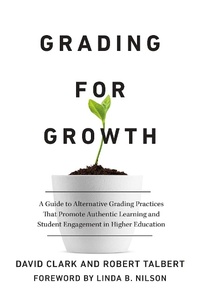
Grading for Growth
A Guide to Alternative Grading Practices that Promote Authentic Learning and Student Engagement in Higher Education
1st Edition
Published on 3. July 2023
262 pages
978-1-000-97543-7 (ISBN)
Description

Are you satisfied with your current and traditional grading system? Does it accurately reflect your students' learning and progress? Can it be gamed? Does it lead to grade-grubbing and friction with your students?The authors of this book - two professors of mathematics with input from colleagues across disciplines and institutions - offer readers a fundamentally more effective and authentic approach to grading that they have implemented for over a decade.
Recognizing that traditional grading penalizes students in the learning process by depriving them of the formative feedback that is fundamental to improvement, the authors offer alternative strategies that encourage revision and growth.Alternative grading is concerned with students' eventual level of understanding. This leads to big changes: Students take time to review past failures and learn from them. Conversations shift from "why did I lose a point for this" to productive discussions of content and process.Alternative grading can be used successfully at any level, in any situation, and any discipline, in classes that range from seminars to large multi-section lectures. This book offers a comprehensive introduction to alternative grading, beginning with a framework and rationale for implementation and evidence of its effectiveness. The heart of the book includes detailed examples - including variations on Standards-Based Grading, Specifications Grading, and ungrading -- of how alternative grading practices are used in all kinds of classroom environments, disciplines and institutions with a focus on first-hand accounts by faculty who share their practices and experience. The book includes a workbook chapter that takes readers through a step-by-step process for building a prototype of their own alternatively graded class and ends with concrete, practical, time-tested advice for new practitioners.
The underlying principles of alternative grading involve?Evaluating student work using clearly defined and context-appropriate content standards.?Giving students helpful, actionable feedback.?Summarizing the feedback with marks that indicate progress rather than arbitrary numbers.?Allowing students to revise without penalty, using the feedback they receive, until the standards are met or exceeded.
This book is intended for faculty interested in exploring alternative forms of learning assessment as well as those currently using alternative grading systems who are looking for ideas and options to refine practice.
Recognizing that traditional grading penalizes students in the learning process by depriving them of the formative feedback that is fundamental to improvement, the authors offer alternative strategies that encourage revision and growth.Alternative grading is concerned with students' eventual level of understanding. This leads to big changes: Students take time to review past failures and learn from them. Conversations shift from "why did I lose a point for this" to productive discussions of content and process.Alternative grading can be used successfully at any level, in any situation, and any discipline, in classes that range from seminars to large multi-section lectures. This book offers a comprehensive introduction to alternative grading, beginning with a framework and rationale for implementation and evidence of its effectiveness. The heart of the book includes detailed examples - including variations on Standards-Based Grading, Specifications Grading, and ungrading -- of how alternative grading practices are used in all kinds of classroom environments, disciplines and institutions with a focus on first-hand accounts by faculty who share their practices and experience. The book includes a workbook chapter that takes readers through a step-by-step process for building a prototype of their own alternatively graded class and ends with concrete, practical, time-tested advice for new practitioners.
The underlying principles of alternative grading involve?Evaluating student work using clearly defined and context-appropriate content standards.?Giving students helpful, actionable feedback.?Summarizing the feedback with marks that indicate progress rather than arbitrary numbers.?Allowing students to revise without penalty, using the feedback they receive, until the standards are met or exceeded.
This book is intended for faculty interested in exploring alternative forms of learning assessment as well as those currently using alternative grading systems who are looking for ideas and options to refine practice.
Reviews / Votes
"In this book, Clark and Talbert offer the finest compilation of the weaknesses of traditional grading...that I have ever run across. They then present 'Four Pillars of Alternative Grading,' shared by all the emerging grading systems that their book addresses: Standards-Based Grading, Specifications Grading, and Ungrading. Among these pillars are clearly defined performance expectations and a focus on encouraging student progress.Clark and Talbert even move beyond these three systems to all kinds of partial conversions and hybrid variations on them. These are not just hypothetical variants. The authors describe these variants, along with the 'pure' forms, as implemented in actual courses that have used them. One variant even integrates student portfolios. These examples come from disparate institutions and encompass a variety of courses: from STEM to humanities, from small to truly large classes, from lecture-based to lab-based to studio labs, from the one-instructor creation to the tightly coordinated multi-section type-something for everyone. And something to give courage to everyone who wants to explore alternative grading.
This book makes it easy to dip your toe into the water. One entire chapter is a 'workbook' to guide the changeover, and it asks only that you make a partial conversion involving only one or two of the Four Pillars and just a few aspects of your course. This guidance makes you think deeply about your course in general-what is special about it, why you are teaching it, how it is structured, who the students are, and what different final grades mean."
"Have you heard about alternative assessment but weren't sure how to make it happen? Worried about rigor? Check. Worried about class size? Check. Worried about shared curricula? STEM? Labs? Grading for Growth, organized around four 'pillars,' has you covered. Faculty members in any discipline, institution, and position, will appreciate the detailed ideas of how to transform classes partially or completely. Come for the explanation of grading; stay for the wisdom about teaching in general."
Susan D. Blum, Professor of Anthropology, University of Notre Dame, editor of Ungrading: Why Rating Students Undermines Learning (and What to Do Instead), and author of the forthcoming Schoolishness: Alienated Education and the Quest for Authentic Learning, Cornell
"It's become clear that traditional grading is a poor-even damaging-choice for meaningfully assessing learning. But the vast range of critiques and alternative approaches can seem overwhelming. Fear not: David Clark and Robert Talbert are here to help us navigate the complicated landscape of grading and assessment. This thorough, informative, and humane book is perfect for those of us looking to do better for our students, no matter where we are on our own 'ungrading' journey."
Kevin Gannon, Director of the Center for the Advancement of Faculty Excellence and Professor of History, Queens University of Charlotte
More details
Edition
1. Auflage
Language
English
Place of publication
London
United Kingdom
Publishing group
Taylor & Francis Ltd
Target group
College/higher education
Professional and scholarly
ISBN-13
978-1-000-97543-7 (9781000975437)
Copyright in bibliographic data and cover images is held by Nielsen Book Services Limited or by the publishers or by their respective licensors: all rights reserved.
Schweitzer Classification
Other editions
Additional editions
David Clark | Robert Talbert
Grading for Growth
A Guide to Alternative Grading Practices that Promote Authentic Learning and Student Engagement in Higher Education
Book
07/2023
Routledge
€45.20
Shipment within 3-4 weeks
David Clark | Robert Talbert
Grading for Growth
A Guide to Alternative Grading Practices that Promote Authentic Learning and Student Engagement in Higher Education
Book
07/2023
Routledge
€196.40
Shipment within 3-4 weeks
Persons
David Clark is an Associate Professor in the Department of Mathematics at Grand Valley State University. As a classroom teacher, his classes are active, engaging, and highly student centered. His research also centers on students, especially through projects that introduce them to mathematical research through puzzles and games. David has won numerous teaching awards, including the Mathematical Association of America's national Alder Award. He lives with his wife Sarah in Grand Rapids, Michigan where he hikes, gardens, and plays board games (usually losing).
Robert Talbert is a Professor in the Department of Mathematics at Grand Valley State University. Robert has experimented with and advocated for innovation in teaching and learning throughout his 25-year career in higher education. Primarily a classroom instructor, he has also served as Scholar-in-Residence at Steelcase, Inc., and held an appointment as Presidential Fellow for the Advancement of Learning in the GVSU President's Office, where he coordinated large-scale initiatives on teaching innovation and built communities of practice around alternative grading. Robert lives in Allendale, Michigan with his wife, two teenage children, and three cats. He aspires to spend more time kayaking or playing bass guitar than in front of a computer.
Robert Talbert is a Professor in the Department of Mathematics at Grand Valley State University. Robert has experimented with and advocated for innovation in teaching and learning throughout his 25-year career in higher education. Primarily a classroom instructor, he has also served as Scholar-in-Residence at Steelcase, Inc., and held an appointment as Presidential Fellow for the Advancement of Learning in the GVSU President's Office, where he coordinated large-scale initiatives on teaching innovation and built communities of practice around alternative grading. Robert lives in Allendale, Michigan with his wife, two teenage children, and three cats. He aspires to spend more time kayaking or playing bass guitar than in front of a computer.
Content
Case Study List Foreword Acknowledgments Part 1 What is Alternative Grading? 1. What this book is about 2. Why do we grade? 3. A framework for alternative grading 4. Does alternative grading work? Part 2 What Alternative Grading Can Look Like 5. Standards-Based Grading 6. Specifications Grading 7. Hybrid systems 8. Large classes 9. Lab classes 10. Partial conversions Part 3 Making Alternative Grading Work for You 11. A workbook for alternative grading 12. How to do it 13. What's next? Appendix. Frequently asked questions References
