

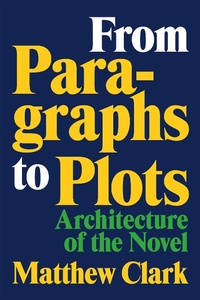
From Paragraphs to Plots
Description

The novel has often been characterized as the art form without a form. Although there may not be any rules for how to write a novel, as Matthew Clark shows in his new work of practical analysis, a good novel is as carefully formed as a good poem.
From Paragraphs to Plots uncovers large compositional features of narrative construction, thereby excavating elements that constitute the architecture of the novel. Clark begins by discussing the segmentation of narratives, from the paragraph level up to the whole novel, with case studies of the composition of Jane Austen's Emma and Virginia Woolf's Mrs. Dalloway. The next chapter explores an important, though often neglected, feature of narrative architecture called ring composition: a particular kind of repetition where the beginning and the end of a text are the same or similar. From there, Clark analyzes in detail two novels, Ford Madox Ford's The Good Soldier and Joseph Heller's Catch-22, identifying the repetitions, inversions, links, and fragmented narrations that comprise each narrative.
The book's second half focuses on simple and complex plot forms. Examining iterations of simple forms-plots that begin with a specific initiating event and proceed in an essentially regular chronological progression from beginning to middle to end-Clark outlines several common beginnings (Arrival, Departure, Meeting, Need, Birth, Death) and endings (Departures, Returns, Marriages, Need Satisfied, Death), along with a short account of less common ways to begin a novel. Subsequent discussions examine devices used in complex plot forms, such as Beginning with the Ending, Second Chapter Retrospects, Ghosts from the Past, Multiple Retrospects, One-Day Novels, One-Year Novels, Mirror Plots, Simultaneous Narration, Unnatural Chronology, and Non-Narrative Elements. The final chapter draws together the preceding discussions with a detailed case study of a recent novel, Viet Thanh Nguyen's Pulitzer Prize-winning The Sympathizer.
By analyzing common practices of narrative construction, From Paragraphs to Plots identifies sources of beauty and meaning in literature, approaching the aesthetic and the thematic as simultaneous and inextricable.
More details
Other editions
Additional editions

Person
Content
- Cover
- Contents
- Acknowledgments
- Introduction
- 1. The Composition of Emma and Mrs. Dalloway
- 2. Ring Composition
- 3. The Composition of The Good Soldier and Catch-22
- 4. Simple Plot Forms
- 5. Complex Plot Forms, Part I
- 6. Complex Plot Forms, Part II
- 7. Viet Thanh Nguyen's The Sympathizer
- Coda
- Notes
- References
- Index
