

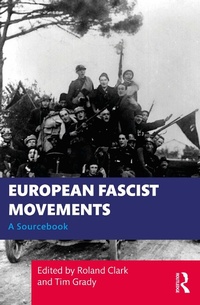
European Fascist Movements
A Sourcebook
1st Edition
Published on 31. May 2023
426 pages
978-1-000-86932-3 (ISBN)
Description

This volume offers a fresh and original collection of primary sources on interwar European fascist movements. These sources reflect new approaches to fascism that emphasise the practical, transnational experience of fascism as a social movement, contextualising ideological statements within the historical moments they were produced.
Divided into 18 geographically based chapters, contributors draw together the history of various fascist and right-wing movements, selecting sources that reflect themes such as transnational ties, aesthetics, violence, female activism, and the instrumentalisation of race, gender, and religion. Each chapter provides a chronological, narrative account of movements interspersed with complete primary sources, from political speeches, internal movement circulars and articles, police reports, oral history, songs and music, photographs, artworks, poetry, and anti-fascist sources. The volume as a whole seeks to introduce readers to the diversity of fascist groups across the continent, to show how fascist groups were constituted through social bonds, rather than around fixed ideologies, and to capture the inexperience and ad hoc character of early fascist groups.
With an Introduction that explains the volume's theoretical approach and elaborates on the chronology of European fascism, this is the perfect sourcebook for any student of Modern European history and politics.
The book is accompanied by a free app, available for download for iOS and Android from: https://www.liverpool.ac.uk/it/app-directory/fascistmovements/
You can use the app to identify places where fascist groups were active during the 1920s and 1930s, and to get a glimpse of what life was like during 'the age of fascism'. The app includes interactive maps, descriptions of 76 points of interest, and images for each point of interest.
Divided into 18 geographically based chapters, contributors draw together the history of various fascist and right-wing movements, selecting sources that reflect themes such as transnational ties, aesthetics, violence, female activism, and the instrumentalisation of race, gender, and religion. Each chapter provides a chronological, narrative account of movements interspersed with complete primary sources, from political speeches, internal movement circulars and articles, police reports, oral history, songs and music, photographs, artworks, poetry, and anti-fascist sources. The volume as a whole seeks to introduce readers to the diversity of fascist groups across the continent, to show how fascist groups were constituted through social bonds, rather than around fixed ideologies, and to capture the inexperience and ad hoc character of early fascist groups.
With an Introduction that explains the volume's theoretical approach and elaborates on the chronology of European fascism, this is the perfect sourcebook for any student of Modern European history and politics.
The book is accompanied by a free app, available for download for iOS and Android from: https://www.liverpool.ac.uk/it/app-directory/fascistmovements/
You can use the app to identify places where fascist groups were active during the 1920s and 1930s, and to get a glimpse of what life was like during 'the age of fascism'. The app includes interactive maps, descriptions of 76 points of interest, and images for each point of interest.
Reviews / Votes
"This is an important collection of sources, many available in English for the first time. European Fascist Movements gives the lie to the fascists' own claims to be unified, well-organised and ideologically rigorous, showing instead how they grew in an ad hoc and reactive fashion, shape-shifting as circumstances demanded."Professor Dan Stone, Royal Holloway, University of London
"This book is the product of a unique convergence of experts across the widest possible range of country case studies who have supplied the best of their expertise, not only in terms of framing narratives but also in terms of curating lists of previously unknown to most primary sources ...What it also manages to do is to be supremely useful to students of fascism while also acquainting more advanced researchers with sources that they would not have come across before."
Professor Aristotle Kallis, Keele University
More details
Edition
1. Auflage
Language
English
Place of publication
London
United Kingdom
Publishing group
Taylor & Francis Ltd
Target group
College/higher education
Illustrations
6 Line drawings, black and white; 32 Halftones, black and white; 38 Illustrations, black and white
ISBN-13
978-1-000-86932-3 (9781000869323)
Copyright in bibliographic data and cover images is held by Nielsen Book Services Limited or by the publishers or by their respective licensors: all rights reserved.
Schweitzer Classification
Other editions
Additional editions
Book
05/2023
1st Edition
Routledge
€197.60
Shipment within 15-20 days
Book
05/2023
1st Edition
Routledge
€58.50
Shipment within 15-20 days
Persons
Roland Clark is a Reader in Modern European History at the University of Liverpool. He is the author of Holy Legionary Youth (2015) and Sectarianism and Renewal in 1920s Romania (2021) as well as numerous articles and book chapters. His research interests include fascism, social movements, antisemitism, the Holocaust, and religion.
Tim Grady is Professor of Modern European History at the University of Chester. His most recent book is A Deadly Legacy: German Jews and the Great War (2017). His research focusses on war, memory, and the contested legacies of conflict.
Tim Grady is Professor of Modern European History at the University of Chester. His most recent book is A Deadly Legacy: German Jews and the Great War (2017). His research focusses on war, memory, and the contested legacies of conflict.
Content
European Fascist Movements: An Introduction 1. Italy 2. Germany 3. Austria 4. Belgium 5. Britain 6. Croats 7. Finland 8. France 9. Hungary 10. Ireland 11. Latvia 12. Netherlands 13. Romania 16. Slovaks 15. Spain 16. Czechoslovakia's Germans 17. Sweden 18. Ukrainians
