

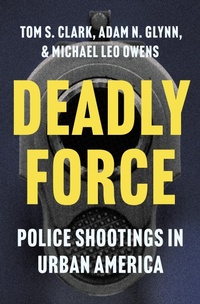
Deadly Force
Police Shootings in Urban America
1st Edition
Published on 1. April 2025
320 pages
978-0-691-26083-9 (ISBN)
Description

A groundbreaking study of when, where, and whom police shoot in America's largest cities
Police shootings in America spark outrage and protest and raise questions about police use of lethal force. Yet despite the attention given to high-profile shootings, it is extremely difficult to draw wider conclusions about the frequency and outcomes of police gunfire because there is no systematic and centralized source of information on these incidents. This pioneering book draws on original data, compiled by the authors, to examine police shootings, both fatal and non-fatal, in hundreds of American cities. It documents racial disparities in shooting incidents and shows that the media spotlight on the most shocking fatal shootings tell only part of the story of police gunfire in our cities.
The authors find that there are patterns in when, where, and whom the police shoot, and they present strong evidence of unjustifiable disparities. It's not just that young, unarmed Black men are disproportionately subjected to gunfire during encounters with police officers; there is also a disproportionate concentration of shootings in the places where most Black and Hispanic urbanites live, even accounting for violent crime rates and other factors. As a consequence, Black and Hispanic residents of large cities are disproportionately exposed to police gunfire, even when they are not themselves the targets of it. The authors offer other insights as well, exploring the connection between police department funding and rates of shootings, and considering the influence of a city's political leadership on police use of gunfire. It is only through a deeper understanding of police shootings, the authors argue, that we can reduce their incidence and make effective reform possible.
Police shootings in America spark outrage and protest and raise questions about police use of lethal force. Yet despite the attention given to high-profile shootings, it is extremely difficult to draw wider conclusions about the frequency and outcomes of police gunfire because there is no systematic and centralized source of information on these incidents. This pioneering book draws on original data, compiled by the authors, to examine police shootings, both fatal and non-fatal, in hundreds of American cities. It documents racial disparities in shooting incidents and shows that the media spotlight on the most shocking fatal shootings tell only part of the story of police gunfire in our cities.
The authors find that there are patterns in when, where, and whom the police shoot, and they present strong evidence of unjustifiable disparities. It's not just that young, unarmed Black men are disproportionately subjected to gunfire during encounters with police officers; there is also a disproportionate concentration of shootings in the places where most Black and Hispanic urbanites live, even accounting for violent crime rates and other factors. As a consequence, Black and Hispanic residents of large cities are disproportionately exposed to police gunfire, even when they are not themselves the targets of it. The authors offer other insights as well, exploring the connection between police department funding and rates of shootings, and considering the influence of a city's political leadership on police use of gunfire. It is only through a deeper understanding of police shootings, the authors argue, that we can reduce their incidence and make effective reform possible.
More details
Other editions
Additional editions
Book
06/2025
Princeton University Press
€31.50
Shipment within 10-20 days
Persons
Tom S. Clark is the David and Mary Winton Green Professor of Political Science at the University of Chicago. He is the author of The Limits of Judicial Independence and The Supreme Court: An Analytic History of Constitutional Decision-Making. Adam N. Glynn is professor of political science and quantitative theory and methods at Emory University. He is a coauthor of Varieties of Democracy: Measuring Two Centuries of Political Change. Michael Leo Owens is professor of political science at Emory University. He is the author of God and Government in the Ghetto: The Politics of Church-State Collaboration in Black America.
Content
- Cover
- Contents
- Acknowledgments
- Preface
- 1. Introduction
- 1.1 Police Shootings
- 1.2 Systemic Challenges to Counting Shootings
- 1.3 Inequalities of Police Shootings
- 1.4 A Few Preliminaries
- 1.5 Organization of the Book
- 2. Chutes and Ladders: Collecting Records of Police Shootings
- 2.1 Common Sources of Information about Police Shootings
- 2.2 Collecting Data by Open Records Requests
- 2.3 Ultimately, What Did We Get?
- 2.4 Transparency and Policing in American Cities
- 3. Good Records?
- 3.1 Representative Responses?
- 3.2 Accurate Responses?
- 4. How Many People Do the Police Shoot?
- 4.1 How Many Police Shootings?
- 4.2 Predicting Police Shootings?
- 4.3 What Does It All Mean?
- 5. Where Do the Police Shoot?
- 5.1 Neighborhood Violence and Police Shootings
- 5.2 Socioeconomic Class and Police Shootings
- 5.3 Neighborhood Racial Composition and Police Shootings
- 5.4 Crime, Class, Race, and Police Shootings
- 6. Who Do the Police Shoot?
- 6.1 Race and Police Shootings
- 6.2 Gender and Police Shootings
- 6.3 Age, Weapons, and Police Shootings
- 6.4 The Big Picture
- 6.5 Conclusion
- 7. When Police Shootings Kill
- 7.1 Fatality Rates in Police Shootings
- 7.2 Explaining Differences in Fatality Rates
- 7.3 Racial Disparities in Fatalities
- 7.4 Conclusion
- 8. Conclusion
- 8.1 What We Learned about Police Shootings
- 8.2 Situating Our Findings
- 8.3 A Plea for Greater Transparency
- 8.4 Police Discretion to Shoot
- 8.5 Implications for American Democracy
- Appendix
- A.1 Appendix to Chapter 2
- A.2 Appendix to Chapter 3
- A.3 Appendix to Chapter 4
- A.4 Appendix to Chapter 5
- A.5 Appendix to Chapter 7
- Notes
- Bibliography
- Index
