

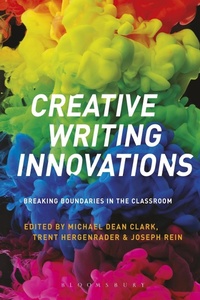
Creative Writing Innovations
Breaking Boundaries in the Classroom
1st Edition
Published on 23. February 2017
240 pages
978-1-4742-9718-9 (ISBN)
Description

When teachers experiment, students benefit. When students gain confidence to pursue their own literary experiments, creative writing can become a life-changing experience.
With chapters written by experienced teachers and classroom innovators, Creative Writing Innovations builds on these principles to uncover the true potential of the creative writing classroom. Rooted in classroom experience, this book takes teaching beyond the traditional workshop model to explore topics such as multi-media genres, collaborative writing and field-based work, as well as issues of identity. Taken together, this is an essential guide for teachers of creative writing at all levels from the authors and editors of Creative Writing in the Digital Age.
With chapters written by experienced teachers and classroom innovators, Creative Writing Innovations builds on these principles to uncover the true potential of the creative writing classroom. Rooted in classroom experience, this book takes teaching beyond the traditional workshop model to explore topics such as multi-media genres, collaborative writing and field-based work, as well as issues of identity. Taken together, this is an essential guide for teachers of creative writing at all levels from the authors and editors of Creative Writing in the Digital Age.
More details
Edition
1. Auflage
Language
English
Place of publication
London
United Kingdom
Publishing group
Bloomsbury Publishing PLC
Target group
College/higher education
Professional and scholarly
Illustrations
1 b/w illustration
ISBN-13
978-1-4742-9718-9 (9781474297189)
Copyright in bibliographic data and cover images is held by Nielsen Book Services Limited or by the publishers or by their respective licensors: all rights reserved.
Schweitzer Classification
Other editions
Additional editions
Michael Dean Clark | Trent Hergenrader | Joseph Rein
Creative Writing Innovations
Breaking Boundaries in the Classroom
Book
08/2018
Bloomsbury Academic
€63.32
Shipment within 15-20 days
Persons
Michael Dean Clark is Associate Professor of Writing at Azusa Pacific University, USA. Formerly an award-winning journalist, his fiction and non-fiction work has appeared in Pleiades, Fast Forward, Relief, and a number of other periodicals.
Trent Hergenrader is an Assistant Professor at the Rochester Institute of Technology, USA. He is a co-founder of the Creative Writing Studies Organization and the Journal of Creative Writing Studies and the author of Collaborative Worldbuilding for Writers and Gamers.
Joseph Rein is Assistant Professor of Creative Writing at the University of Wisconsin, River Falls, USA. He is the editor of Dispatches from the Classroom and his fiction, poetry and essays have appeared in such publications as The Pinch Literary Magazine, Iron Horse Literary Review, and Ruminate Magazine. He is also an award-winning short-film screenwriter.
Trent Hergenrader is an Assistant Professor at the Rochester Institute of Technology, USA. He is a co-founder of the Creative Writing Studies Organization and the Journal of Creative Writing Studies and the author of Collaborative Worldbuilding for Writers and Gamers.
Joseph Rein is Assistant Professor of Creative Writing at the University of Wisconsin, River Falls, USA. He is the editor of Dispatches from the Classroom and his fiction, poetry and essays have appeared in such publications as The Pinch Literary Magazine, Iron Horse Literary Review, and Ruminate Magazine. He is also an award-winning short-film screenwriter.
Content
1. Introduction
Part 1: Rethinking the Workshop
2. Invention and Early Process: A framework for the introductory multi-genre Creative Writing course (Timothy Mayers, Millersville University, USA)
3. Against Undergraduate Creative Writing: Or, how to trick students into wanting what they need (Katharine Haake, California State University-Northridge, USA)
4. Space Changing and Time Traveling: Empowering evolutionary creative writing (Graeme Harper, Oakland University, USA)
5. Rocks are Hard; There Are Many Kinds of Rocks: A meta-workshop for undergraduate writers (Rachel Himmelheber, Warren Wilson College, USA)
6. Emphasizing the Macro: An argument for the sequence graduate workshop (Derrick Harriell, University of Mississippi, USA
Part 2: Expanding Genre
7. The Poetry of Music, the Music of Poetry (Tom Hunley, Western Kentucky University, USA)
8. Musico-Literary Miscegenations: Word and sound relationships in creative writing pedagogy (Hazel Smith, University of Western Sydney, Australia)
9. Words with Borders, Projects Without: The collaborative possibilities of screenwriting (Joseph Rein, University of Wisconsin-River Falls, USA)
10. Non-Sensical Sense: Impressions as connections in creative nonfiction (Michael Dean Clark, Azusa Pacific University, USA)
Part 3: Creative Collaborations
11. Collaborative Story Writing and the Question of Influence (Mary Ann Cain, Indiana University-Purdue University Fort Wayne, USA)
12. Steampunk Rochester: A collaborative, location-based, interdisciplinary project (Trent Hergenrader, Rochester Institute of Technology, USA)
13. Place-Based Pedagogy and Creative Writing as a Fieldwork Course (Janelle Adsit, Humboldt State University, USA)
14. Our Town: Teaching Creative Writing students to love research and collaboration (Cathy Day, Ball State University, USA)
Part 4: Identity and the Creative Writing Classroom
15. Radical Inclusivity: Honesty and agony in an "imperfect" Creative Writing classroom (Tonya Hegamin, Medgar Evers College, USA)
16. Genre-Queering the Creative Writing Classroom (Ching-In Chen, University of Wisconsin-Milwaukee, USA)
17. Pedagogy and Authority in Teaching The Wasteland: Authorial voices and postcolonial criticism (Prageeta Sharma, University of Montana in Missoula, USA)
Index
Part 1: Rethinking the Workshop
2. Invention and Early Process: A framework for the introductory multi-genre Creative Writing course (Timothy Mayers, Millersville University, USA)
3. Against Undergraduate Creative Writing: Or, how to trick students into wanting what they need (Katharine Haake, California State University-Northridge, USA)
4. Space Changing and Time Traveling: Empowering evolutionary creative writing (Graeme Harper, Oakland University, USA)
5. Rocks are Hard; There Are Many Kinds of Rocks: A meta-workshop for undergraduate writers (Rachel Himmelheber, Warren Wilson College, USA)
6. Emphasizing the Macro: An argument for the sequence graduate workshop (Derrick Harriell, University of Mississippi, USA
Part 2: Expanding Genre
7. The Poetry of Music, the Music of Poetry (Tom Hunley, Western Kentucky University, USA)
8. Musico-Literary Miscegenations: Word and sound relationships in creative writing pedagogy (Hazel Smith, University of Western Sydney, Australia)
9. Words with Borders, Projects Without: The collaborative possibilities of screenwriting (Joseph Rein, University of Wisconsin-River Falls, USA)
10. Non-Sensical Sense: Impressions as connections in creative nonfiction (Michael Dean Clark, Azusa Pacific University, USA)
Part 3: Creative Collaborations
11. Collaborative Story Writing and the Question of Influence (Mary Ann Cain, Indiana University-Purdue University Fort Wayne, USA)
12. Steampunk Rochester: A collaborative, location-based, interdisciplinary project (Trent Hergenrader, Rochester Institute of Technology, USA)
13. Place-Based Pedagogy and Creative Writing as a Fieldwork Course (Janelle Adsit, Humboldt State University, USA)
14. Our Town: Teaching Creative Writing students to love research and collaboration (Cathy Day, Ball State University, USA)
Part 4: Identity and the Creative Writing Classroom
15. Radical Inclusivity: Honesty and agony in an "imperfect" Creative Writing classroom (Tonya Hegamin, Medgar Evers College, USA)
16. Genre-Queering the Creative Writing Classroom (Ching-In Chen, University of Wisconsin-Milwaukee, USA)
17. Pedagogy and Authority in Teaching The Wasteland: Authorial voices and postcolonial criticism (Prageeta Sharma, University of Montana in Missoula, USA)
Index
