

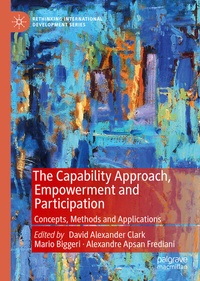
The Capability Approach, Empowerment and Participation
Description

More details
Other editions
Additional editions
Persons
David Alexander Clark is Affiliated Lecturer in the Centre of Development Studies at the University of Cambridge, UK.
Mario Biggeri is Associate Professor in Development Economics at the Department of Economics and Management at the University of Florence, Italy.
Alexandre Apsan Frediani is Associate Professor in the Bartlett Development Planning Unit at University College London, UK.
Content
1. The Human Development and Capability Approach - The Role of Empowerment and Participation.- 2. The Practice of Participation and the Capability Approach.- 3. Power and Deliberative Participation in Sen's Capability Approach.- 4. Balancing Pessimism of the Intellect and Optimism of the Will: Some Reflections on the Capability Approach, Gender, Empowerment and Education.- 5. Notions of Empowerment and Participation: Contributions from and to the Capability Approach.- 6. Process and Outcomes: participation and empowerment in a multidimensional poverty framework.- 7. Participatory Development: A Sustainable Approach for Reducing Inequality and Fighting Poverty? The Example of Disability Policies in Afghanistan.- 8. Children and Youth Participation in Decision Making and Research Processes.- 9. The Integrated Capabilities Framework: Exploring Multiculturalism and Human Well-Beingin Participatory Settings.- 10. Participatory Research Methods and the Capability Approach: Researching the Housing Dimensions of Squatter Upgrading Programmes in Salvador da Bahia, Brazil.- 11. Participatory Monitoring of Development Projects in the South Pacific.- 12. Planning and Managing for Human Development: What Contribution Can the Capability Approach Make?.- 13. Emancipatory Research as Empowerment: An Illustration from a Research Study of Persons with Disabilities in Palestine.- 14. Capability Development and Decentralisation.- 15. Participation, Empowerment and Capabilities: Key Lessons and Future Challenges
