

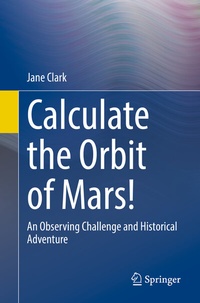
Calculate the Orbit of Mars!
Description

This book shows readers how to calculate the orbit of Mars, based on their own observations and using observations made by the author. The historical, observational, and analytical aspects of the project to measure the orbit of Mars are all combined in this one book!
Determining the orbit of Mars is particularly important, as originally solving this problem required the founding of modern science. Clark discusses how people came to believe in the Newtonian model of the Solar System, works through the mathematical basis for the theory of gravity, and shows how Newton ruled out the possibility of alternative theories. Readers also learn how it became possible to accurately measure the positions of Mars from a moving, spinning platform-the Earth.
This mid-level observational challenge is well within reach of most serious amateur astronomers. For the observations, only a telescope with auto-guiding capability and the ability to mount a digital single lens reflex (DSLR) camera is required. For the calculations, it is assumed that the reader has a science, engineering, or mathematics background and is familiar with calculus, vectors, and trigonometry.
Reviews / Votes
"It is a book that can be followed by anyone who has taken A-level mathematics, albeit fully understood only if they have read the subject for at least a year at university. . This is a unique text, and represents a rare piece of individual research and writing that has much to commend it. . If you enjoy a mathematical challenge it will be well worth your while to obtain . ." (Richard McKim, The Observatory, Vol. 142 (1291), December, 2022)More details
Other editions
Additional editions
Person
Jane Clark has a Bachelor of Science with First Class Honours Physics from the University of London, a PhD in physics from University of Warwick, and an MBA from the University of Warwick. She was a Postdoctoral Research Associate at Case Western Reserve University, and she has over 30 years of experience in industrial research and development.
Previously published books include Measure Solar System Objects and their Movements for Yourself! (Springer 2009) and Viewing and Imaging the Solar System: A Guide for Amateur Astronomers (Springer 2014), both in Springer's Patrick Moore's Practical Astronomy Series. Other works include "An Experience to Remember," a short comedy play about astronomers shown at the Alma Theatre, Bristol in June 2016.
