

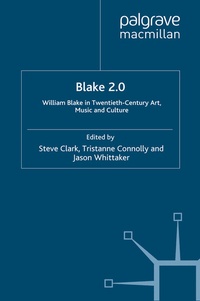
Blake 2.0
William Blake in Twentieth-Century Art, Music and Culture
1st Edition
Published on 24. January 2012
XIII, 309 pages
978-0-230-36668-8 (ISBN)
Description

Blake said of his works, 'Tho' I call them Mine I know they are not Mine'. So who owns Blake? Blake has always been more than words on a page. This volume takes Blake 2.0 as an interactive concept, examining digital dissemination of his works and reinvention by artists, writers, musicians, and filmmakers across a variety of twentieth-century media.
Reviews / Votes
'A ground-breaking series of essays on the widely-spread and dynamic influence of Blake's composite art on the artistic practices of the twentieth century, right up to the emerging digital age.' - Professor Edward Larrissy, Queen's University Belfast, UK
More details
Series
Language
English
Place of publication
London
United Kingdom
Publishing group
Palgrave Macmillan UK
Target group
Professional and scholarly
Product notice
Reflowable
Illustrations
XIII, 309 p.
File size
5,82 MB
ISBN-13
978-0-230-36668-8 (9780230366688)
DOI
10.1057/9780230366688
Schweitzer Classification
Other editions
Additional editions
Book
01/2012
Palgrave Macmillan
€106.99
Shipment within 15-20 days
Persons
STEVE CLARK Visiting Professor at the Graduate School of Humanities and Sociology, University of Tokyo, Japan. He has edited several collections of essays on Blake, most recently
Blake, Modernity and Popular Culture
with Jason Whittaker (2007) and
Reception of Blake in the Orient with Masashi Suzuki
(2006).
TRISTANNE CONNOLLY Associate Professor of English at St. Jerome's University in the University of Waterloo, Canada. She is the author of William Blake and the Body (2002), and editor of several essay collections including Liberating Medicine 1720-1835 with Steve Clark (2009) and Queer Blake with Helen P. Bruder (2010).
JASON WHITTAKER Professor of Blake Studies and Head of the Department of Writing at University College Falmouth in Cornwall, UK. He has authored and edited eleven books, including Radical Blake: Influence and Afterlife from 1827 with Shirley Dent (2002), and is editor of the Blake 2.0 digital media network.
TRISTANNE CONNOLLY Associate Professor of English at St. Jerome's University in the University of Waterloo, Canada. She is the author of William Blake and the Body (2002), and editor of several essay collections including Liberating Medicine 1720-1835 with Steve Clark (2009) and Queer Blake with Helen P. Bruder (2010).
JASON WHITTAKER Professor of Blake Studies and Head of the Department of Writing at University College Falmouth in Cornwall, UK. He has authored and edited eleven books, including Radical Blake: Influence and Afterlife from 1827 with Shirley Dent (2002), and is editor of the Blake 2.0 digital media network.
Content
List of Illustrations Notes on Contributors Acknowledgements List of Abbreviations Introduction; J.Whittaker , S.Clark & T.Connolly PART I: BLAKEAN CIRCULATIONS Mirrored Text / Infinite Planes: Reception Aesthetics in Blake's Milton; M.Lussier 'Rouze up, O Young Men of the New Age!': William Blake, Theodore Roszak, and the Counter Culture of the 1960s-70s; P.Otto Digital Blake 2.0; R.Whitson 'Rob & Plunder... Translate & Copy & Buy & Sell & Criticise, but not Make': Blake and Copyright Today; S.Dent 'New matter': Mona Wilson's The Life of William Blake 85 Years On; A.Whitehead PART II: BLAKE AND VISUAL ART Celebration and Censure: William Blake and Stories of Masterliness in the British Art World, 1930-1959; C.Trodd Blake and Surrealism; M.Sung 'The Sculptor Silent Stands before His Forming Image': Blake and Contemporary Sculpture; M.Crosby 'Mental Joy & Mental Health / And Mental Friends & Mental Wealth': Blake and Art Therapy; P.Simpson PART III: BLAKE IN FILM AND GRAPHIC ARTS 'And did those feet?': Blake and the Role of the Artist in Post-War Britain; S.Matthews Film in a Time of Crisis: Blake, Dead Man, The New Math(s), and Last Days; M.Douglas 'The end of the world. That's a bad thing right?': Form and Function from William Blake to Alan Moore; M.J.A.Green PART V: BLAKE IN MUSIC Blake Set to Music; K.Davies 'Only the wings on his heels': Blake and Dylan; S.Clark & J.Keery 'He Took a Face from the Ancient Gallery': Blake and Jim Morrison; T.Connolly 'Hear the Drunken Archangel Sing': Blakean Notes in 1990s Pop Music; D.Fallon 'Mental Fight', 'Corporeal War', and Righteous Dub: The Struggle for 'Jerusalem', 1979-2009; J.Whittaker Works Cited Index
