

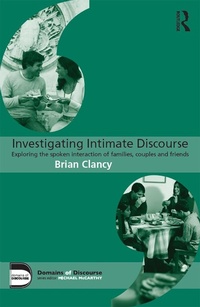
Investigating Intimate Discourse
Exploring the spoken interaction of families, couples and friends
Published on 16. October 2015
194 pages
978-1-317-37219-6 (ISBN)
Description

Intimate discourse - that between couples, family and close friends in private, non-professional settings - lies at the heart of our everyday linguistic experience. It creates and sustains our closest relationships.
Using an innovative blend of the community of practice model with a corpus linguistic methodology, Brian Clancy expertly reveals the patterns that characterise the shared linguistic repertoire of intimates. Corpus methods such as frequency and concordance are thoroughly introduced, exemplified and systematically employed in order to operationalise the concept of the community of practice in relation to intimate discourse. A half-million-word corpus of intimate data collected in various settings throughout Ireland provides the data for insights into patterns such as intimates' use of pronouns, vocatives, taboo language and pragmatic markers. The intimate linguistic repertoire that emerges is shown to facilitate the delicate balance between our instinctive desire to be involved in the lives of those closest to us while at the same time recognising their need for privacy and non-imposition.
Investigating Intimate Discourse will primarily be of interest to postgraduate students and researchers working in the area, and to those working in related areas such as discourse analysis, corpus linguistics, sociolinguistics and pragmatics. Advanced undergraduates taking modules in those subjects will also find the book useful.
Using an innovative blend of the community of practice model with a corpus linguistic methodology, Brian Clancy expertly reveals the patterns that characterise the shared linguistic repertoire of intimates. Corpus methods such as frequency and concordance are thoroughly introduced, exemplified and systematically employed in order to operationalise the concept of the community of practice in relation to intimate discourse. A half-million-word corpus of intimate data collected in various settings throughout Ireland provides the data for insights into patterns such as intimates' use of pronouns, vocatives, taboo language and pragmatic markers. The intimate linguistic repertoire that emerges is shown to facilitate the delicate balance between our instinctive desire to be involved in the lives of those closest to us while at the same time recognising their need for privacy and non-imposition.
Investigating Intimate Discourse will primarily be of interest to postgraduate students and researchers working in the area, and to those working in related areas such as discourse analysis, corpus linguistics, sociolinguistics and pragmatics. Advanced undergraduates taking modules in those subjects will also find the book useful.
Reviews / Votes
'How refreshing to have a study devoted to the most pervasive and important form of human interaction which remains relatively under-researched. Dr Clancy's study is insightful and thought-provoking and, through his astute choice of examples, he reminds us of just how central this form of communication is in building and maintaining our relationships with one another.' Martin Warren, The Hong Kong Polytechnic University, ChinaMore details
Series
Language
English
Place of publication
London
United Kingdom
Publishing group
Taylor & Francis Ltd
Target group
College/higher education
Illustrations
25 s/w Tabellen
25 Tables, black and white
File size
7,88 MB
ISBN-13
978-1-317-37219-6 (9781317372196)
Copyright in bibliographic data and cover images is held by Nielsen Book Services Limited or by the publishers or by their respective licensors: all rights reserved.
Schweitzer Classification
Other editions
Additional editions
Brian Clancy
Investigating Intimate Discourse
Exploring the spoken interaction of families, couples and friends
Book
10/2015
1st Edition
Routledge
€276.90
Shipment within 15-20 days
Brian Clancy
Investigating Intimate Discourse
Exploring the spoken interaction of families, couples and friends
Book
10/2015
1st Edition
Routledge
€79.10
Shipment within 15-20 days

Brian Clancy
Investigating Intimate Discourse
Book
10/2015
Routledge
Unfortunately, price unknown
Article exhausted; check different version
Person
Brian Clancy is a lecturer in academic writing and research methods at Mary Immaculate College, University of Limerick, Ireland. He is co-author of Introducing Pragmatics in Use (Routledge, 2011).
Content
1. Intimate Discourse: An Overview 2. Approaches to Analysing Intimate Discourse 3. A Framework for the Analysis of Intimate Discourse 4. The Shared Linguistic Repertoire of Intimates 5. The Pragmatics of 'Being Intimate' 6. Linguistic Variation and Intimate Discourse 7. Conclusion
