

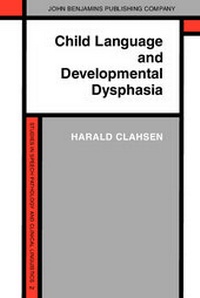
Child Language and Developmental Dysphasia
Linguistic studies of the acquisition of German
1st Edition
Published on 31. October 1991
X, 350 pages
978-90-272-7763-3 (ISBN)
Description

The subject of this two part work is the acquisition of language structure in which the development of syntax and morphology is examined by investigations on children without language problems and on children with developmental dysphasia. The author uses a comparative acquisition study to provide insights into the structure and development of the language acquisition device, which cannot be obtained by isolated analysis of only one type of learning. The theoretical framework used for the investigations is the learnability theory, in which acquisition models are proposed which are heavily influenced by theoretical linguistics. Part I shows how child grammar acquisition can be explained in the framework of learnability theory and Part II deals with deficiencies in normal grammar acquisition using the learnability theory.
More details
Other editions
Additional editions
Harald Clahsen
Child Language and Developmental Dysphasia
Linguistic studies of the acquisition of German
Book
10/1991
John Benjamins Publishing Co
€132.50
Shipment within 10-15 days
Persons
Content
- CHILD LANGUAGE AND DEVELOPMENTAL DYSPHASIA Linguistic Studies of the Acquisition of German
- Editorial page
- Title page
- Copyright page
- Preface
- Table of Contents
- Introduction
- PART I: FIRST LANGUAGE ACQUISITION
- 1. Theoretical approaches in language acquisition research
- 1.1 The functionalist approach
- 1.2 The theory of Operating Principles
- 1.2.1 A sketch of Slobin's model
- 1.2.2 On the analysis of transitivity markers
- 1.2.3 On the theoretical status of Operating Principles
- 1.3 Learnability theory
- 1.3.1 Learnability constraints
- 1.3.2 Grammatical theory and learnability
- 1.3.3 On the structure of the language acquisition device
- 2. Early child grammars
- 2.1 Some features of Stage I in German child language
- 2.2 A phrase structure grammar for phase II
- 2.3 Learnability considerations on syntactic categorisation
- 2.4 Parameter theory and the acquisition of word order
- 2.4.1 Pinker's analysis
- 2.4.2 An alternative solution within GB-theory
- 3. The grammar of a three year-old
- 3.1 Some features of phase IV in German child language
- 3.2 Syntactic structures in phase IV
- 3.3 Learning mechanisms for inflectional elements
- 3.3.1 On the construction of morphological paradigms
- 3.3.2 Verb inflection in German child language
- PART II: DEVELOPMENTAL DYSPHASIA
- 4. Grammar acquisition and dysphasia (with particular reference to the research situation in West Germany)
- 4.1 Linguistic features
- 4.2 Psycholinguistic aspects
- 4.3 Aims and basic hypotheses
- 4.4 On the design of the empirical investigation
- 4.4.1 Selecting the children
- 4.4.2 Analysing the linguistic data
- 4.4.3 Overview of the data investigated
- 5. Grammatical units
- 5.1 Nominal elements and the structure of the noun phrase
- 5.2 Adverbial elements and prepositional phrases
- 5.3 Verbal elements
- 5.4 Conjunctions
- 6. Selected areas of the inflectional system
- 6.1 Case markings
- 6.1.1 On the form and function of case markings in German
- 6.1.2 Case markings in dysphasia
- 6.1.3 A comparison with the acquisition of case morphology in normal children
- 6.2 Verb inflection
- 6.2.1 On subject-verb agreement in dysphasia
- 6.2.2 Functional analyses of the inflection of verbs in dysphasia
- 7. Word order
- 7.1 Verb placement
- 7.1.1 Overview: V1,V2 and verb-final patterns
- 7.1.2 Verb placement and verb inflection
- 7.1.3 Verb placement and verbal elements
- 7.2 Argument order
- 7.3 The position of the negator
- 8. Learnability theory and the acquisition of grammar
- 8.1 Child language development
- 8.2 Developmental dysphasia
- 9. Appendix
- 9.1 Profile charts
- 9.2 Transcripts
- Transcript: andreas 1
- Transcript: andreas 2
- Transcript: anja 1
- Transcript: anja 2
- Transcript: jonas 1
- Transcript: jonas 2
- Transcript: julia 1
- Transcript: julia 2
- Transcript: klaus 1
- Transcript: klaus 2
- Transcript: patrick
- Transcript: petra 1
- Transcript: petra 2
- Transcript: petra 3
- Transcript: Stefan
- Transcript: sven
- Transcript: wolfgang
- Bibliography
- Index
