

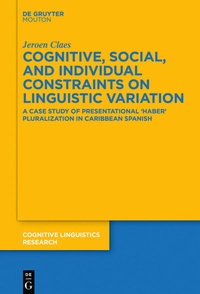
Cognitive, Social, and Individual Constraints on Linguistic Variation
A Case Study of Presentational 'Haber' Pluralization in Caribbean Spanish
1st Edition
Published on 19. December 2016
XVIII, 244 pages
978-3-11-052415-4 (ISBN)
Description

The present volume tries to answer the question: What constrains morphosyntactic variation? By analyzing the variable agreement of presentational haber ('there to be') in Caribbean Spanish with advanced statistical tools and theoretical constructs of Cognitive Sociolinguistics, psycholinguistics, and variationist sociolinguistics, it proposes an innovative theoretical model of the constraints that govern morphosyntactic variation.
More details
Series
Language
English
Place of publication
Berlin/Boston
Germany
Publishing group
de Gruyter Mouton
Target group
Professional and scholarly
US School Grade: College Graduate Student
Illustrations
36 ill., 30 tbl.
File size
3,31 MB
ISBN-13
978-3-11-052415-4 (9783110524154)
Schweitzer Classification
Other editions
Additional editions
Jeroen Claes
Cognitive, Social, and Individual Constraints on Linguistic Variation
A Case Study of Presentational 'Haber' Pluralization in Caribbean Spanish
E-Book
12/2016
1st Edition
De Gruyter Mouton
€149.95
Available for download
Jeroen Claes
Cognitive, Social, and Individual Constraints on Linguistic Variation
A Case Study of Presentational 'Haber' Pluralization in Caribbean Spanish
Book
12/2016
1st Edition
De Gruyter Mouton
€149.95
Shipment within 7-9 days
Person
Jeroen Claes
, Katholieke Universiteit Leuven, Belgium.
Content
- Intro
- Acknowledgements
- Contents
- List of figures
- List of tables
- Abbreviations and other conventions
- Chapter 1: Introduction
- 1 Introduction
- Part A: Preliminaries
- Chapter 2: Presentational haber pluralization
- 2 Presentational haber pluralization
- 2.1 Earlier studies in (perceptual) dialectology
- 2.2 Earlier studies in variationist sociolinguistics
- 2.3 Summary
- Chapter 3: Cognitive Construction Grammar and language variation
- 3 Cognitive Construction Grammar and language variation
- 3.1 Cognitive Construction Grammar
- 3.2 Cognitive Construction Grammar and language variation
- 3.3 Summary
- Chapter 4: Research questions and hypotheses
- 4 Research questions and hypotheses
- 4.1 Research questions
- 4.2 Hypotheses
- 4.3 Summary
- Chapter 5: Methodology
- 5 Methodology
- 5.1 Judgment sample, selection criteria, and stratification variables
- 5.2 Fieldwork methods
- 5.3 Transcription, selection of cases, and envelope of variation
- 5.4 Statistical toolkit
- 5.5 Comparative sociolinguistics
- 5.6 Summary
- Chapter 6: Semantic and syntactic properties of presentational haber
- 6 Semantic and syntactic properties of presentational haber
- 6.1 The meaning of the presentational haber constructions: POINTING-OUT
- 6.2 The nominal argument
- 6.3 The adverbial phrase
- 6.4 Implicit nominal arguments and adverbial phrases
- 6.5 Summary and box diagrams
- Part B: Cognitive, social, and individual constraints on presentational haber pluralization
- Chapter 7: Cognitive constraints on presentational haber pluralization
- 7 Cognitive constraints on presentational haber pluralization
- 7.1 Structure of the corpus and the regression models
- 7.2 Markedness of coding
- 7.3 Statistical preemption
- 7.4 Structural priming
- 7.5 Interaction between the linguistic predictors
- 7.6 Relative importance of the linguistic predictors
- 7.7 Summary
- Chapter 8: Social constraints on presentational haber pluralization
- 8 Social constraints on presentational haber pluralization
- 8.1 Social constraints: Age, education, and gender
- 8.2 Linguistic predictors across social groups
- 8.3 Relative importance of the linguistic predictors across social groups
- 8.4 Summary
- Chapter 9: Individual constraints on presentational haber pluralization
- 9 Individual constraints on presentational haber pluralization
- 9.1 Distribution across individuals
- 9.2 Random intercepts, slopes, and participant-specific regression coefficients
- 9.3 Linguistic predictors across individuals
- 9.4 The behavior of the Havana university graduates
- 9.5 Summary
- Chapter 10: Cognitive, social, and individual constraints on presentational haber pluralization
- 10 Cognitive, social, and individual constraints on presentational haber pluralization
- 10.1 Cognitive constraints
- 10.2 Social constraints
- 10.3 Individual constraints
- 10.4 Conclusion
- References
- Index
