

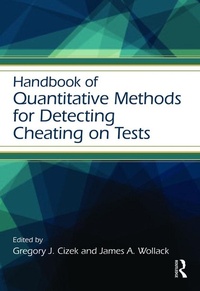
Handbook of Quantitative Methods for Detecting Cheating on Tests
Published on 26. October 2016
444 pages
978-1-317-58810-8 (ISBN)
Description

The rising reliance on testing in American education and for licensure and certification has been accompanied by an escalation in cheating on tests at all levels. Edited by two of the foremost experts on the subject, the Handbook of Quantitative Methods for Detecting Cheating on Tests offers a comprehensive compendium of increasingly sophisticated data forensics used to investigate whether or not cheating has occurred. Written for practitioners, testing professionals, and scholars in testing, measurement, and assessment, this volume builds on the claim that statistical evidence often requires less of an inferential leap to conclude that cheating has taken place than do other, more common sources of evidence.
This handbook is organized into sections that roughly correspond to the kinds of threats to fair testing represented by different forms of cheating. In Section I, the editors outline the fundamentals and significance of cheating, and they introduce the common datasets to which chapter authors' cheating detection methods were applied. Contributors describe, in Section II, methods for identifying cheating in terms of improbable similarity in test responses, preknowledge and compromised test content, and test tampering. Chapters in Section III concentrate on policy and practical implications of using quantitative detection methods. Synthesis across methodological chapters as well as an overall summary, conclusions, and next steps for the field are the key aspects of the final section.
This handbook is organized into sections that roughly correspond to the kinds of threats to fair testing represented by different forms of cheating. In Section I, the editors outline the fundamentals and significance of cheating, and they introduce the common datasets to which chapter authors' cheating detection methods were applied. Contributors describe, in Section II, methods for identifying cheating in terms of improbable similarity in test responses, preknowledge and compromised test content, and test tampering. Chapters in Section III concentrate on policy and practical implications of using quantitative detection methods. Synthesis across methodological chapters as well as an overall summary, conclusions, and next steps for the field are the key aspects of the final section.
Reviews / Votes
"Today, cheating increasingly presents ever-changing challenges to the integrity of test results used for admissions, graduation, certification, professional licensure, and accountability. Cizek and Wollack are two of the most recognized and cited experts on educational test security, and the Handbook of Quantitative Methods for Detecting Cheating on Tests provides the most comprehensive treatment of statistical methods for detection that simply must be incorporated into any large-scale assessment program used for high-stakes decisions."--Wayne Camara, Senior Vice President, Research, ACT
This edited volume has taken the importance of test security in test validation to a different level. It reflects the maturity of the field of cheating detection, whereby statistical probabilities are no longer presented as inferential leaps into vague, colluded, remote chances of cheating behavior; rather, they are presented using precise empirical evidence that identifies specific cheating behaviors on which one can act. The authors bring together comprehensive knowledge on increasing data forensics and methodologies alongside legally presentable evidence to help reduce the fraudulent use of test results. The book will sit atop my bookshelf for years to come.
--Ardeshir Geranpayeh, Head of Automated Assessment & Learning at Cambridge English Language Assessment, University of Cambridge, UK
More details
Series
Language
English
Place of publication
London
United Kingdom
Publishing group
Taylor & Francis Ltd
Target group
Professional and scholarly
Illustrations
71 s/w Abbildungen, 57 s/w Tabellen
72 Tables, black and white; 71 Illustrations, black and white
File size
6,31 MB
ISBN-13
978-1-317-58810-8 (9781317588108)
Copyright in bibliographic data and cover images is held by Nielsen Book Services Limited or by the publishers or by their respective licensors: all rights reserved.
Schweitzer Classification
Other editions
Additional editions
Gregory J. Cizek | James A. Wollack
Handbook of Quantitative Methods for Detecting Cheating on Tests
Book
10/2016
1st Edition
Routledge
€405.30
Shipment within 10-20 days
Gregory J. Cizek | James A. Wollack
Handbook of Quantitative Methods for Detecting Cheating on Tests
Book
09/2016
1st Edition
Routledge
€165.00
Shipment within 10-20 days
Persons
Gregory J. Cizek is the Guy B. Phillips Distinguished Professor of Educational Measurement and Evaluation in the School of Education at the University of North Carolina, Chapel Hill, USA.
James A. Wollack is Professor of Quantitative Methods in the Educational Psychology Department and Director of Testing and Evaluation Services at the University of Wisconsin, Madison, USA.
James A. Wollack is Professor of Quantitative Methods in the Educational Psychology Department and Director of Testing and Evaluation Services at the University of Wisconsin, Madison, USA.
Content
Editors' Introduction
SECTION I - INTRODUCTION
Chapter 1 - Exploring Cheating on Tests: The Context, the Concern, and the Challenges
Gregory J. Cizek and James A. Wollack
SECTION II - METHODOLOGIES FOR IDENTIFYING CHEATING ON TESTS
Section IIa - Detecting Similarity, Answer Copying, and Aberrance
Chapter 2 - Similarity, Answer Copying, and Aberrance: Understanding the Status Quo
Cengiz Zopluoglu
Chapter 3 - Detecting Potential Collusion Among Individual Examinees Using Similarity Analysis
Dennis D. Maynes
Chapter 4 - Identifying and Investigating Aberrant Responses Using Psychometrics-Based and Machine Learning-Based Approaches
Doyoung Kim, Ada Woo, and Phil Dickison
Section IIb - Detecting Preknowledge and Item Compromise
Chapter 5 - Detecting Preknowledge and Item Compromise: Understanding the Status Quo
Carol A. Eckerly
Chapter 6 - Detection of Test Collusion Using Cluster Analysis
James A. Wollack and Dennis D. Maynes
Chapter 7 - Detecting Candidate Preknowledge and Compromised Content Using Differential Person and Item Functioning
Lisa S. O'Leary and Russell W. Smith
Chapter 8 - Identification of Item Preknowledge by the Methods of Information Theory and Combinatorial Optimization
Dmitry Belov
Chapter 9 - Using Response Time Data to Detect Compromised Items and/or People
Keith A. Boughton, Jessalyn Smith, and Hao Ren
Section IIc - Detecting Unusual Gain Scores and Test Tampering
Chapter 10 - Detecting Erasures and Unusual Gain Scores: Understanding the Status Quo
Scott Bishop and Karla Egan
Chapter 11 - Detecting Test Tampering at the Group Level
James A. Wollack and Carol A. Eckerly
Chapter 12 - A Bayesian Hierarchical Model for Detecting Aberrant Growth at the Group Level
William P. Skorupski, Joe Fitzpatrick, and Karla Egan
Chapter 13 - Using Nonlinear Regression to Identify Unusual Performance Level Classification Rates
J. Michael Clark, William P. Skorupski, and Stephen Murphy
Chapter 14 - Detecting Unexpected Changes in Pass Rates: A Comparison of Two Statistical Approaches
Matthew Gaertner and Yuanyuan (Malena) McBride
SECTION III - THEORY, PRACTICE, AND THE FUTURE OF QUANTITATIVE DETECTION METHODS
Chapter 15 - Security Vulnerabilities Facing Next Generation Accountability Testing
Joseph A. Martineau, Daniel Jurich, Jeffrey B. Hauger, and Kristen Huff
Chapter 16 - Establishing Baseline Data for Incidents of Misconduct in the NextGen Assessment Environment
Deborah J. Harris and Chi-Yu Huang
Chapter 17 - Visual Displays of Test Fraud Data
Brett P. Foley
Chapter 18 - The Case for Bayesian Methods When Investigating Test Fraud
William P. Skorupski and Howard Wainer
Chapter 19 - When Numbers Are Not Enough: Collection and Use of Collateral Evidence to Assess the Ethics and Professionalism of Examinees Suspected of Test Fraud
Marc J. Weinstein
SECTION IV - CONCLUSIONS
Chapter 20 - What Have We Learned?
Lorin Mueller, Yu Zhang, and Steve Ferrara
Chapter 21 - The Future of Quantitative Methods for Detecting Cheating: Conclusions, Cautions, and Recommendations
James A. Wollack and Gregory J. Cizek
SECTION I - INTRODUCTION
Chapter 1 - Exploring Cheating on Tests: The Context, the Concern, and the Challenges
Gregory J. Cizek and James A. Wollack
SECTION II - METHODOLOGIES FOR IDENTIFYING CHEATING ON TESTS
Section IIa - Detecting Similarity, Answer Copying, and Aberrance
Chapter 2 - Similarity, Answer Copying, and Aberrance: Understanding the Status Quo
Cengiz Zopluoglu
Chapter 3 - Detecting Potential Collusion Among Individual Examinees Using Similarity Analysis
Dennis D. Maynes
Chapter 4 - Identifying and Investigating Aberrant Responses Using Psychometrics-Based and Machine Learning-Based Approaches
Doyoung Kim, Ada Woo, and Phil Dickison
Section IIb - Detecting Preknowledge and Item Compromise
Chapter 5 - Detecting Preknowledge and Item Compromise: Understanding the Status Quo
Carol A. Eckerly
Chapter 6 - Detection of Test Collusion Using Cluster Analysis
James A. Wollack and Dennis D. Maynes
Chapter 7 - Detecting Candidate Preknowledge and Compromised Content Using Differential Person and Item Functioning
Lisa S. O'Leary and Russell W. Smith
Chapter 8 - Identification of Item Preknowledge by the Methods of Information Theory and Combinatorial Optimization
Dmitry Belov
Chapter 9 - Using Response Time Data to Detect Compromised Items and/or People
Keith A. Boughton, Jessalyn Smith, and Hao Ren
Section IIc - Detecting Unusual Gain Scores and Test Tampering
Chapter 10 - Detecting Erasures and Unusual Gain Scores: Understanding the Status Quo
Scott Bishop and Karla Egan
Chapter 11 - Detecting Test Tampering at the Group Level
James A. Wollack and Carol A. Eckerly
Chapter 12 - A Bayesian Hierarchical Model for Detecting Aberrant Growth at the Group Level
William P. Skorupski, Joe Fitzpatrick, and Karla Egan
Chapter 13 - Using Nonlinear Regression to Identify Unusual Performance Level Classification Rates
J. Michael Clark, William P. Skorupski, and Stephen Murphy
Chapter 14 - Detecting Unexpected Changes in Pass Rates: A Comparison of Two Statistical Approaches
Matthew Gaertner and Yuanyuan (Malena) McBride
SECTION III - THEORY, PRACTICE, AND THE FUTURE OF QUANTITATIVE DETECTION METHODS
Chapter 15 - Security Vulnerabilities Facing Next Generation Accountability Testing
Joseph A. Martineau, Daniel Jurich, Jeffrey B. Hauger, and Kristen Huff
Chapter 16 - Establishing Baseline Data for Incidents of Misconduct in the NextGen Assessment Environment
Deborah J. Harris and Chi-Yu Huang
Chapter 17 - Visual Displays of Test Fraud Data
Brett P. Foley
Chapter 18 - The Case for Bayesian Methods When Investigating Test Fraud
William P. Skorupski and Howard Wainer
Chapter 19 - When Numbers Are Not Enough: Collection and Use of Collateral Evidence to Assess the Ethics and Professionalism of Examinees Suspected of Test Fraud
Marc J. Weinstein
SECTION IV - CONCLUSIONS
Chapter 20 - What Have We Learned?
Lorin Mueller, Yu Zhang, and Steve Ferrara
Chapter 21 - The Future of Quantitative Methods for Detecting Cheating: Conclusions, Cautions, and Recommendations
James A. Wollack and Gregory J. Cizek
