

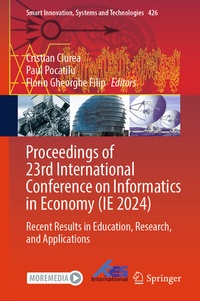
Proceedings of 23rd International Conference on Informatics in Economy (IE 2024)
Description

This book includes high-quality research papers presented at 23rd International Conference on Informatics in Economy (IE 2024), which is held in Bucharest, Romania, during May 2024. This book covers research results in business informatics and related computer science topics, such as IoT, mobile-embedded and multimedia solutions, e-society, enterprise and business solutions, databases and big data, artificial intelligence, data mining and machine learning, quantitative economics.
More details
Other editions
Additional editions
Persons
Cristian Ciurea is Professor at the Department of Economic Informatics and Cybernetics from Bucharest University of Economic Studies. He is also Head of department. He has graduated the Faculty of Economic Cybernetics, Statistics and Informatics from the Bucharest University of Economic Studies in 2007. He has a master's in Informatics Project Management (2010) and a Ph.D. in Economic Informatics (2011) from the Bucharest University of Economic Studies. He has a solid background in computer science and is interested in collaborative systems-related issues. Other fields of interest include intelligent systems, software metrics, data structures, object-oriented programming, windows applications programming, mobile devices programming and testing process automation for software quality assurance.
Paul Pocatilu graduated the Faculty of Cybernetics, Statistics and Economic Informatics in 1998. He achieved the Ph.D. in Economics in 2003 with thesis on Software Testing Cost Assessment Models. He has published as author and co-author over 45 articles in journals and over 40 articles on national and international conferences. He is author and co-author of 10 books, (Mobile Devices Programming and Software Testing Costs are two of them). He is Professor at the Department of Economic Informatics and Cybernetics within the Bucharest University of Economic Studies, Bucharest. He teaches courses, seminars and laboratories on Mobile Devices Programming, Economic Informatics, Computer Programming and Project Quality Management to graduate and postgraduate students. His current research areas are software testing, software quality, project management and mobile application development.
Florin Gheorghe Filip graduated in Automation at Politehnica University of Bucharest in 1970 and received his Ph.D. degree from the same university in 1982. He was elected as Corresponding Member of the Romanian Academy in 1991 and became Full Member of the Academy in 1999. During 2000-2010, he was Vice-President of the Romanian Academy (elected in 2000, re-elected in 2004, and 2006). In 2010, he was Elected President of the Information Science and Technology section of the Academy (re-elected in 2015, and 2019). He was Managing Director of National Institute for R&D in Informatics-ICI, Bucharest (1991-1997). He is Honorary Member of the Romanian Academy of Technical Sciences, and Academy of Sciences of Republic of Moldova.
