

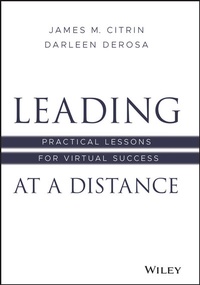
Leading at a Distance
Description

Leading at a Distance provides executives with the necessary skills to successfully lead in the new virtual workplace, backed by the research and expertise of global leadership firm Spencer Stuart. Although working remotely is not new, the global pandemic has placed virtual work at the center of everyday life. And it has thrust workforce strategies to the core of business operations globally. As the shift towards large-scale virtual work continues to grow and become a permanent fixture--by some estimates, 30% of the workforce will be working virtually - leaders must understand how to build virtual work environments that foster connected, engaged, and high-performing teams. Although some forward-thinking companies and not-for-profit organizations have made significant investments in technology and virtual collaboration, many others have simply joined the "Zoom culture" without fully appreciating what it takes to operate effectively at a distance on a sustained basis.
Leading at a Distance is a timely, research-based, and highly practical guide for developing and implementing strategies for conducting high-impact virtual work, building trust, and enhancing team unity. Designed to help leaders shape organizational culture remotely, this must-have resource demonstrates how to conduct virtual onboarding for senior leaders, build top teams from a distance, manage accountability in the new virtual environment, and much more. A hands-on toolkit filled with compelling examples, expert insights, and invaluable advice, this book:
* Provides clear guidance on establishing effective leadership in the virtual workplace
* Offers practical approaches for establishing strong relationships, increasing employee engagement, and coaching from a distance
* Addresses ways to keep geographically dispersed team members aligned and accountable
* Illustrates creative ideas for boosting team morale
* Features an overview of the unique challenges facing leaders in the virtual workplace
* Discusses often-overlooked topics such as virtual hiring and onboarding
Leveraging the authors' in-depth research and consulting experience, Leading at a Distance is required reading for anyone needing to adapt to a virtual way of working and develop their virtual leadership skills to maximize organizational effectiveness and performance.
More details
Other editions
Additional editions
Persons
DARLEEN DEROSA is a consultant in Spencer Stuart's Stamford office and is a core member of the Life Sciences and Leadership Advisory Services practices. She has over 15 years of consulting experience with a professional focus on talent management, executive assessment, virtual teams, and leadership development.
Content
Introduction xxiii
Chapter 1 What We Learned from the Pandemic: Our Research Shows Remote Work Is Here to Stay 1
Chapter 2 No Trust = No Team: The Formula for Building Cohesive Relationships Virtually 23
Chapter 3 What Does Good Look Like? Profile of High-Performing Virtual Teams 35
Chapter 4 How to RAMP Up Your Virtual Team's Performance: A Blueprint for Success 49
Chapter 5 Out of Sight, Not Out of Mind: How to Inspire and Motivate from Afar 65
Chapter 6 "You're on Mute": The Ultimate Guide for Hosting Virtual Meetings 79
Chapter 7 Hiring Without a Handshake: Discovering Successful Virtual Leaders 97
Chapter 8 Surviving Day One: A Toolkit for Remote Onboarding 111
Chapter 9 Continuous Improvement: High-Impact Coaching and Accountability at a Distance 129
Chapter 10 The Culture Conundrum: Building and Sustaining Culture Virtually 147
Afterword: The Virtual Road Ahead 165
Acknowledgments 177
About the Authors 185
Index 189
Introduction: The Virtual Revolution
At the start, we were all operating on adrenaline.
When the COVID-19 global pandemic broke in early 2020, millions of organizations and hundreds of millions of employees shifted on a dime to working remotely. A can-do spirit set in individually and collectively, fueled by the once-in-a-generation sense of shared humanity, driving people around the world to adapt and perform at unimaginably high levels of productivity. Employee engagement scores increased as CEOs and corporate leaders stepped up and communicated with much greater frequency, transparency, and authenticity than they had felt appropriate before the crisis set in. And a great many office workers, powered by Zoom, Teams, WebEx, and BlueJeans, quickly found joys in working from home and eliminating the grind of the daily commute and business travel.
A year later, much of this novelty had washed away.
This is not only about Zoom burnout. Fear and uncertainty about the virus and the resulting global economic collapse, concerns about the well-being of loved ones, and job insecurity were further exacerbated by the many other afflictions of Annus Horribilis 2020. The all-too-well-known list includes historic levels of political polarization, nationwide protests over racial injustice ignited by the killing of George Floyd, and record-destructive wildfires throughout the West Coast of the United States, just to name a few. And the work-from-home (WFH) trend, which was a part of many professionals' working lives pre-COVID-19 but dramatically accelerated when companies closed offices due to the pandemic, will remain both a privilege and source of ongoing stress, taxing mental health, putting pressure on personal relationships, and uncovering new challenges for employees and their leaders alike.
Someday the COVID-19 pandemic will end - and we hope you are reading this book from that vantage point. But even as we write this, at a time when "social distancing" remains an imperative and few companies are encouraging or even letting workers return to offices (with masks on), this much is clear: we are in the early days of a dramatic, long-term shift in how work is done. In this emerging world, the work of leaders will less frequently occur face-to-face, and more of it will be done virtually, whether by means of audio, video, email, text, Slack, Teams, or whatever new technologies emerge. Our goal with Leading at a Distance is to share highly practical insights for how to be the best virtual leader you can be. Given that an important aspect of leadership is role modeling, it will also be important to share advice about how to be the most effective virtual employee you can be.
Our insights are based on deep academic and professional research on the topic of virtual leadership, coupled with our fieldwork from partnering with many of the most successful CEOs, business leaders, and organizations around the world. We have interviewed (virtually, of course) over 100 CEOs, CHROs, and top business leaders for this book, surveyed thousands of individuals and companies, and applied our own observations as practitioners advising boards and companies on leadership selection, executive assessment and development, CEO succession, and board governance.
Luckily, there are effective ways both to work and to lead at a distance. And in the coming years, we believe that leaders' ability to master these skills of leadership will mean the difference between individual and organizational success and failure.
Accelerating an Existing Trend: Virtual Work Is Here to Stay
To set the stage, let us share some foundational data. Prior to COVID-19, our survey of HR and talent leaders from over 150 companies showed that virtual work was not a rare phenomenon - 13% of the workforce, on average, was considered fully remote. When we resurveyed CHROs and rewards and talent leaders over a span of two weeks in July and August 2020 in which leaders from 55 organizations participated, that percentage skyrocketed to over 60% at the end of March 2020 and reached well in excess of 80% as of August 2020.
Looking ahead, these same HR and talent leaders anticipate that nearly half of their employees will continue to work from home even when things have stabilized. Another study by Northeastern University's Experience magazine1 found that 80% of employees who were new to remote work reported that they wanted to continue to work remotely at least part time in the future (although only 15% said they would want to do so full time), and those who had already been working remotely before COVID-19 were even more enthusiastic about continuing to work remotely.
A 2020 McKinsey and Leanin.org Women in the Workplace report2 showed that the COVID-19 crisis led many organizations to rethink remote work. The report indicated that 93% of companies say that more jobs can be done remotely, and 67% predict many employees will regularly work remotely in the future. Further, almost 8 in 10 employees reported that they want to continue to work remotely more often than before.
The point is that virtual work is no longer a temporary phenomenon in our lives, but rather a long-term transformation in how millions of people will work and how most organizations will function. Virtual work is here to stay.
A Tale of Three Perspectives
One of the most extraordinary things about the rapid shift to remote work in early 2020 was how universal it was. No matter who you talked to, nearly every professional who normally works in an office was going through the shift to remote work together. Those who were not making the shift were risking their lives as first responders or continuing their duties as essential workers - and for all these heroes, we are deeply thankful. Their corporate counterparts were only able to do their work from home because they kept our society functioning and moving forward.
Navigating the shift meant managers had to learn how to keep their teams running through videoconferences, colleagues had to figure out how to design or develop products while not being physically together, or professionals had to learn how to advise, sell, and service clients remotely. We were all going through it on a personal basis too. Most people were forced to abandon their plans and rituals and find new routines. Families turned to celebrating holidays, birthdays, and even weddings over Zoom, and there was an explosion of self-recorded video tributes. People talked about living in lockdown and how it was all working for them the way that they've talked about the weather for millennia.
But that is not to suggest that everyone was experiencing life and work the same way. Far from it. As one example, in research from LeanIn.org,3 working mothers have been doing significantly more caregiving and housework than men during the pandemic, and as a result, they've been showing signs of burnout and anxiety. Among women and men who have full-time jobs, partners, and children, women have been spending an average of 20 hours more per week than men on childcare, housework, and caring for relatives. This is the equivalent of an extra part-time job. Another group hit hard has been young, single urbanites, who were forced to work from small apartments. This cohort reported far greater levels of isolation and depression, not surprisingly, than executives and wealthy senior professionals working from second homes with well-equipped home offices.
In general, leaders at all levels felt the shift, too. Based on our surveys, only about a quarter of CEOs believe that the shift to remote work has been a net positive for them individually compared to a surprisingly high 61% of non-CEOs, who said that remote work has been positive. However, the great majority of both CEOs and non-CEOs report much higher levels of personal stress as a result of the shift to remote work in their organizations. Furthermore, leaders acknowledge that their personal connections with colleagues have been negatively impacted by remote work.
Both CEOs and other leaders report that they are more productive as a result of working remotely. Over three-quarters of CEOs and 90 percent of other leaders report being more productive or equally productive as compared to their usual in-office routine, and both populations agree that technology experience and access to learning and development opportunities have been positively impacted by remote work.
This, in turn, has enabled advances in leaders' ability to communicate with and inspire employees, which has fostered improved innovation, collaboration, and teamwork. And while no one expects CEOs to have great work-life balance (or sympathizes with them if they don't), CEOs report that the shift to remote work has been about neutral on their work-life balance, due to the elimination of customer and client travel and fewer (if any) in-person management, board, and investor meetings. On the other hand, among the broader group of leaders we surveyed, 60% of leaders report that their work-life balance has shifted in a positive direction.
The key goal is to build on the benefits of virtual leadership and overcome its disadvantages.
As we watched how companies adapted to the sudden, pandemic-driven need to work from home, and how leaders were assessing the potential for this trend to remain or increase after the pandemic eases, we identified three distinct perspectives:
The First Perspective: Net Positive
An inspiring example of the net positive...
