

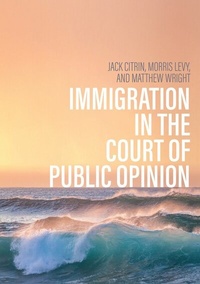
Immigration in the Court of Public Opinion
Description

What does a nation of immigrants think and feel about immigration? Recent accounts of immigration policy routinely cast Americans as divided into two warring camps - one fueled by threat to livelihoods and way of life, the other by a fervent cosmopolitanism that sees the nation-state as passé.
This counter-intuitive book shows that these accounts miss the mark. First, almost all Americans hold a mix of ""pro-"" and ""anti-immigrant"" opinions. Their views are pragmatic and flexible rather than dead-set. Second, opinions about immigration are more powerfully influenced by liberal values and concerns about the well-being of American society as a whole than by identity politics. Third, the assimilation Americans demand from immigrants matches patterns of integration that Hispanic and Asian immigrants overwhelmingly follow. Finally, American attitudes toward immigrants are ""exceptional"" for their openness and respect for cultural pluralism.
In Citrin, Levy, and Wright's view, long-elusive comprehensive immigration reform can win in the court of public opinion - but only if leaders heed their constituents rather than the polarized activists who claim to speak on their behalf. This expert analysis rethinks the role of public opinion in immigration matters: its insights will be welcomed by all interested in immigration debates and public policy.
More details
Other editions
Additional editions
Persons
Morris Levy is Associate Professor of Political Science at the University of Southern California
Matthew Wright is Associate Professor in Political Behaviour at the University of British Columbia
Content
Chapter 1: Who Are We Now?
Chapter 2: Moderation, Malleability, and the Myth of Warring Camps
Chapter 3: Motivations
Chapter 4: Assimilation Then and Now
Chapter 5: American Exceptionalism?
Chapter 6: Conclusion
Notes
1
Who Are We Now?
Every nation has a story, a collective answer to the "who are we, how did we get here, and what are we becoming" questions that are at the heart of its identity. Part of America's story is that it is a nation of immigrants, symbolized by the Statue of Liberty, arm outstretched in welcome. Yet every new wave of immigrants has provoked its share of anxiety and hostility as well. Immigration brings "strangers" into "our" land, and the human instinct is to view strangers with a mixture of curiosity, suspicion, and fear. The newcomers look different, speak differently, worship differently, and act differently. They will compete with Us for space, jobs, and, ultimately, for recognition and power.
How a nation of immigrants thinks and feels about immigration is the subject of this book. The core issues in immigration policy are how many should be allowed to come, who should be allowed to come, what should be expected of those who come, and what rights they should receive in return. Taken together, the US public's preferences about immigration speak to its conception of what it means to be an American.
We track public opinion over an era bookended by an extraordinary policy liberalization and the demographic transformation that ensued, and an effort by Donald Trump to close the door in a bid to "Make America Great Again." Openly ethnocentric, Trump singled out Muslim immigrants as potential terrorists and Mexicans as criminals, while rhapsodizing about welcoming idealized Norwegians. He cast immigration as a threat to American jobs and values and called for a revised admissions policy based on a points system rewarding immigrants according to their skills (including speaking English) rather than their family ties.
As president, Trump issued a flurry of executive orders to ban immigration from Middle Eastern nations deemed a security threat, limit the number of H-1 visas for "essential workers," slow the access of foreign students to American universities, and end Deferred Action for Childhood Arrivals (DACA), the Obama-backed program allowing migrants under thirty who were brought to the United States illegally to remain and find work. Trump took special aim at illegal immigration, demanding a border wall, an end to "sanctuary cities," and harsher treatment and faster dismissal of asylum seekers. With Mexico's help, he capitalized on the pandemic to stem illegal entry.
During the Trump presidency partisan division on immigration hardened. As a result of movement among Democrats, attitudes shifted toward more support for increasing the level of immigration. Still, pushed into the background by Covid, immigration was not a salient issue in the 2020 election. Nevertheless, immediately upon taking office, President Biden sought to turn back the clock. Official rhetoric took on a decidedly pro-immigrant tone; for example, the terms "illegal alien" and even "assimilation" are now forbidden on official government documents.1 Biden's own executive orders negated most of Trump's actions, including the ban on immigration from several Muslim-majority and select African nations, the construction of the border wall, the effort to curtail the DACA program, and the policy of sending asylum seekers back to Mexico before their hearing, among others.2 Biden also has promised the major reforms that eluded his predecessors. But he too is finding the politically fraught situation at the Mexican border difficult to control and his predecessor's changes to asylum policy challenging to reverse.3 The administration has equivocated, for example, about whether it will follow through on discontinuing a pandemic-era policy (Title 42) that permits removal of illegal immigrants without the opportunity to apply for asylum, a policy change that has publicly divided Democrats.
It is not our intention in this short book to follow these policy debates through the legislative, judicial, and regulatory labyrinths. Instead, we draw on a compendium of polls and academic surveys about immigration to see where the public stands on the more fundamental and enduring conflicts over immigration that shape the course of current conflicts. We track continuity and change in opinion, assess controversies about the structure and motivational underpinnings of immigration attitudes, compare the opinions of the country's main ethnic groups, and contrast Americans' views about immigration to those of citizens of other wealthy democracies.
We begin with a brief historical account of America's immigration regimes from the Founding to the present, emphasizing both the anxieties triggered by each wave of immigrants and the swing of the pendulum from inclusiveness to restriction based on ethnicity. Our review of public opinion then takes on the claim that a mean-spirited prejudice against immigrants, particularly Hispanics and Muslims, accompanied by resistance to cultural pluralism, dominates public opinion and policy in the United States. That is, we ask how much of the public shares Donald Trump's views on these issues.4 We show instead that nativism, negativity, and polarization do not describe how the majority of Americans think about immigration. To be sure, there is a sliver whose views can be characterized as hostile, uniform, and intensely rigid. But by and large, the most accurate portrait of the public's views, we show, is one of ambivalence and complexity with a generally positive hue. Few line up on the same side of every issue, their policy attitudes are not especially consistent over time, and they make reasonable distinctions between categories of migrants.
Tribal or group-interested impulses do arise when people form opinions about immigration, but they often come into conflict with basic beliefs about law and order, assimilation, egalitarianism, and humanitarianism. Different aspects of immigration call forth different values, and thus the salience of these values and the context in which they are embedded will shape public attitudes, a factor that underpins the ambivalent and malleable nature of the responses of many.
Americans strongly favor assimilation over multiculturalism. But they also favor a thin form of assimilation that accommodates space for minority cultures over the nativist's insistence on Anglo-Conformity. The evidence also shows that the new wave of immigrants from Asia and Latin America are assimilating; over time they increasingly identify as Americans, accept the value of English as the nation's common language, and express high levels of patriotism. The rapid spread of intermarriage is another important unifying mechanism. So, if America is being torn apart, immigrants aren't the culprit.
Is American opinion about immigration "exceptional"? We address this age-old question at a time when anti-immigrant sentiment also is churning the politics of European democracies, pushing official policies toward tightening borders and moving away from the embrace of multiculturalism in favor of the assimilation of newcomers. Using cross-national studies that include European countries and the "settler" countries of Canada, Australia, and New Zealand, we find clear evidence of American distinctiveness, sometimes unique and sometimes in concert with other settler nations, in its optimism about the consequences of immigration, openness to cultural pluralism (but not government intervention to sustain it), and, at least in the last decade, leniency toward illegal immigrants.
It is fair to ask why one should devote a whole book to public opinion about immigration when it is easy to point to large gaps between mass preferences and current policies. Despite widespread skepticism about the power of majorities in a political system with many barriers to change, when a problem becomes highly visible and salient, elites must pay attention to public opinion. To use the terminology of V.O. Key Jr., there may be a permissive consensus giving politicians the electoral leeway to act, or a directive consensus clearly warning against taking certain steps.5 Key also points to the presence of opinion dikes, intense blocs of opinion that constrain change and, in the case of immigration, create difficulties for the Holy Grail of comprehensive reform.
No less important, the character of citizens' attitudes toward immigration speaks to the endurance and meaning of America's national identity and self-conception in the twenty-first century. Will the ideal of a multi-ethnic nation united by a common attachment to universal values and love of country endure as diverse newcomers arrive, or will a competing image of America defined by the primacy of narrower identities come to dominate public thinking?
Contrary to the polarizing punditry, most Americans embrace neither nativism nor political multiculturalism. They are not hostile to foreigners or rising diversity, and they largely see immigration as a cultural and economic benefit to the nation. But they reject race-conscious policies that depart from the principle of colorblindness and equal treatment irrespective of race and ethnicity or that give a "free pass" to those who are in the country without permission. And they insist that immigrants adapt to their new environments enough to become self-sufficient.
The public's embrace of the American Creed - equality, individualism, and the rule of law - in the sphere of...
