

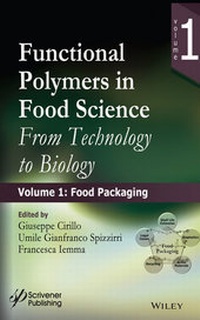
Functional Polymers in Food Science
Description

More details
Other editions
Additional editions

Content
Preface xi
1 Polymers and Food Packaging: A Short Overview 1
Umile Gianfranco Spizzirri, Giuseppe Cirillo and Francesca Iemma
1.1 Introduction 1
References 6
2 Polymers for Food Shelf-Life Extension 9
M. G. Volpe, M. Di Stasio, M. Paolucci and S. Moccia
2.1 Shelf-Life Concept 9
2.2 Shelf-Life Definitions 11
2.3 Measuring Shelf Life 21
2.4 Extending Shelf Life by Means of Food Packaging 29
2.5 The Role of Packaging 32
2.6 Innovative Polymers for Food Packaging Applications 36
2.7 Future Trends in Food Packaging 60
References 61
3 Transfer Phenomena in Food/Packaging System 67
Elmira Arab-Tehrany and Laura Sanchez Gonzalez
3.1 Introduction 67
3.2 Food-Packaging Interaction 69
3.3 Mass Transport Processes 70
3.4 Effects of Different Parameters on Partition Coefficient 75
3.5 Model Migrants 76
3.6 Instrumental Analyses 77
3.7 Conclusion 83
References 84
4 Production, Chemistry and Properties of Biopolymers in Food Science 95
Hima Puthussery, Rishika Prasad, Katarzyna Gorazda and Ipsita Roy
4.1 Introduction 95
4.2 Material Properties of Bioplastics Relevant to Food Packaging 98
4.3 Materials 101
4.4 Future Prospects 121
References 122
5 Modification Strategies of Proteins for Food Packaging Applications 127
Agustin González, Miriam Cristina Strumia and Cecilia Inés Alvarez Igarzabal
5.1 Biopolymers as Packaging Materials 128
5.2 Protein-Based Materials for Packaging 131
5.3 SPI as a Base Material for Packaging 136
5.4 Conclusion 140
References 140
6 Films Based on Starches 147
Olivia Lopez, Maria Alejandra Garcia and Noemi Zaritzky
6.1 Introduction: General Aspects of Films Based on Native and Modified Starches 148
6.2 Characterization of Biodegradable Films Obtained by Casting from Different Native Starches and Acetylated Corn Starch 151
6.3 Development of Active Starch Films Containing an Antimicrobial Agent (Potassium Sorbate) 182
6.4 Advances in Starch Films Production Using Non-Casting Methods: Thermocompression and Blown Extrusion 184
6.5 Future Trends 196
References 197
7 Polysaccharides as Valuable Materials in Food Packaging 211
Alberto Jiménez, María José Fabra, Pau Talens and Amparo Chiralt
7.1 Introduction 212
7.2 Polysaccharides Used in Biodegradable Food Packaging 213
7.3 Formation and Main Characteristics of Polysaccharide-Based Films 218
7.4 Physicochemical Properties of Polysaccharide-Based Materials 221
7.5 Functionalization of Polysaccharide Materials 230
7.6 Applications of Polysaccharide-Based Materials in Food Packaging 237
References 241
8 Food Packaging for High Pressure Processing 253
Pablo Juliano, Tobias Richter and Roman Buckow
8.1 High Pressure Processing of Foods 254
8.2 Commercial HPP Applications and Packaging Formats 256
8.3 Modified Atmosphere Packaging (MAP) for HPP 259
8.4 Active Packaging Materials for HPP 268
8.5 Challenges Encountered after HPP 269
8.6 Laminate Selection for HPP at Low Temperature 270
8.7 Laminate Selection for HPP at High Temperature 273
8.8 Final Remarks 276
9 Inorganic-Organic Hybrid Polymers for Food Packaging 281
Sreejarani Kesavan Pillai and Suprakas Sinha Ray
9.1 Introduction 282
9.2 Classification and Terminology of Inorganic-Organic Hybrids 284
9.3 General Preparation Strategies for Organic-Inorganic Hybrid Polymers 287
9.4 Characteristics of Polymer-Based Food Packaging Materials 292
9.5 Hybrid Polymers in Packaging Applications 298
9.6 Current Status and Future Prospects 308
References 310
10 Antimicrobial Active Polymers in Food Packaging 323
María José Galotto, Abel Guarda and Carolina López de Discastillo 323
10.1 Introduction to Food Packaging 323
10.2 Antimicrobial Agents 327
10.3 Antimicrobial Construction and Release System 341
10.4 Conclusions 345
11 Recycling of Food Packaging Materials 355
Marek Kozlowski
11.1 Introduction 355
11.2 European Policy on Packaging Waste and Raw Materials 357
11.3 Packaging 361
11.4 Recovery Systems 367
11.5 Bioplastics 390
11.6 Polymer Nanocomposites 393
11.7 Polymer Blends 396
References 397
12 Food Applications of Active and Intelligent Packaging: Legal Issues and Safety Concerns 401
Donatella Restuccia, Francesco Puoci, Ortensia I. Parisi and Nevio Picci
12.1 Introduction 402
12.2 AP and IP: Main Characteristics and Applications 404
12.3 Legal Issues 414
12.4 Dossier Submission and EFSA Safety Assessment 420
12.5 Conclusions 425
References 426
Index 431
